
Grades and specifications for Church Street regeneration blocks
Every calcium sulphate screed has a code from the European screed standard printed on the specification. C tells you how much crushing it resists and F how much bending, both in N/mm2. Knowing which is which helps when a contractor or supplier suggests an alternative. In a flat's lightly used rooms, CA-C20-F4 can be enough. Typical homes and offices are specified as CA-C25-F5. The busy communal corridors and entrance areas of a block need CA-C30-F6.
On new blocks in the Church Street regeneration, the specification comes from the design team, and we pour the grade named. Occasionally the design team swaps in an alpha hemihydrate material. These are used where faster drying or a thinner section matters, which is often the case in apartment floors with a fixed height. Those come with their own data sheets, which is what we follow.
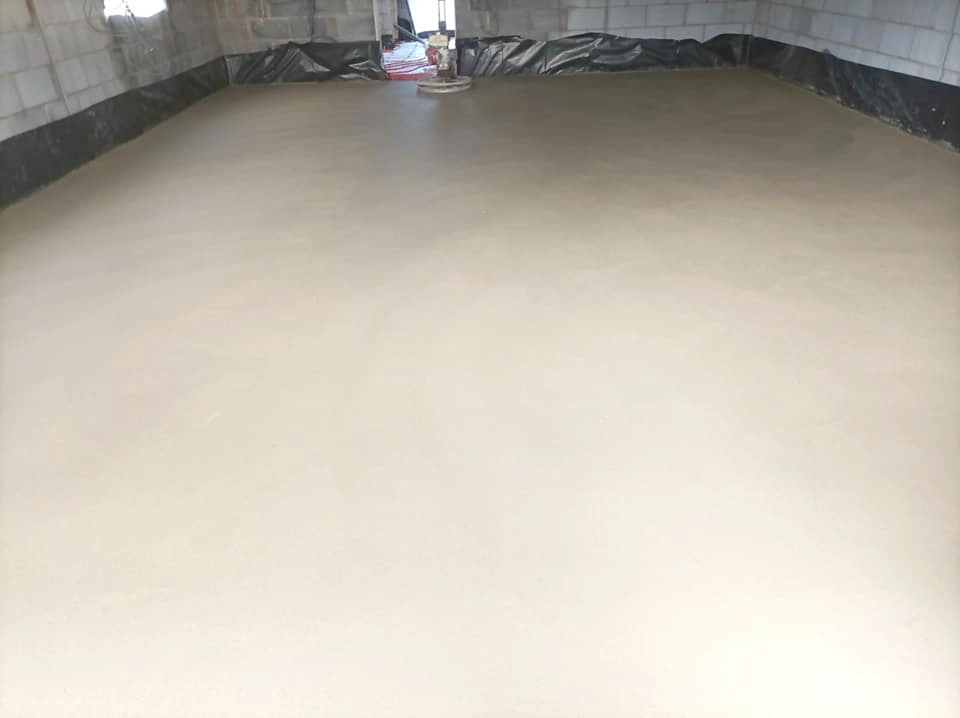
Flats suit it because it hardly shrinks. A whole open-plan apartment can often be poured in one bay, with joints only where the building needs them: at thresholds, between heating zones and over structural movement joints. We plan that layout before pouring.
On a refurbishment, calcium sulphate can go over an acoustic layer or insulation, provided the layer is designed for a flowing screed, the joints in it are sealed and the room will stay dry in use. For background, see anhydrite screed explained.
Laitance and moisture before flooring in Westminster flats
Drying calcium sulphate grows laitance, a weak top skin that glue cannot hold to with any confidence. When the floor has dried far enough we sand that skin away, then prime with a calcium sulphate primer before compound, adhesive or flooring goes on.
Moisture testing comes next. Calcium sulphate usually has a stricter moisture limit from the flooring maker than cement does, so measure with a hygrometer and hold the result up against their number. If the flat has underfloor heating, switching it on to speed drying is usually possible from about 7 days, handy when a refurbishment has a deadline.
Skipping the laitance step is a common reason for LVT and tiles lifting months later. Areas that may stay wet are the exception to using this screed at all. The bathroom, shower room and utility floor of that flat should be cement, either poured as a flowing cement mix or laid by hand as traditional sand and cement.
In a new block that usually means anhydrite through the living areas and cement in the wet rooms, poured to finish at the same level. For a job in Islington, our Islington anhydrite page covers it.
Anhydrite & Flow Screed prices in Westminster
Liquid flowing screed (which includes anhydrite): £24 to £31 per m² supplied and laid (MyJobQuote, August 2026), so £960 to £1,240 for 40 m². MyJobQuote does not say whether these figures include VAT. See our floor screeding cost guide or screed calculator.
Who lays your anhydrite and flow screed in Westminster
K & B Screeding’s own team, led by director Donatas Bardisevicius. Founded 2019, company 12298780.
See what customers say in our Google reviews and on our testimonials page.
Anhydrite & Flow Screed from Slough to Westminster
As the crow flies, our yard in Slough is about 21 miles from Westminster, which lies to the east. Postcodes here include W2, SW1W, SW1X and SW7, and Kensington and Chelsea (1.6 miles), Camden (2.1 miles), Hammersmith and Fulham (2.8 miles) and Islington (3 miles) are close by.
More on anhydrite screed, part of our screeding services.