
Heated floors in Fisherton Street and Luton Street blocks
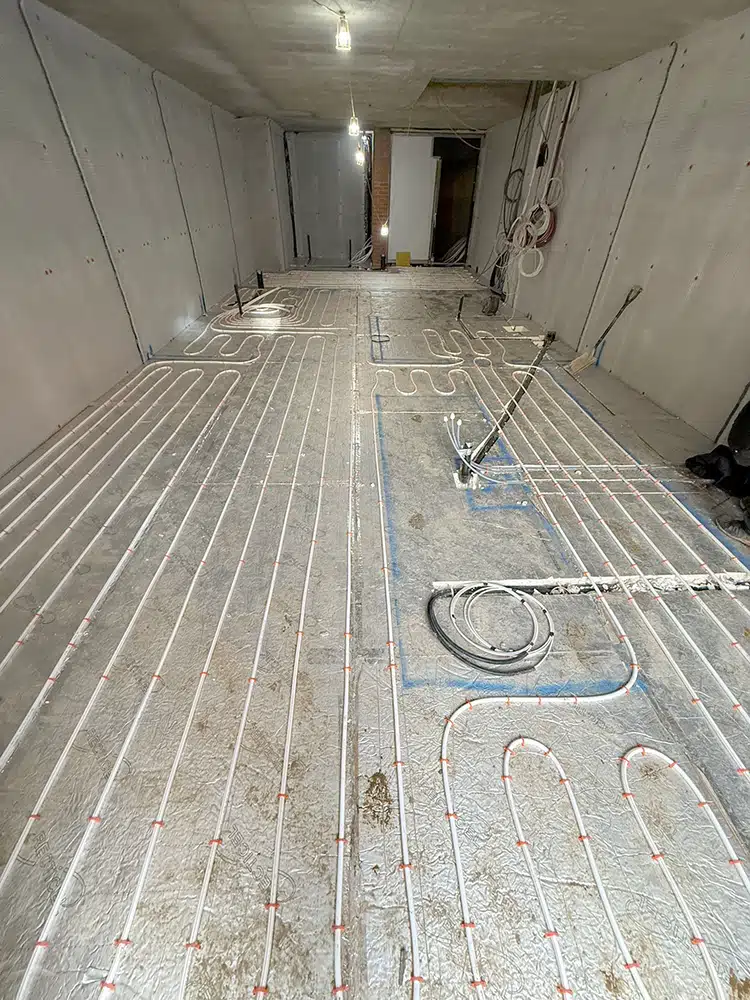
15% of Westminster's homes were built since 2000, and new blocks are where heated floors are most likely to be designed in from the start. New blocks at Fisherton Street and Luton Street, part of the Church Street programme, bring acoustic and underfloor heating screeds together in one build-up.
In a block like that, the screed does three jobs at once. It covers and protects the pipes, it spreads the heat evenly across the room, and it forms the top of a separating floor that has to limit sound passing to the flat below. The depth and product are set by the designers, and following them matters, because the heating output and the acoustic performance were both calculated on that build-up.
A liquid pour must leave 25mm or more over the pipes, which tends to mean 45 to 50mm of screed. Sand and cement, by contrast, wants close to 45mm over them. Because a liquid mix closes round every pipe without trapping air, warmth spreads evenly and the floor reacts quickly when the thermostat changes. Our liquid screed page covers how it is pumped to upper floors.
On pour day we walk the floor to make sure the insulation or acoustic layer has no gaps, the membrane is down and every wall has an edge strip to give the warm screed room to move. Your installer should test the loops under pressure and leave them that way while we pour, so a leak gives itself away before the screed hides it.
Retrofitting heating in older Westminster flats
Refurbishment is the other route to a heated floor here. When old floors are taken up in a Victorian conversion or a mansion flat, there is a chance to add heating. The difficulty is height: every millimetre of insulation, pipe and screed has to fit between the structure and a threshold that will not move.
That usually favours liquid screed, because its minimum cover is less than sand and cement. Low profile systems help too, and so does taking the old floor up fully rather than building on top of it. In a Victorian conversion, the acoustic build-up and the heating have to be designed together, so the screed suits both. If insulation or a membrane is missing, see insulation and membranes.
Commissioning is where heated screeds are most often spoiled. Gentle heat is usually fine on calcium sulphate after 7 days or so, whereas sand and cement should stay unheated for no fewer than 21. The temperature is then raised gradually, held and lowered before flooring. The drying time guide has more detail.
Over pipes, liquid screed is listed for 2026 from £20, rising to £35, per square metre. If the flat is over the line in Camden, our Camden heated screed page applies.
Underfloor Heating Screed prices in Westminster
Liquid screed over underfloor heating: £20 to £35 per m² supplied and laid (trade2base, June 2026), so £700 to £1,230 for 35 m². trade2base gives these figures excluding VAT. See our floor screeding cost guide or screed calculator.
Who lays your underfloor heating screed in Westminster
K & B Screeding’s own team, led by director Donatas Bardisevicius. Founded 2019, company 12298780.
See what customers say in our Google reviews and on our testimonials page.
Underfloor Heating Screed from Slough to Westminster
As the crow flies, our yard in Slough is about 21 miles from Westminster, which lies to the east. Postcodes here include W2, SW1W, SW1X and SW7, and Kensington and Chelsea (1.6 miles), Camden (2.1 miles), Hammersmith and Fulham (2.8 miles) and Islington (3 miles) are close by.
More on underfloor heating screed, part of our screeding services.
