
Finding the height in West Hampstead and Kentish Town conversions
In a converted period house, floor build-up is the scarcest resource. Each layer takes height: insulation to stop heat escaping downwards, the pipes, and a screed thick enough to protect them and spread the warmth. Add the finished floor and the total can clash with door heads, stair nosings and the flat above or below.
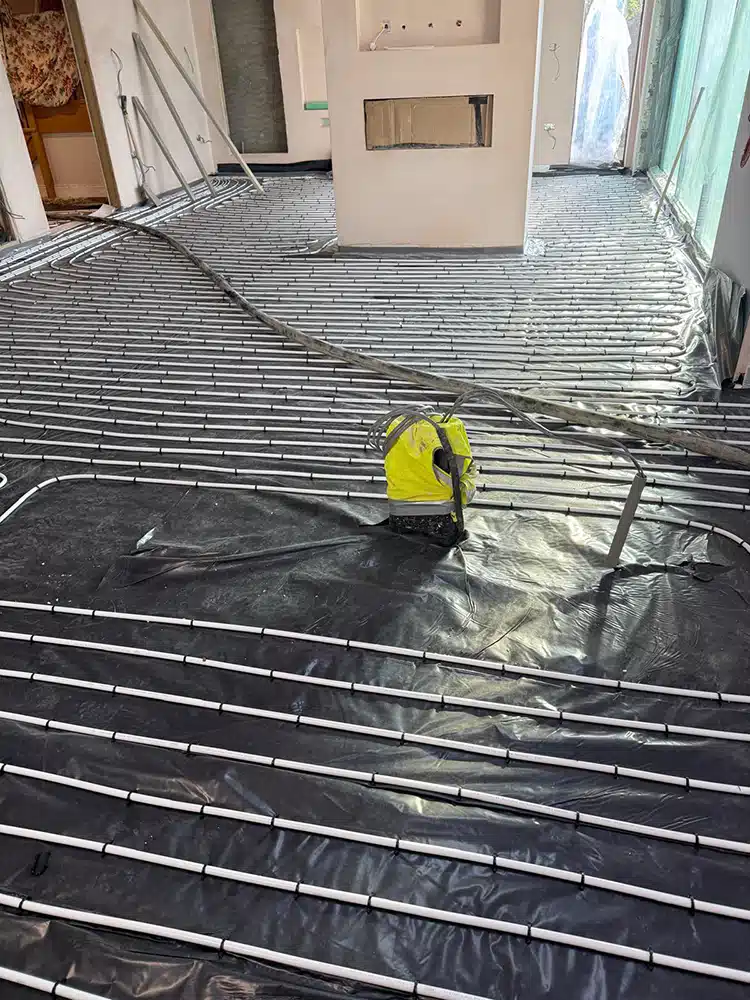
The screed choice is where height is won or lost. Pumped liquid wants a minimum of 25mm over the pipes, giving a layer of 45 to 50mm overall, while a hand-laid cement screed wants about 45mm on top of them and so eats more height. In a converted flat in West Hampstead or Kentish Town, or a lower ground floor conversion, liquid usually leaves more room for insulation, and it wraps the pipes with no air pockets for quicker, more even heat.
Acoustic layers also have to fit. A floor between flats normally needs sound insulation within its build-up, with the heating and screed above it, which squeezes the depth further. Where the height simply is not there, a different build-up may be needed altogether, and that is worth settling with your designer and heating engineer before the pipes are bought, not after the flooring has been chosen.
For how the pour itself works, see liquid screed in Camden, and for depths in detail, the screed thickness guide.
Warming up a new heated floor in Camden homes
At the upper end of the market, 27% of Camden's homes sit in council tax bands F to H. Where a larger house is having heating laid under stone, large tiles or engineered wood, those finishes are unforgiving of a screed that has been rushed or warmed too quickly.
Leave the thermostat alone at first. Calcium sulphate can usually take some warmth after about 7 days; for a sand and cement screed, wait 21 days at the very least before any heat goes in. After that the flow temperature climbs in small notches spread over several days, never straight to maximum, and we write the steps down so your heating engineer can follow them.
A patient warm-up also helps drying, which the flooring needs before it goes down. Stone and large format tiles need a flat base as well, so floor levelling in Camden may follow the screed. Heated liquid floors are published at £20 to £35 per m², and our screeding cost guide covers the other things that move the total.
Underfloor Heating Screed prices in Camden
Liquid screed over underfloor heating: £20 to £35 per m² supplied and laid (trade2base, June 2026), so £700 to £1,230 for 35 m². trade2base gives these figures excluding VAT. See our floor screeding cost guide or screed calculator.
Who lays your underfloor heating screed in Camden
K & B Screeding’s own team, led by director Donatas Bardisevicius. Founded 2019, company 12298780.
See what customers say in our Google reviews and on our testimonials page.
Underfloor Heating Screed from Slough to Camden
On the map, Camden sits east of Slough, about 21.3 miles from our base in a straight line (postcodes including WC1B, NW1, N6 and W1T), next to Islington (1.7 miles), Westminster (2.1 miles), Kensington and Chelsea (3.4 miles) and Haringey (3.5 miles).
More on underfloor heating screed, part of our screeding services.