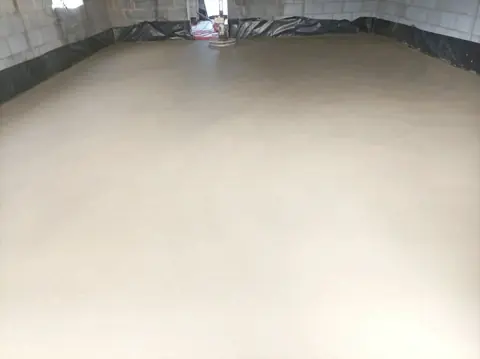
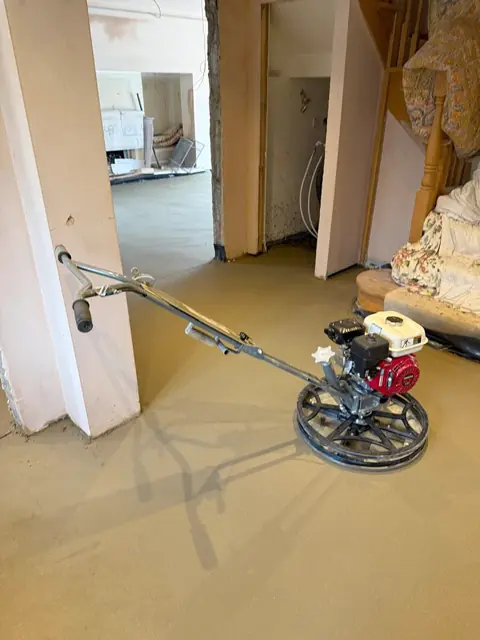
Wet underfloor heating is now standard in extensions and new builds, and it is increasingly paired with heat pumps that run at lower water temperatures. In both cases the screed does a critical job. It protects the pipes, spreads the heat across the floor and stores it, and gives a flat, stable surface for the floor finish. Get the screed right and the system is comfortable, even and efficient. Get it wrong and no amount of adjusting the thermostat will fix it. K & B Screeding lays screed over wet underfloor heating to the depth and cover the system needs.
We lay screed over underfloor heating across London and the Home Counties, for homeowners, heating engineers, builders and developers.
Liquid or sand and cement over underfloor heating?
Both work well when laid correctly, and the choice depends on the job.
Liquid screed is our most common recommendation for underfloor heating. Because it flows, it encapsulates every pipe completely with no air pockets, and it can be laid with less depth over the pipes. Less depth means a faster heat-up and a more responsive floor, which suits heat pumps particularly well. Find out more on our liquid screed page.
Sand and cement screed remains a good option, especially in smaller areas, wet rooms, or where the floor must be loaded early. It needs more depth and careful compaction around the pipes to avoid voids, and adding polypropylene fibres helps control cracking in a heated floor. See sand and cement screed and fibre reinforced screed.
Depth over the pipes
The screed must have enough cover over the pipes to be strong and to spread heat evenly across the surface. As a general guide, and always subject to the screed manufacturer and the heating designer:
| Screed type | Typical total depth | Typical cover over pipes |
|---|---|---|
| Liquid calcium sulphate screed | from about 45 to 50mm | at least 25mm |
| Sand and cement, floating | from 65mm (75mm commercial) | commonly about 45mm, never less than 25mm |
Swipe the table sideways to see every column.
Our screed thickness guide explains these figures in more detail.
Getting the build-up right
Most underfloor heating floor problems start below the screed. Before we pour or lay anything we check:
- Insulation is level, fully supported and tightly jointed, with no rocking boards.
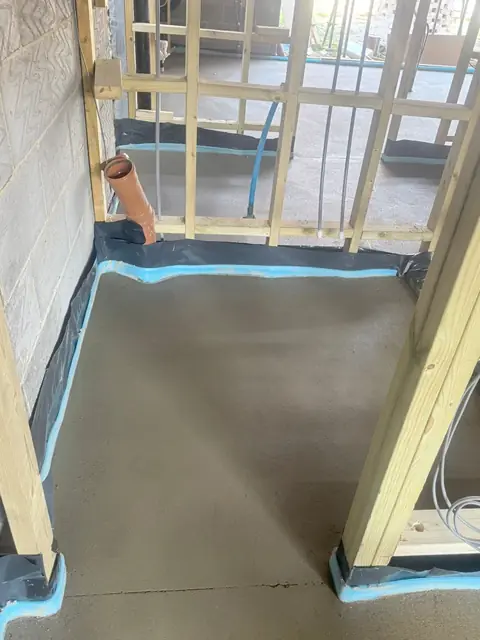
- Edge strip runs around every wall, column and upstand so the heated screed can expand without cracking.
- Membrane is lapped and taped so a liquid screed cannot leak into the insulation.
- Pipes are securely clipped at the right spacing, pressure tested, and for liquid screed usually filled with water so they cannot float.
- Manifold and joints are protected, and movement joints are planned between heating zones where needed.
We can supply and install the insulation and membranes ourselves, which keeps every layer compatible and under one set of hands.
Commissioning and the heat-up
A heated screed must be brought up to temperature slowly. Running the heating hard on a new screed is one of the fastest ways to crack it.
As a general pattern, a sand and cement screed is left to cure for at least 21 days before any heat is applied (the period given in BS EN 1264-4), and a calcium sulphate screed can usually be heated after about seven days. In both cases the water temperature is started low and increased gradually over several days, held, and then brought back down before floor finishes go on. The exact schedule comes from the screed and heating manufacturers, and we give you clear guidance to pass to your heating engineer.
Using the heating in this controlled way also helps dry the screed, which can save weeks on the programme. Our guide on how long screed takes to dry explains how to check it is ready for flooring.
Floor finishes over heated screed
Tiles, stone, LVT, engineered wood and many carpets all work well over a heated screed, provided the screed is dry and flat. Calcium sulphate screeds need their surface laitance removed and a compatible primer before tiling. Solid timber and very thick carpet and underlay reduce heat output, so check with your heating designer before choosing.
Underfloor heating screed near you
We lay screed over underfloor heating across London and the Home Counties from our base in Slough, including liquid screed in Slough, Maidenhead, Windsor and throughout London.
Underfloor Heating Screed prices in 2026
Published 2026 UK figures put liquid screed over underfloor heating at about £20 to £35 per m², supplied and laid (trade2base, June 2026). trade2base gives these figures excluding VAT. Depth, area, access and preparation move the figure either way, so we fix your price in writing within 24 hours. See our floor screeding cost guide or the screed calculator.
“I used K & B for a screeding job at the beginning of the year (Jan 2023), extremely competitive quotation and first class delivery, on time and on budget.”
Part of our screeding and floor screeding services, laid by our own team across London and the Home Counties.