
Retrofitting heated floors in Eastcote and Ickenham
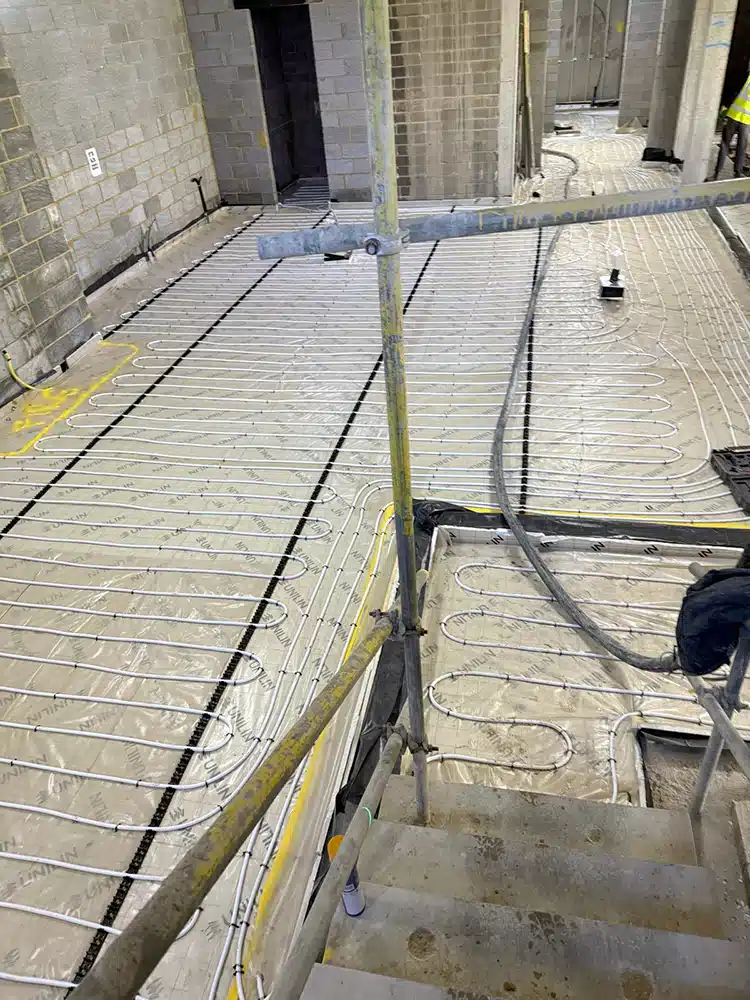
More than a third of Hillingdon's housing, 37%, was put up between 1919 and 1944. Putting heating into a floor in a house of that age usually means digging out the old concrete, laying a membrane and insulation, and clipping the pipes on top before the screed goes over them. The problem is height. The new floor must meet the existing doors, hallway and stair, and there is only so far down you can dig.
So the depth each screed needs becomes the deciding point. Liquid screed needs a minimum of 25mm of cover over the pipes, so its total depth usually comes to 45 to 50mm. A hand-laid mix wants around 45mm over them, and the floor ends up thicker. In a tight retrofit, liquid screed often wins on depth alone.
The screed does more than cover the pipes. It spreads their heat across the room, so it must surround every pipe completely with no air pockets. A flowing screed does that naturally, and heats up faster once the system is running. The details of pumping and access are on our liquid screed page for Hillingdon.
A heated garden room or rear extension off a Ruislip semi works the same way across a smaller floor. The insulation and edge strip under the screed matter as much as the screed itself, and our insulation and membranes service covers checking or supplying them. Any gaps there show up later as cracks or cold spots.
Heating up a new floor in a Northwood home
Detached homes make up 14% of Hillingdon's housing, and in Northwood those bigger houses often have the full ground floor taken up and relaid over new insulation. If heating goes in at that stage, the pipes run across several rooms. Big floors bring joints into play. Where heating zones meet, or across doorways, a joint lets each area expand and contract without cracking the next, and we agree those positions with the heating engineer before the pour.
Then comes commissioning. On a calcium sulphate floor, low heat can normally start from around day 7. No heat should go into a cement screed for at least the first 21 days. After that, the flow temperature rises in small steps, holds, and comes down again before flooring is laid. Going too fast is a common cause of cracking.
We write the schedule down and hand it over, so the homeowner and heating engineer are working from the same plan. For the long view on drying, see how long screed takes to dry. Heated floors are laid on the same terms over the border, with underfloor heating screed in Slough close by.
Underfloor Heating Screed prices in Hillingdon
Liquid screed over underfloor heating: £20 to £35 per m² supplied and laid (trade2base, June 2026), so £700 to £1,230 for 35 m². trade2base gives these figures excluding VAT. See our floor screeding cost guide or screed calculator.
Who lays your underfloor heating screed in Hillingdon
K & B Screeding’s own team, led by director Donatas Bardisevicius. Founded 2019, company 12298780.
See what customers say in our Google reviews and on our testimonials page.
Underfloor Heating Screed from Slough to Hillingdon
As the crow flies, our yard in Slough is about 8.4 miles from Hillingdon, which lies to the east. Postcodes here include UB8, UB3, HA5 and UB9, and Harrow (5.6 miles), Ealing (6.1 miles), Hounslow (6.4 miles) and Slough (6.6 miles) are close by.
More on underfloor heating screed, part of our screeding services.