
Heated floors in Ashford's detached and semi houses
Detached homes make up 20% of Ashford's housing, and larger houses tend to have larger ground floors where heated screed is attractive. Semis are more common still, and their rear extensions are a natural place for underfloor heating: a new floor, built from scratch, with room planned in for insulation and pipes.
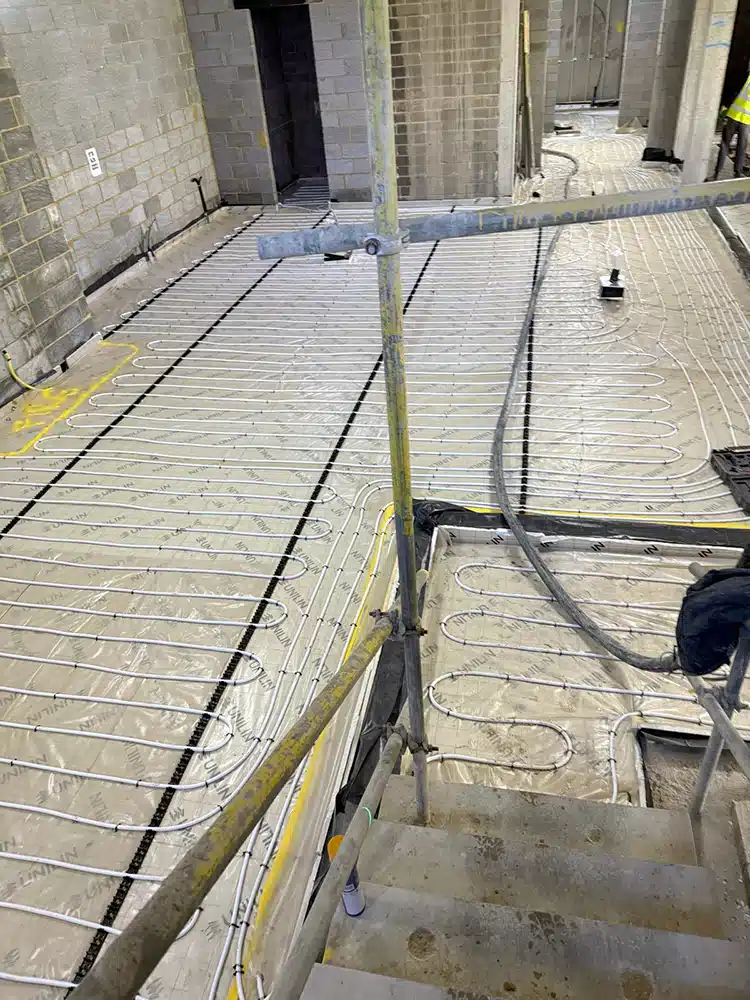
The number to settle first is the depth of screed above the pipes. Pumped liquid needs 25mm minimum on top, bringing the screed to roughly 45 to 50mm; hand-laid sand and cement needs around 45mm on top, which makes for a deeper build-up overall. In an extension that must match the house floor, the choice of screed decides how much insulation fits.
Retrofits in older rooms are harder. Many Ashford projects start from solid concrete with no insulation, so adding heating means digging out and rebuilding rather than building up. That also gives the chance to lay a proper membrane where the old one has failed. The finished level is fixed by the thresholds, so we measure those before recommending a build-up.
Insulation, membrane and edge strip all get checked before the pour, and anything absent we supply. A flowing screed encases the pipes fully with no air gaps, which helps heat spread evenly. See liquid screed for Ashford floors for the pumping side, and our insulation and membranes service for the layers underneath.
Commissioning heated screed in Ashford homes
Only 5% of Ashford homes date from 2015 onwards, so a heated floor here is more likely to be in an addition than in a new house. That makes the handover between trades important: the heating engineer fits and pressure tests the pipes, we screed, and then the engineer brings the system up to temperature.
Timing depends on the screed. Calcium sulphate can normally take warmth a week after it goes down, at about 7 days, while sand and cement is left 21 days or more.
Ease the system up. The water temperature starts low and rises a little each day, following the engineer's schedule, before the system goes into normal use. Push it too fast and cracks appear. Keep windows open a little during this period, and do not lay rugs, sheeting or boxes on the floor, because anything covering it traps moisture and heat in patches. The same rules apply in a heated garden room or converted garage.
Warm pipes do help the screed dry, yet a moisture reading still decides when the flooring goes down. Each finish, whether tiles, LVT or engineered wood, has its own moisture limit, and drying times for screed runs through the waits.
Underfloor Heating Screed prices in Ashford
Liquid screed over underfloor heating: £20 to £35 per m² supplied and laid (trade2base, June 2026), so £700 to £1,230 for 35 m². trade2base gives these figures excluding VAT. See our floor screeding cost guide or screed calculator.
Who lays your underfloor heating screed in Ashford
K & B Screeding’s own team, led by director Donatas Bardisevicius. Founded 2019, company 12298780.
See what customers say in our Google reviews and on our testimonials page.
Underfloor Heating Screed from Slough to Ashford
Ashford is about 10.5 miles south-east of our Slough base as the crow flies, with postcodes including TW15. The nearest towns to it are Sunbury-on-Thames (2.1 miles), Staines-upon-Thames (2.2 miles), Chertsey (3.3 miles) and Egham (3.8 miles).
More on underfloor heating screed, part of our screeding services.