
Pipe cover and depth in Addlestone extensions
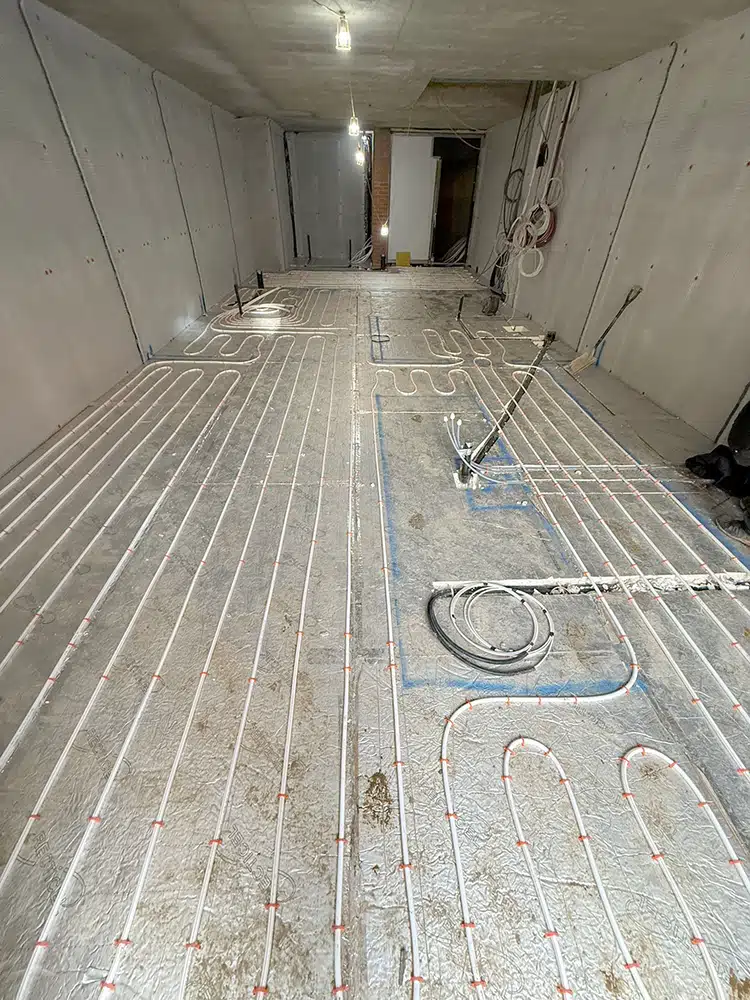
Heated pipes are only as good as the screed that covers them. The screed has to encase the pipes completely, spread the heat and be strong enough over them, which is why cover depth is the first thing to settle.
In an Addlestone kitchen extension the pipes must end up under at least 25mm of pumped screed, and that pour typically totals 45 to 50mm. A sand and cement screed needs around 45mm of cover, so the overall build-up is deeper. In an extension that must meet an existing kitchen floor, those numbers decide how much insulation fits beneath.
The post-war share of the town is significant too: 21% of homes were built between 1945 and 1972. Retrofitting heating into rooms of that age often means taking up the existing floor, because there is not enough height to build the insulation, pipes and screed on top. The level of the doorway into the hall fixes the finished height, so we measure it first and work down from there.
Flowing screed wraps round the pipes with no air pockets, which helps heat reach the surface evenly and lets the system respond faster when the thermostat calls for warmth. Ahead of the pour we look at the insulation, membrane and edge strip, and bring any that are missing. The liquid screed page for Addlestone covers pumping and access, and the screed thickness guide explains depths.
Switching the heating on in Addlestone homes
The first question after the pour is usually when the heating can go on. For a calcium sulphate screed, the answer is from about 7 days. With sand and cement, though, the thermostat waits three full weeks, 21 days, before the first warm-up.
Bring it up to temperature slowly. The water temperature is raised a little each day over a period set by the heating engineer, then held before the system is used normally. Heating a fresh screed too fast can crack it and stress the pipe joints.
Warming the floor also helps it dry, but it does not replace a moisture test. Tiles, LVT and engineered wood all have limits, and the screed has to meet them before they go down.
Garden rooms and outbuildings are a common home for heated floors too, and the same rules apply. Where a garage is being converted into a heated room, the slab is often low and needs insulation built up first. Our insulation and membrane service covers that preparation, and low ground near the Bourne makes it especially worth getting right.
Underfloor Heating Screed prices in Addlestone
Liquid screed over underfloor heating: £20 to £35 per m² supplied and laid (trade2base, June 2026), so £700 to £1,230 for 35 m². trade2base gives these figures excluding VAT. See our floor screeding cost guide or screed calculator.
Who lays your underfloor heating screed in Addlestone
K & B Screeding’s own team, led by director Donatas Bardisevicius. Founded 2019, company 12298780.
See what customers say in our Google reviews and on our testimonials page.
Underfloor Heating Screed from Slough to Addlestone
On the map, Addlestone sits south-south-east of Slough, about 12.9 miles from our base in a straight line (postcodes including KT15), next to Weybridge (1.5 miles), Chertsey (1.6 miles), Walton-on-Thames (3.4 miles) and Staines-upon-Thames (4.4 miles).
More on underfloor heating screed, part of our screeding services.