
Open-plan floors in Addlestone's newer homes
A liquid screed arrives mixed and is pumped by hose onto the insulation. It flows out and levels itself, so a large ground floor or open-plan kitchen is covered in one visit without hand compaction. What you get is a dense surface that can meet SR1 or SR2 flatness, so LVT or big tiles can follow without much fuss.
Taking a longer view, 23% of Addlestone's homes date from 2000 or later. Floors in homes of this age are usually floating over insulation, sometimes with heating pipes, and a flowing screed fills round pipes with no voids.
Older houses matter just as much. The most common Addlestone job is a rear extension or open-plan kitchen on a post-war or 1970s and 1980s house, where new screed goes over insulation and has to meet the existing floor level. Because a domestic liquid screed can be laid from about 35mm, it leaves more room for insulation than a 65mm traditional screed. That extra space helps when the old floor level leaves little room to work with.
Behind the word liquid sit two different materials, calcium sulphate and a cement based mix. Calcium sulphate types are common in dry rooms, and cement based types are used where a floor may get wet. Which one your Addlestone rooms get depends on how they are used and what flooring goes on top, and we advise once we know both. For the material details, see our anhydrite flow screed page for Addlestone.
Pumping to flats and semis in Addlestone
The pump sits outside and a hose carries the screed to the room, so the questions are about where things can stand. We need space for the pump and the delivery lorry near the property, and a clear route for the hose through a hallway, side gate or stairwell.
Pouring an upper floor flat, say in a scheme like Addlestone ONE, means feeding the hose up the staircase or in at a window. The rooms need sealing, doorways need damming, and building management often has to agree the route and any lift use. On a semi, the route is usually through the side passage to the rear extension. Protecting the path and any finished rooms along the way is part of the setup.
Feet can go on it a day or two after pouring, 24 to 48 hours in most cases, but flooring has a longer wait that hangs on depth, airflow and whether heating is running. Realistic screed drying times are set out in our guide. For long hose runs or upper floors, our screed pumping service page explains how the pump is set up.
Liquid Screed prices in Addlestone
Liquid screed: £24 to £31 per m² supplied and laid (MyJobQuote, August 2026), so £960 to £1,240 for 40 m². MyJobQuote does not say whether these figures include VAT. See our floor screeding cost guide or screed calculator.
Who lays your liquid screed in Addlestone
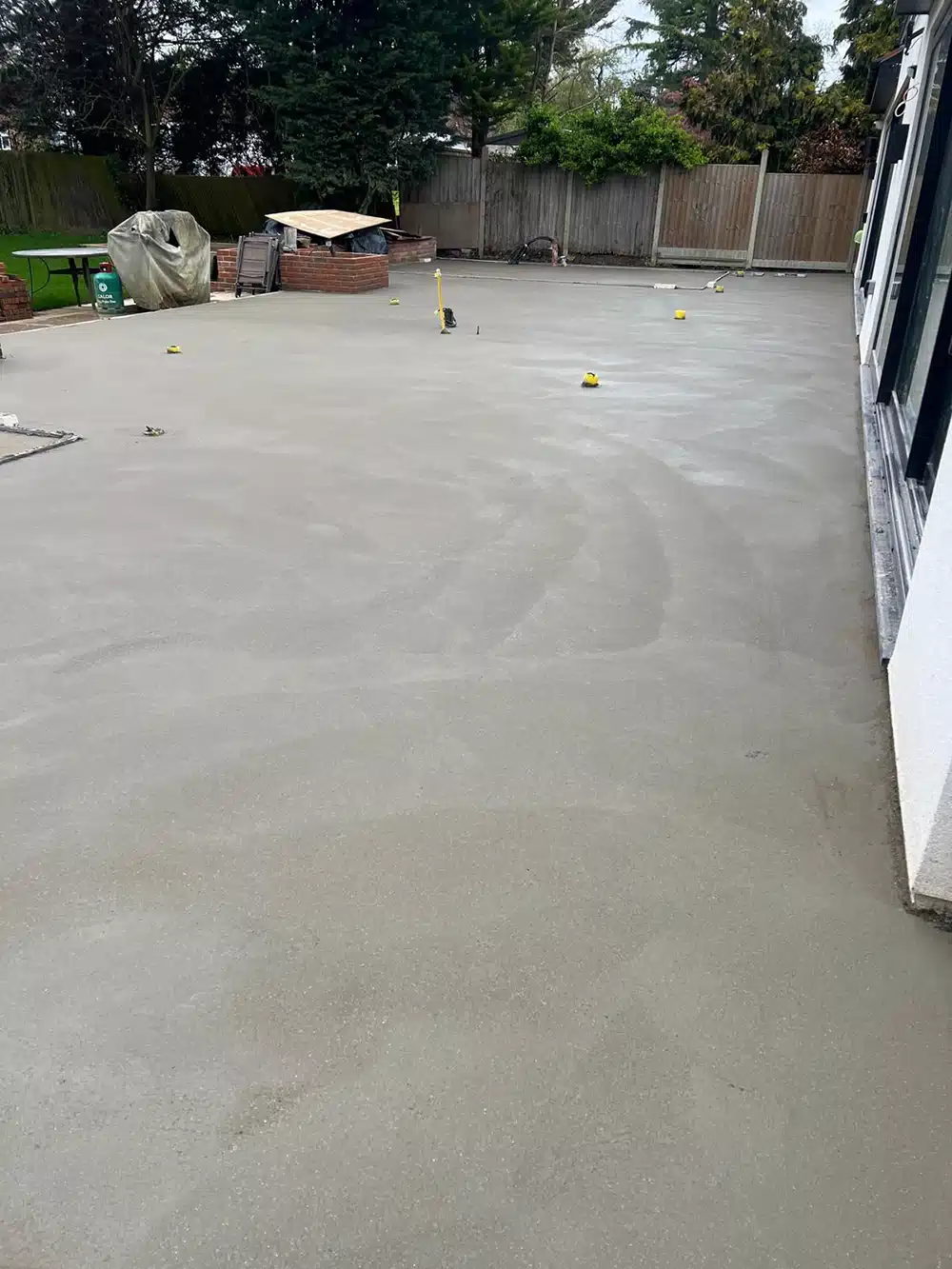
K & B Screeding’s own team, led by director Donatas Bardisevicius. Founded 2019, company 12298780.
See what customers say in our Google reviews and on our testimonials page.
Liquid Screed from Slough to Addlestone
On the map, Addlestone sits south-south-east of Slough, about 12.9 miles from our base in a straight line (postcodes including KT15), next to Weybridge (1.5 miles), Chertsey (1.6 miles), Walton-on-Thames (3.4 miles) and Staines-upon-Thames (4.4 miles).
More on liquid screed, part of our screeding services.
