
Grades and products for Addlestone apartment floors
On an Addlestone drawing the screed shows up as a string such as CA-C25-F5. The letters CA mean calcium sulphate, and the two numbers give compressive (C) and flexural (F) strength in N/mm2, tested under the European screed materials standard.
Three grades cover most housing. CA-C20-F4 is enough for a lightly trodden house floor; the mid grade, CA-C25-F5, goes into most homes, apartments and offices; CA-C30-F6 is kept for busier commercial areas and other heavy use.
Mixed schemes show why the grade matters. At Addlestone ONE, flats sit alongside commercial units, and a building like that can carry different grades for different floors. When offices are converted to homes, the new floors are also specified to suit the new use. We pour what the drawings say rather than substituting a grade that looks close enough. The grade is written on the drawings or in the specification, and we confirm it before ordering the material.
Sometimes the drawings ask for an alpha hemihydrate product. That happens where quicker drying or a thinner pour is wanted, and the maker's sheet then governs depth and drying.
Because it barely shrinks, big open bays need few joints. Those that are needed, at door thresholds or between heating zones, go into the bay plan before pouring. How anhydrite screed behaves gives more on the material.
Preparing Addlestone anhydrite floors for finishes
Pouring is half the work. As calcium sulphate dries, a weak surface film called laitance forms. Leave it on and the adhesive or compound grips the film, not the screed, so it has to be sanded away first. Our sander goes over it when the screed has dried enough, and then a primer made for calcium sulphate goes on.
Then comes testing. Flooring makers tend to set a stricter moisture limit on calcium sulphate than on cement, so you get a hygrometer result from us in writing. If pipes are in, the heating can normally start force drying it after around 7 days.
Around 10% of Addlestone homes were built between 2000 and 2014, and newer plots can mix anhydrite in dry rooms with a cement based screed in wet ones. Keep calcium sulphate out of anywhere water gets in: shower areas, wet rooms and utility floors with a risk of leaks are poured in a cement based flowing screed. For hand-laid wet room floors, see sand and cement screed in Addlestone. Heated plots are covered on the Addlestone underfloor heating screed page.
Anhydrite & Flow Screed prices in Addlestone
Liquid flowing screed (which includes anhydrite): £24 to £31 per m² supplied and laid (MyJobQuote, August 2026), so £960 to £1,240 for 40 m². MyJobQuote does not say whether these figures include VAT. See our floor screeding cost guide or screed calculator.
Who lays your anhydrite and flow screed in Addlestone
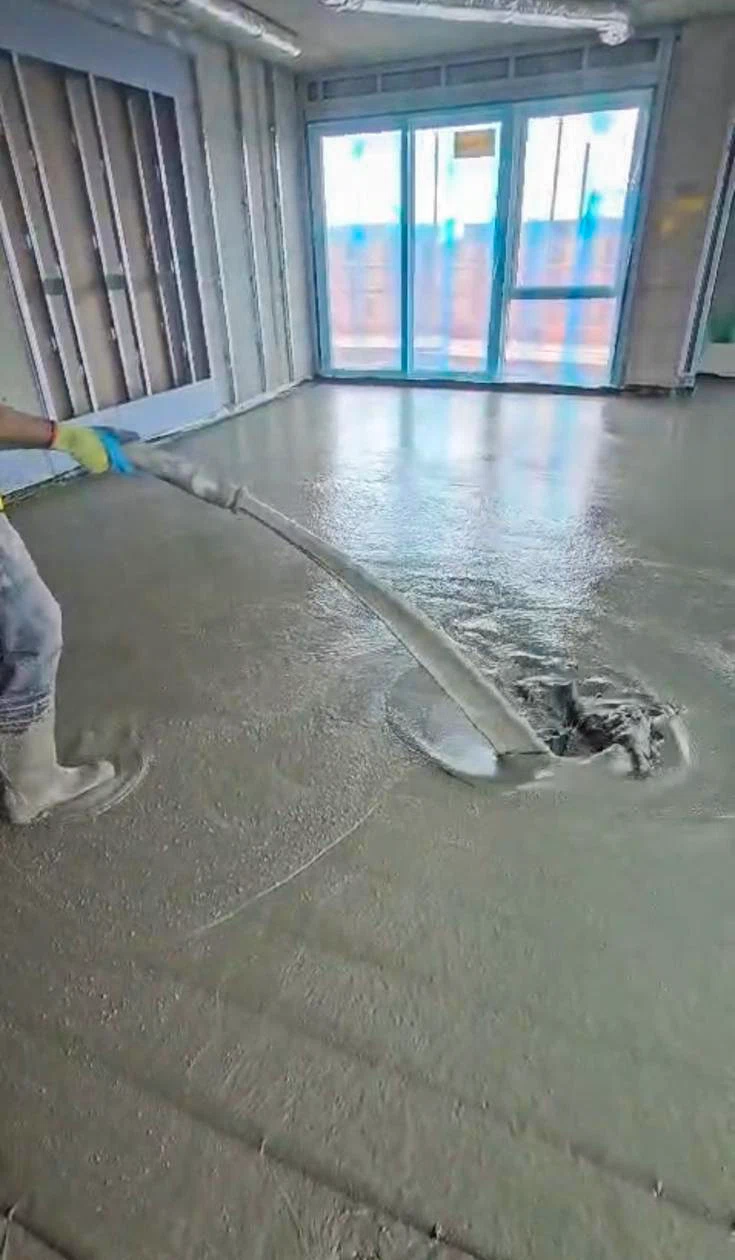
K & B Screeding’s own team, led by director Donatas Bardisevicius. Founded 2019, company 12298780.
See what customers say in our Google reviews and on our testimonials page.
Anhydrite & Flow Screed from Slough to Addlestone
On the map, Addlestone sits south-south-east of Slough, about 12.9 miles from our base in a straight line (postcodes including KT15), next to Weybridge (1.5 miles), Chertsey (1.6 miles), Walton-on-Thames (3.4 miles) and Staines-upon-Thames (4.4 miles).
More on anhydrite screed, part of our screeding services.