
Anhydrite grades for Guildford apartments and new plots
Every calcium sulphate screed has a code under the European screed standard. Read it as two numbers, C for how much load it takes in compression and F for how it resists bending, each in N/mm2. Lightly used domestic floors take CA-C20-F4. The bulk of homes, apartments and offices get CA-C25-F5. Heavier wear calls for CA-C30-F6.
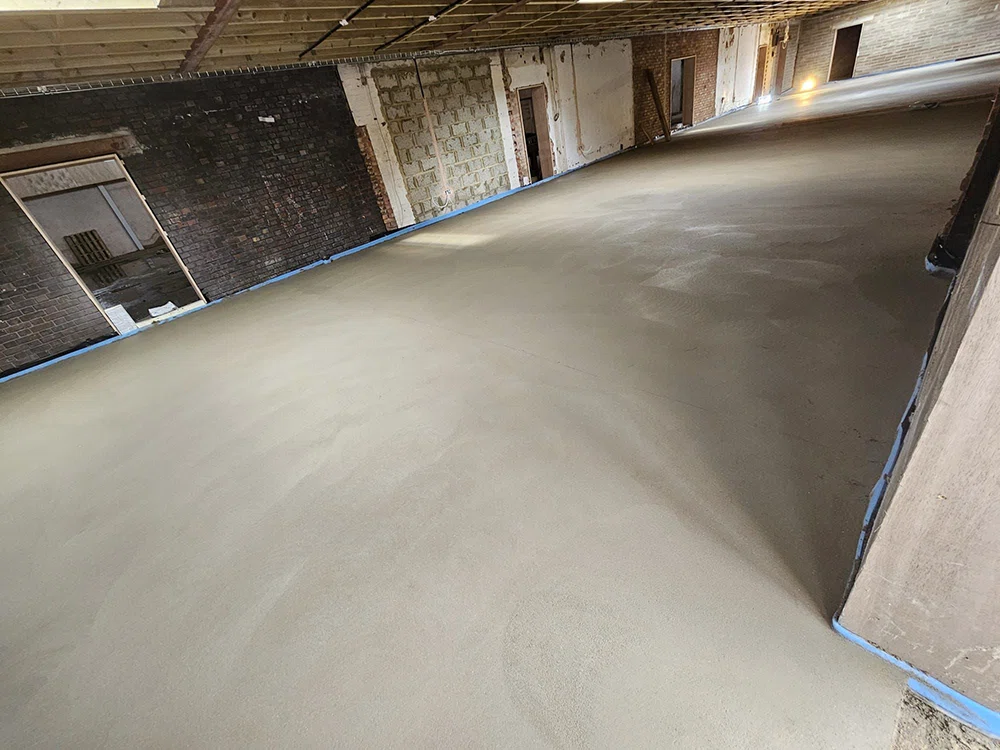
Purpose-built flats make up 22% of Guildford homes, and apartment floors are a natural setting for this material. It hardly shrinks at all, which lets a wide floor go in as a single bay with very few joints, over insulation and often over heating. Any joints that are needed, say across a doorway or where one heating zone meets another, are set out before pouring starts.
We pour the grade the engineer specifies and do not substitute. When a specification names an alpha hemihydrate product, usually because faster drying or a thinner section matters, we follow that product's own data sheet for depth and drying, even where it differs from the general figures on this page.
There is one thing it cannot do. Long exposure to water weakens calcium sulphate, so keep it out of any area that might get wet. In those rooms we switch to a flowing screed made with cement, or a hand-laid sand and cement floor for wet rooms. Our guide to what anhydrite screed is covers the material in more depth.
Sanding and moisture testing before Guildford flooring
A calcium sulphate floor is finished in two stages. The first is laitance removal. While the screed dries, a fragile skin builds up on top. Glue and levelling compound will not hold reliably on that skin, so once the floor is dry we sand it off and prime the surface with a product made for calcium sulphate.
The second stage is testing. Flooring manufacturers often cap moisture lower for calcium sulphate than for a cement screed, so the reading has to be taken rather than assumed. If there is heating, running it from around 7 days helps force dry the floor, which shortens the wait on a busy programme. The heating is raised gently and held, following the screed maker's schedule, rather than turned up to full on day one.
You get our drying and laitance advice in writing when the floor is handed over. Anhydrite is not only for new building. It can also go into Guildford conversions and refurbishments, where the base may need floor preparation before the pour.
Anhydrite & Flow Screed prices in Guildford
Liquid flowing screed (which includes anhydrite): £24 to £31 per m² supplied and laid (MyJobQuote, August 2026), so £960 to £1,240 for 40 m². MyJobQuote does not say whether these figures include VAT. See our floor screeding cost guide or screed calculator.
Who lays your anhydrite and flow screed in Guildford
K & B Screeding’s own team, led by director Donatas Bardisevicius. Founded 2019, company 12298780.
See what customers say in our Google reviews and on our testimonials page.
Anhydrite & Flow Screed from Slough to Guildford
As the crow flies, our yard in Slough is about 20.4 miles from Guildford, which lies to the south. Postcodes here include GU1, GU4, GU2 and GU3, and Godalming (4.1 miles), Woking (5.5 miles), Aldershot (8.1 miles) and Farnborough (8.5 miles) are close by.
More on anhydrite screed, part of our screeding services.
