
Choosing an anhydrite grade for a Dorking build
On a drawing, anhydrite is written as a code from the European standard covering screed materials. In that code, C gives compressive strength and F gives flexural strength, each measured in N/mm2. Three grades cover most work in a town like Dorking.
For a lightly used house floor, CA-C20-F4 does the job. CA-C25-F5, the middle grade, covers the bulk of house, flat and office floors. Heavier wear calls for CA-C30-F6. If an architect or engineer has set the grade on the drawings, we pour that grade and do not substitute.
Alpha hemihydrate screeds sit outside those three grades. Specifiers reach for them if drying time is short or the depth available is shallow, such as a retrofit in an older Dorking house with little height left above the insulation. Their minimum depth and drying time come from the maker's data sheet, and that sheet governs the programme instead of the usual rules.
What the material offers is very low shrinkage. Large bays can go in with few joints between them, handy where a Dorking ground floor has been opened up into one space, or for storey after storey of flats. Doorways and the boundaries between heating zones still get a joint, and we mark out where each one goes before pour day.
For flats the figures are worth knowing: 24% of homes in Dorking are purpose-built flats. On a refurbishment or a new block, anhydrite over acoustic insulation is a common specification. Read anhydrite screed explained for more detail on the material.
Sanding, testing and priming anhydrite floors in Dorking
Calcium sulphate does not finish itself. A thin, weak skin known as laitance rises to the top while it dries, and adhesive will not grip it properly. Once drying has gone far enough, the skin is sanded off and the surface primed with a product made for calcium sulphate. Skip that and tiles or LVT can come loose months later.
Moisture is judged differently too. A calcium sulphate base often has a tighter moisture limit from the flooring maker than a cement one, so the reading is judged against whatever figure the maker of your tiles, boards or vinyl gives. Our sign-off comes from a hygrometer reading, not from a date on the calendar. If pipes are in, the heating can be run from around 7 days to speed the drying, which normally cuts the wait a good deal.
Then there are rooms where the material should not go. Long exposure to water weakens calcium sulphate, which is why a wet room, a shower you walk straight into or a utility floor where a leak is possible is better given a cement based flowing screed or a traditional hand-laid floor. On a Dorking project that needs both, we plan the two together.
If the new screed is going over an existing base that needs attention first, see floor preparation.
Anhydrite & Flow Screed prices in Dorking
Liquid flowing screed (which includes anhydrite): £24 to £31 per m² supplied and laid (MyJobQuote, August 2026), so £960 to £1,240 for 40 m². MyJobQuote does not say whether these figures include VAT. See our floor screeding cost guide or screed calculator.
Who lays your anhydrite and flow screed in Dorking
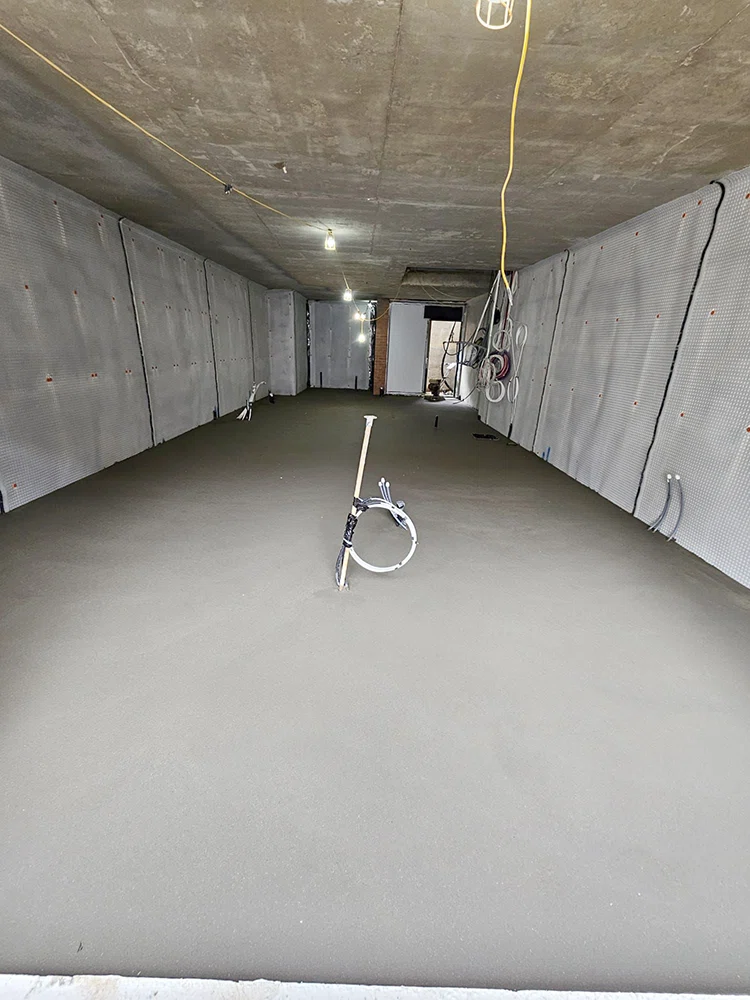
K & B Screeding’s own team, led by director Donatas Bardisevicius. Founded 2019, company 12298780.
See what customers say in our Google reviews and on our testimonials page.
Anhydrite & Flow Screed from Slough to Dorking
As the crow flies, our yard in Slough is about 24.8 miles from Dorking, which lies to the south-east. Postcodes here include RH4 and RH5, and Leatherhead (4.4 miles), Reigate (5.4 miles), Redhill (6.9 miles) and Epsom (7.5 miles) are close by.
More on anhydrite screed, part of our screeding services.