
Latex over old Dorking kitchens and bathrooms
Latex screed is the name the flooring trade gives to a two part smoothing compound. A cement based powder is stirred into a latex liquid, used in place of water, and the mix is spread a few millimetres thick over a base that is already sound. It is a finishing skim rather than a structural layer. Its whole purpose is to stop board edges, grout lines and old trowel ridges from printing through a thin covering.
In a Dorking house the call for it usually comes during a kitchen or bathroom refit, when the old covering is pulled up and a patchwork appears underneath. Upstairs that patchwork is normally timber. Bare floorboards shrink, gap and move, so latex is never spread straight onto them. The boards are first screwed down and covered with flooring grade plywood, and the latex then fills the sheet joints and screw heads to leave one continuous surface.
Downstairs the base may be quarry tiles, ceramic tiles or an old slab patched many times over. Tiles that are still firmly bonded can stay where they are once cleaned and primed, which spares the house the noise and dust of breaking them out. Thin, well stuck adhesive from a previous floor can often stay too.
Homes built from 1945 to 1972 make up 22% of Dorking's housing, and floors of that age have often been recovered more than once. Whatever is down there, the latex only performs as well as its bond, so the base is tapped, scraped and tested before anything is mixed. Where ridges or an old coating stand proud, grinding the base back first gives the latex clean material to grip.
When latex is wrong for a Dorking floor
A coat this thin has limits, and three conditions rule it out until something else has been put right.
Damp comes first. With so many original ground floors in the older parts of Dorking laid without a membrane, a moisture reading is taken before any primer is opened. Latex does nothing to stop rising damp, and vinyl or rubber laid over a wet base seals the moisture in until the adhesive lets go. A floor in that condition has to be dug out and rebuilt, which is explained on our Dorking sand and cement page.
Movement is the second. A timber floor that bounces underfoot will crack any compound spread on it, however good the product. Loose boards are refixed, any weak joists are dealt with by a carpenter, and the plywood is down before we come back.
The third is a room that is badly out of level. Latex lifts a surface by a few millimetres; it will not correct a floor that falls away towards one wall. Deeper hollows are filled or screeded first, and the wider choice between compound and fresh screed is covered on our floor levelling page for Dorking.
Primers are matched to the base. Plywood, tiles, concrete and old adhesive each have their own, and a calcium sulphate screed is always sanded free of laitance and primed before latex touches it.
How we price latex screed in Dorking
A fixed written price within 24 hours, once we know the area and the base. See our floor screeding cost guide.
Who lays your latex screed in Dorking
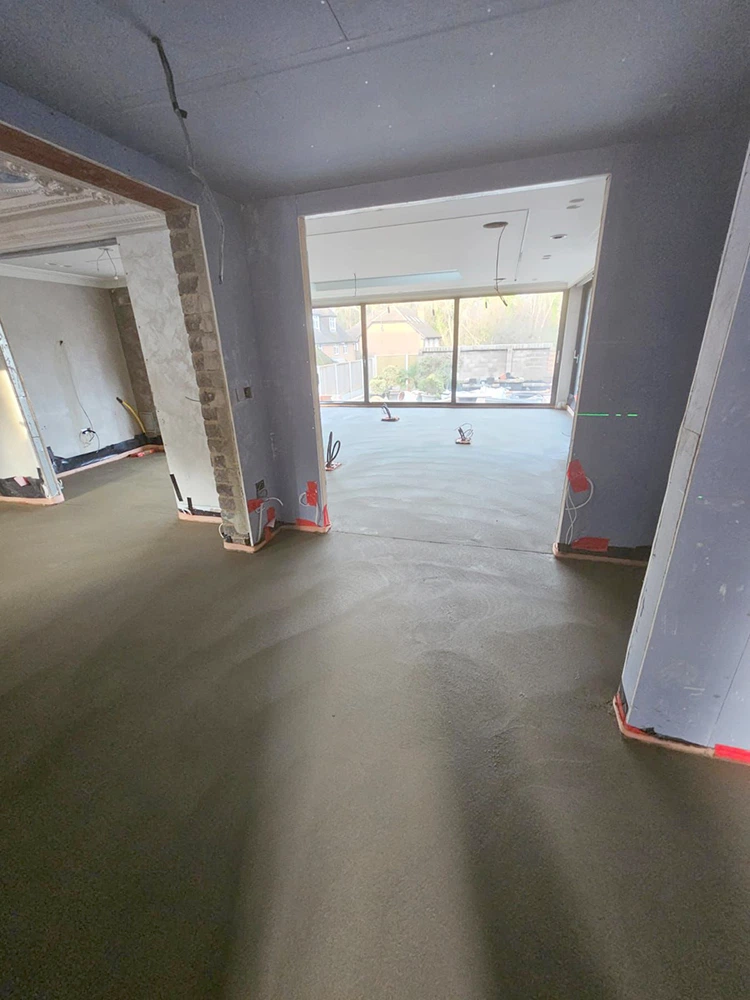
K & B Screeding’s own team, led by director Donatas Bardisevicius. Founded 2019, company 12298780.
See what customers say in our Google reviews and on our testimonials page.
Latex Screed from Slough to Dorking
As the crow flies, our yard in Slough is about 24.8 miles from Dorking, which lies to the south-east. Postcodes here include RH4 and RH5, and Leatherhead (4.4 miles), Reigate (5.4 miles), Redhill (6.9 miles) and Epsom (7.5 miles) are close by.
More on latex screed, part of our screeding services.