
Rebuilding original floors in Rose Hill and Tower Hill
About 24% of homes in Dorking were built before 1919, and a floor that has lasted that long rarely meets modern standards. Floors from that era are usually solid and sits directly on the earth, with nothing to keep damp out and nothing to keep heat in. Over time it cracks, crumbles at the edges or pushes moisture into new flooring.
The fix starts with excavation. We break out the old slab and dig deep enough for every new layer to fit, working up from a compacted base through a damp proof membrane and rigid insulation to the screed on top. The membrane and boards come under our insulation and membranes work. Working out the depth matters in an older house, because the finished floor has to meet existing door thresholds, skirtings and the hallway.
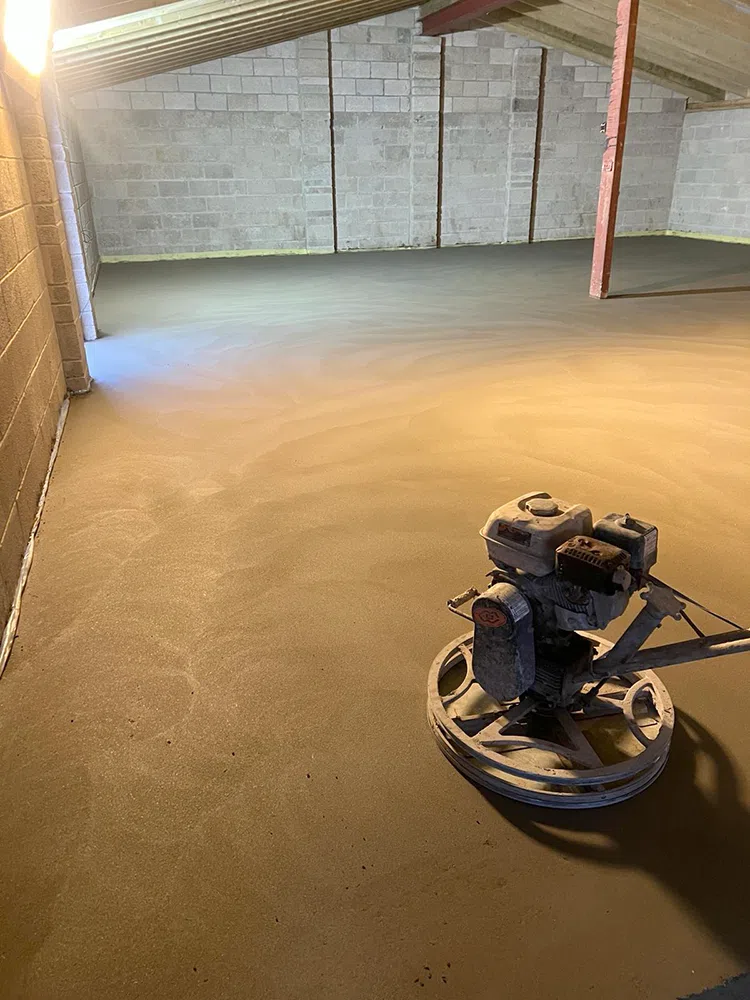
Sand and cement is mixed on site and compacted by hand, so the team can work it into a narrow Victorian hallway, around a chimney breast or under a staircase without a pump outside. On a floating floor over insulation, the domestic depth is 65mm, rising to 75mm for commercial use. If there is already sound concrete to bond to, 25 to 40mm of screed will do.
Houses around The Oval in Rose Hill were laid out from the 1830s, and the National Freehold Land Society built at Tower Hill from 1850. Both are old enough for surprises under the floor, so we price after learning what the base is made of and how deep the dig needs to go.
Wet rooms, garages and drying times in Dorking
Hand-laid screed has jobs that liquid products cannot do. A wet room floor needs falls towards the drain, formed accurately so water runs away rather than pooling, and it needs a cement base because calcium sulphate is weakened by persistent moisture. The same thinking applies to utility rooms and shower areas.
Garages being turned into rooms are another fit. A garage slab is normally lower than the house floor beside it, so the screed lifts it up flush. Each layer of that build-up is set out in our garage conversion screed guide.
What you give up is speed of drying. Up to 40mm deep, the screed dries at roughly a millimetre each day, and past that it slows down, so a 65mm floor in an old Dorking house is weeks away from taking a finish, not days. A quick drying screed mix can shorten the wait when a programme is tight, and fibres can be added for crack resistance.
On the published 2026 UK rates, hand-laid sand and cement is priced at £18 to £25 for each square metre. On a Dorking renovation, the dig-out, membrane and insulation are usually priced alongside it, so the written figure covers the whole floor rather than just the top layer.
Sand and Cement Screed prices in Dorking
Sand and cement screed: £18 to £25 per m² supplied and laid (MyJobQuote, August 2026), so £450 to £630 for 25 m². MyJobQuote does not say whether these figures include VAT. See our floor screeding cost guide or screed calculator.
Who lays your sand and cement screed in Dorking
K & B Screeding’s own team, led by director Donatas Bardisevicius. Founded 2019, company 12298780.
See what customers say in our Google reviews and on our testimonials page.
Sand and Cement Screed from Slough to Dorking
As the crow flies, our yard in Slough is about 24.8 miles from Dorking, which lies to the south-east. Postcodes here include RH4 and RH5, and Leatherhead (4.4 miles), Reigate (5.4 miles), Redhill (6.9 miles) and Epsom (7.5 miles) are close by.
More on sand & cement screed, part of our screeding services.
