
Opening up old ground floors near Redhill Common
The signs of a tired solid floor are easy to spot: tiles that crack along a line, a hollow ring underfoot, a damp tidemark at the skirting, or a dip in the middle of the room. Patching rarely holds. In a house built before membranes were standard, the lasting repair is to break the floor out, excavate to the right level, then rebuild with a damp proof membrane, insulation and a fresh screed.
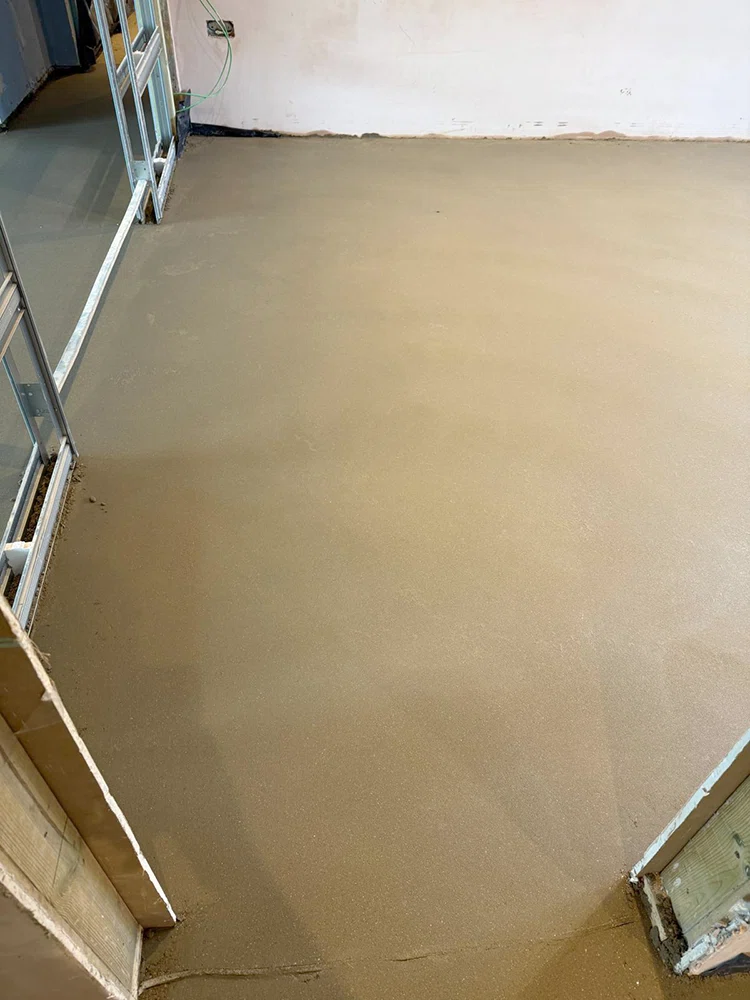
Houses of that age tend to have smaller rooms, chimney breasts and hearths, and floors that must finish flush with old thresholds. Laying by hand deals with each of those. It is mixed in small batches, run to levels room by room and compacted around awkward corners, with no pump standing in the street.
Thickness follows the build-up. Floating on insulation, a domestic floor goes down at about 65mm, and a commercial one at 75mm; go thinner and it is liable to crack. If the old concrete slab is still solid, a bonded screed fixed straight to it may only need 25 to 40mm. Our guide to screed depths shows where those numbers come from.
One caution for older houses: some have suspended timber ground floors rather than solid ones. Swapping timber for a solid screeded floor changes ventilation under the house, so it needs thought before work starts.
Wet rooms, falls and garage floors in Redhill
Cement copes with water; calcium sulphate does not. So for a Redhill wet room or a level-access shower, where the surface must slope to a drain, sand and cement is the base to use. The falls are formed in the screed itself, so the tiler follows a true surface instead of building it up in adhesive.
Garage conversions are the other everyday use. Converting the garage on one of Redhill's post-war semis usually means lifting the floor up to the level of the house, with a membrane and insulation laid beneath the screed. Each stage is set out in screeding a garage floor. If a floor must carry heavier loads or go into use early, a fibre reinforced screed or a higher strength mix can be specified.
The drawback is drying time. A 65mm floor dries far more slowly than a thinner liquid screed, so programmes need to allow for it, or a quick drying mix can be used. The published 2026 rate is £18 to £25 per m², and adding fibres costs another £1 to £3 per m².
Sand and Cement Screed prices in Redhill
Sand and cement screed: £18 to £25 per m² supplied and laid (MyJobQuote, August 2026), so £450 to £630 for 25 m². MyJobQuote does not say whether these figures include VAT. See our floor screeding cost guide or screed calculator.
Who lays your sand and cement screed in Redhill
K & B Screeding’s own team, led by director Donatas Bardisevicius. Founded 2019, company 12298780.
See what customers say in our Google reviews and on our testimonials page.
Sand and Cement Screed from Slough to Redhill
As the crow flies, our yard in Slough is about 28.7 miles from Redhill, which lies to the south-east. Postcodes here include RH1, and Reigate (1.5 miles), Horley (4.8 miles), Caterham (4.9 miles) and Dorking (6.9 miles) are close by.
More on sand & cement screed, part of our screeding services.
