
Replacing tired solid floors in Ewell houses
Many of Ewell's interwar homes still have their original solid ground floor. When it cracks, sinks or turns out to have no proper damp proof membrane, the usual fix is to break it out, lay hardcore and a new slab where needed, then a membrane and insulation, and finish with a floating sand and cement screed.
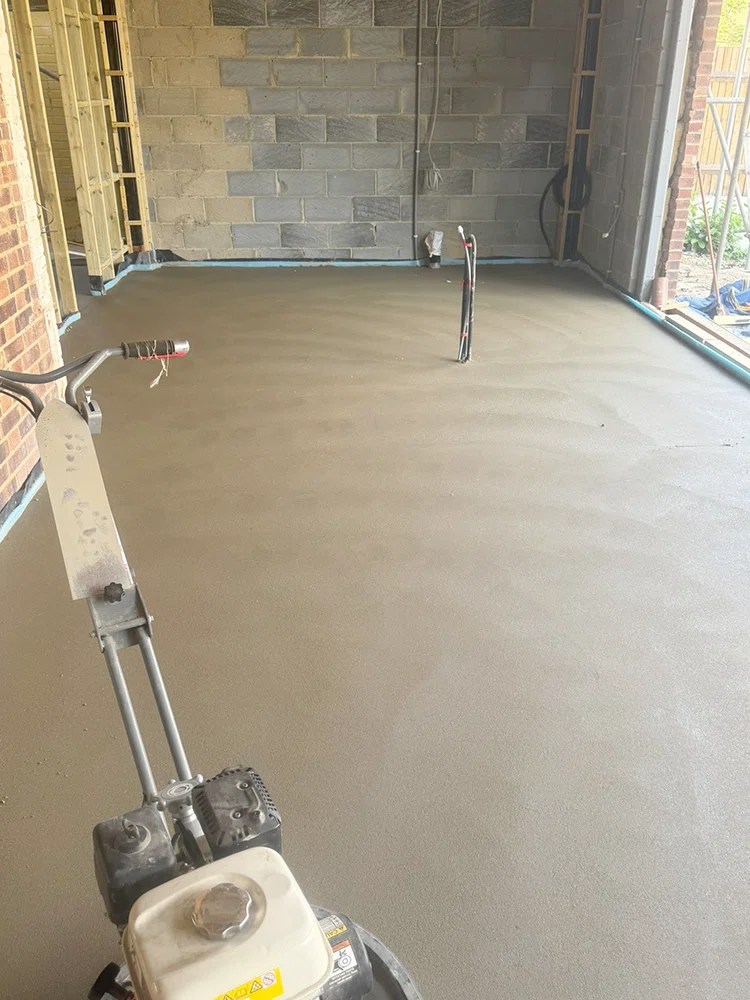
We mix it on the drive, lay it a bay at a time, tamp it down by hand and trowel it level. A floating screed in a house is laid at about 65mm, which gives it the strength to span insulation without cracking. Where the new screed is fixed straight to a sound concrete base, a bonded screed of 25 to 40mm works and saves height; the bonded screed page explains the preparation it needs.
Small and awkward rooms are where the traditional method is most efficient. A hallway, a cloakroom or a narrow utility can be screeded from a mixer on the drive without setting up a pump.
Bathrooms and utilities that see water are another reason to stay with cement. Calcium sulphate should be kept out of a wet room, but a hand-laid mix can slope gently to the drain and carry water away from the doorway.
It does take longer to dry than a pumped floor. Reckon on one day for every millimetre of the first 40mm and more for each one after that; at 65mm, it adds up to several weeks before testing the moisture makes sense. For a direct comparison of the two methods, see liquid screed vs sand and cement.
Garage conversions and wet rooms around Ewell
A garage becoming a room is one of the jobs where sand and cement is the natural choice. Garage concrete is normally a step down from the hall, so the converted room has to be built up until it meets the house floor. That often means insulation, a membrane and a floating screed, with the depth set by the step between the two. Each layer is described in screeding a garage floor.
A wet room, or a shower you walk into without a tray or step, needs the floor to slope towards its drain. Sand and cement can be shaped by hand towards the drain, which a self-levelling screed cannot do, and the tanking goes on once it is dry.
Some floors need early strength as well: a workshop, a utility where heavy appliances sit, or a garage that will still take a car. Mixing in fibres to resist cracking costs £1 to £3 per m², and where that is not enough we can lay a stronger screed mix.
As a guide to cost, expect £18 to £25 per m² for sand and cement, going by 2026 published UK rates. Small rooms often cost more per metre than open ones, because the setting up is the same whatever the size.
Sand and Cement Screed prices in Ewell
Sand and cement screed: £18 to £25 per m² supplied and laid (MyJobQuote, August 2026), so £450 to £630 for 25 m². MyJobQuote does not say whether these figures include VAT. See our floor screeding cost guide or screed calculator.
Who lays your sand and cement screed in Ewell
K & B Screeding’s own team, led by director Donatas Bardisevicius. Founded 2019, company 12298780.
See what customers say in our Google reviews and on our testimonials page.
Sand and Cement Screed from Slough to Ewell
As the crow flies, our yard in Slough is about 21.2 miles from Ewell, which lies to the south-east. Postcodes here include KT17 and KT19, and Epsom (1.4 miles), Kingston upon Thames (3.2 miles), Sutton (3.6 miles) and Merton (4.5 miles) are close by.
More on sand & cement screed, part of our screeding services.
