
Replacing membrane-less floors in Thornton Heath and Selhurst
An old solid floor with no membrane lets ground moisture through, and finishes laid over it can fail. Patching does not stop the damp, so the usual fix is to break out the floor, lay a new damp proof membrane, add insulation where the depth allows and lay a new screed on top.
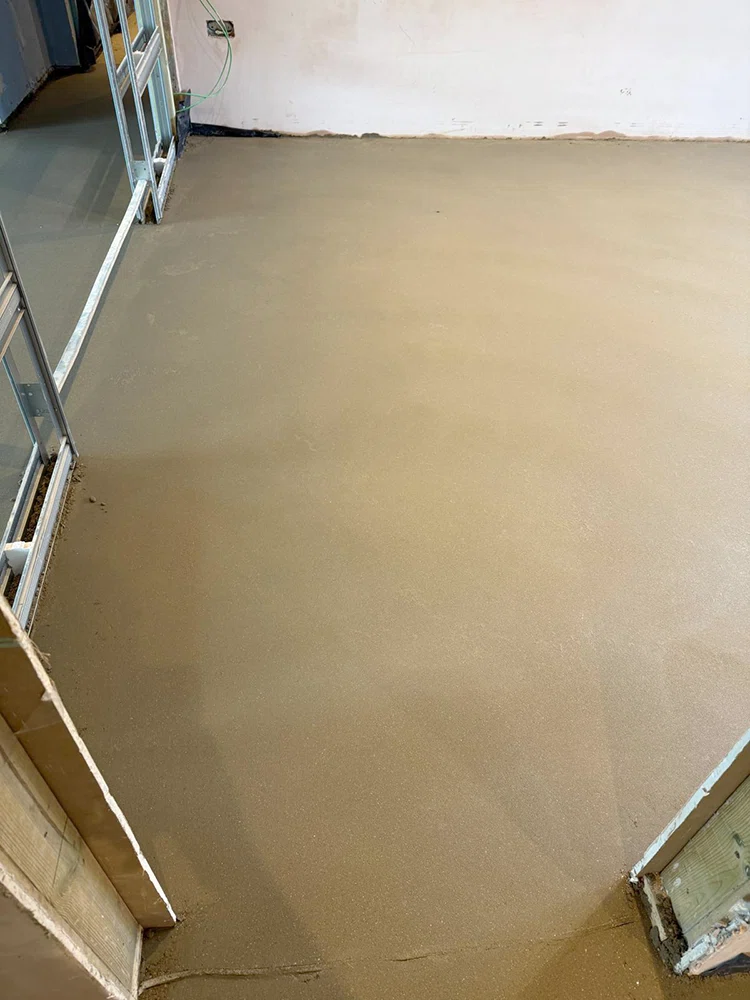
Terraced houses make up 23% of Croydon's homes, and in the Victorian terraces of Thornton Heath, Selhurst and South Norwood this is typical work. In a terraced house the materials usually have to come in through the front door, and sand and cement handles that well. It is mixed in batches on site, barrowed in, laid to the levels set out, then compacted and power floated, so each room can be finished to its own height where the house has changes of level.
How deep it goes comes down to what it sits on. Laid over insulation, a house floor is 65mm and a commercial one 75mm. A bonded screed on a sound, prepared slab can be 25 to 40mm, which suits a floor where only the top has failed and the slab below is dry.
This kind of floor is slow to dry, at about one day per mm until 40mm and slower past that, so a South Norwood terrace with a new 65mm floor waits weeks for timber or LVT. Depth by depth, our guide to screed thicknesses has the figures.
Croydon wet rooms, garages and small awkward floors
Not every floor in a house should be the same screed. Wherever water sits on the floor, in a bathroom, a wet room or a walk-in shower, the screed should be cement based, as moisture that lingers softens calcium sulphate. Sand and cement can be laid to falls towards a drain and gives the tiler a cement substrate to work on.
Then there is the garage being turned into living space. Its slab is lower than the house, so insulation, membrane and screed bring it up to the hall level, and hand laying suits a space that size with a step to climb. Read how a garage floor is screeded for the full sequence.
On a tight programme, a fast drying mix costs £20 to £28 per m² and brings the flooring date forward; adding fibres puts £1 to £3 per m² on the bill and helps keep cracks in check. See fibre reinforced screed for when they are worth adding.
Small jobs suit this method. A single utility room is quick to mix and lay by hand, whereas pump hire runs at £300 to £600 per day in published figures. If the same house also has a large open extension, the liquid screed option in Croydon may suit that part.
Sand and Cement Screed prices in Croydon
Sand and cement screed: £18 to £25 per m² supplied and laid (MyJobQuote, August 2026), so £450 to £630 for 25 m². MyJobQuote does not say whether these figures include VAT. See our floor screeding cost guide or screed calculator.
Who lays your sand and cement screed in Croydon
K & B Screeding’s own team, led by director Donatas Bardisevicius. Founded 2019, company 12298780.
See what customers say in our Google reviews and on our testimonials page.
Sand and Cement Screed from Slough to Croydon
As the crow flies, our yard in Slough is about 26.8 miles from Croydon, which lies to the east-south-east. Postcodes here include CR0, CR5, CR8 and CR7, and Sutton (3.7 miles), Caterham (5.7 miles), Bromley (5.8 miles) and Merton (6.3 miles) are close by.
More on sand & cement screed, part of our screeding services.
