
Relaying old solid floors in Caterham Valley
Caterham's age profile is unusually even, and older homes are a big part of it. Some 14% of homes were built before 1919 and 23% between the wars, and in the Valley, which grew after the railway came in 1856, those houses often sit on ground floors laid without any damp proof membrane.
The signs are familiar to anyone renovating one: damp at the edges of the floor, tiles lifting, a musty smell under carpets, or a floor that sounds hollow or has cracked. Patching rarely lasts. What lasts is taking the old floor up, putting down a membrane and insulation, then screeding on top.
Over insulation, a house floor takes 65mm of sand and cement, and a shop or office 75mm. If there is good concrete underneath and little height to spare, bonding 25 to 40mm straight onto it can work instead. The finished level has to meet existing doors, hearths and thresholds, so we work back from the finished floor height before deciding the build-up.
Hand-laid screed suits older houses because it is mixed on site in small batches and can be taken through narrow hallways by barrow. Once tamped down and floated, it sets dense and level, and its cement face takes stone and ceramic tiles well. The trade-off is a slower dry than a pumped floor, around one day per millimetre through the first 40mm. How depth changes strength and drying is covered in choosing a screed thickness.
Wet rooms and small rooms on Caterham on the Hill
Several buildings along Church Hill, in the older village of Caterham on the Hill, are listed. Before any floor work on a listed building, check with the council what consent is needed, because the build-up may need to suit the old structure.
Whatever the address, sand and cement is the screed for rooms that get wet. Showers you step straight into need the floor sloping to the drain, and we can trowel a hand-laid screed to exactly that slope. A flowing screed cannot. Calcium sulphate is also unsuitable where water may sit, so bathrooms and utility rooms are a natural job for a cement based screed.
Small rooms favour it too. A single hallway, cloakroom or kitchen does not justify a pump truck, and on that scale sand and cement is often the better value option.
Two variations help on some jobs. Mixing in fibres costs roughly £1 to £3 more per m² and helps keep cracks in check; see fibre reinforced screed. And if the kitchen fitter already has a date, a faster drying sand and cement mix brings the flooring forward. For wider floors, weigh this up against liquid screed in Caterham.
Sand and Cement Screed prices in Caterham
Sand and cement screed: £18 to £25 per m² supplied and laid (MyJobQuote, August 2026), so £450 to £630 for 25 m². MyJobQuote does not say whether these figures include VAT. See our floor screeding cost guide or screed calculator.
Who lays your sand and cement screed in Caterham
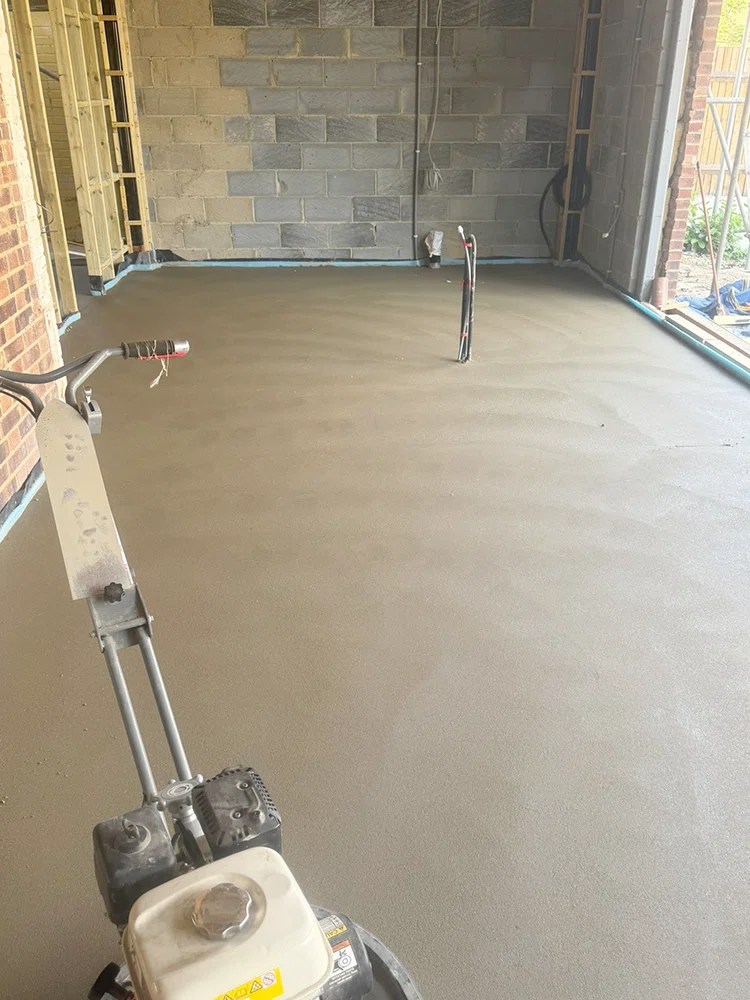
K & B Screeding’s own team, led by director Donatas Bardisevicius. Founded 2019, company 12298780.
See what customers say in our Google reviews and on our testimonials page.
Sand and Cement Screed from Slough to Caterham
As the crow flies, our yard in Slough is about 30 miles from Caterham, which lies to the south-east. Postcodes here include CR3 and RH1, and Oxted (3.6 miles), Redhill (4.9 miles), Croydon (5.7 miles) and Reigate (6.3 miles) are close by.
More on sand & cement screed, part of our screeding services.
