
Where flowing screed suits Caterham floors
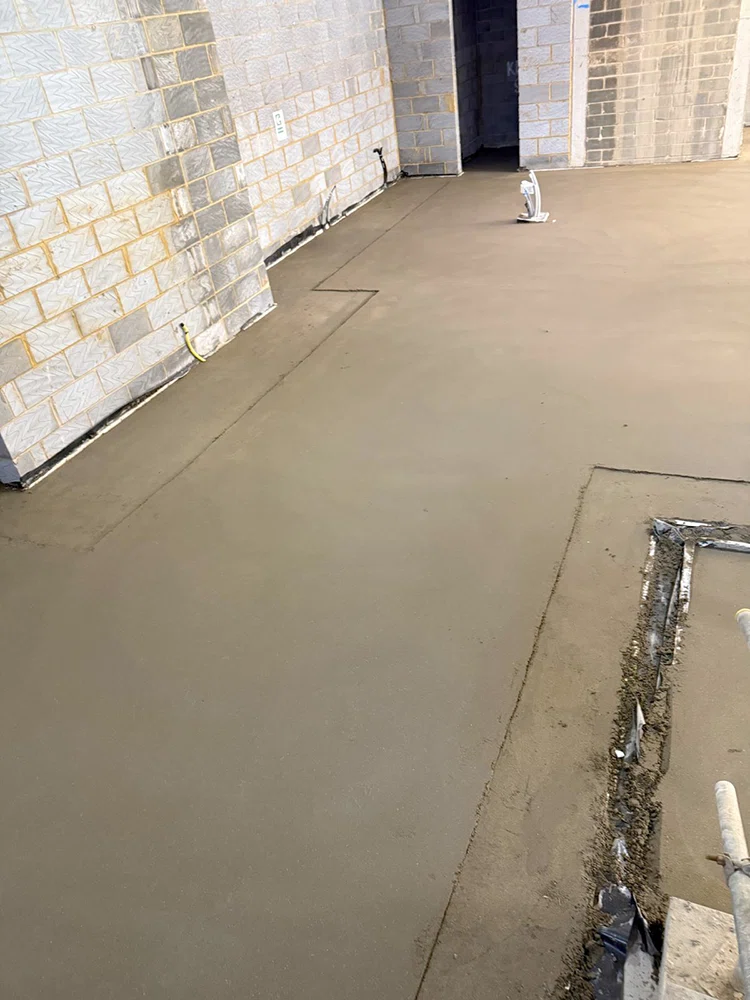
A liquid screed arrives ready mixed, is pumped through a hose onto the insulation or slab, and settles to a flat surface without hand compaction. That makes SR1 or SR2 flatness readily achievable, which matters when thin finishes such as LVT follow.
It suits three kinds of floor in Caterham. The first is the open-plan extension, where a kitchen is knocked through into new space at the back of a semi or detached house. The whole space goes down in one unbroken pour, needing far fewer joints than hand-laid work and shrinking very little. The second is the flat. An upper floor is easier to screed by hose, and a flowing screed fills an irregular plan without leaving voids. The third is the heated floor, because the screed flows fully around the pipes and helps the room warm up quickly.
Depth is where it saves height in Caterham's older houses. On insulation in a home we start at roughly 35mm, or 40mm on a commercial job, where a traditional mix needs 65mm. Over heating pipes it needs at least 25mm of cover, taking the total to about 45 to 50mm, useful in a Victorian or interwar house where the doors and hearths leave little room.
Liquid mixes come as calcium sulphate or cement based, and we match them to the room and the flooring going on top. Only 7% of Caterham's homes were built since 2015, so most pours go into existing buildings where the programme is set by the rest of the renovation. To plan the weeks after the pour, see how long screed takes to dry.
Getting the pump to a Caterham house or flat
The pump is what makes liquid screed quick, and it is also what needs planning. On a Caterham street the lorry and pump stop as near your front door as they can, and the hose goes in through a door or window. With a drive, that takes no planning at all. A terrace or a converted building with parking on the road needs a clear space outside for the morning, and a route inside that can be protected.
In a block, the line can climb the stairs or pass through a window, so a second floor flat is still within reach. Communal areas are covered to protect them while the hose is in place.
Get the room prepared before pour morning. Edge strip goes round the walls, the membrane is taped so screed cannot escape beneath it, and door openings are dammed. The pour takes hours, not days, and the room then stays closed until the next day.
For tight sites where a truck cannot stand close enough, a screed pumping setup with a longer line can sometimes bridge the gap. If a smaller room would be better value by hand, compare with sand and cement for Caterham homes. We also lay liquid screed in Oxted, which is close by.
Liquid Screed prices in Caterham
Liquid screed: £24 to £31 per m² supplied and laid (MyJobQuote, August 2026), so £960 to £1,240 for 40 m². MyJobQuote does not say whether these figures include VAT. See our floor screeding cost guide or screed calculator.
Who lays your liquid screed in Caterham
K & B Screeding’s own team, led by director Donatas Bardisevicius. Founded 2019, company 12298780.
See what customers say in our Google reviews and on our testimonials page.
Liquid Screed from Slough to Caterham
As the crow flies, our yard in Slough is about 30 miles from Caterham, which lies to the south-east. Postcodes here include CR3 and RH1, and Oxted (3.6 miles), Redhill (4.9 miles), Croydon (5.7 miles) and Reigate (6.3 miles) are close by.
More on liquid screed, part of our screeding services.