
Latex over old bases in Caterham Valley houses
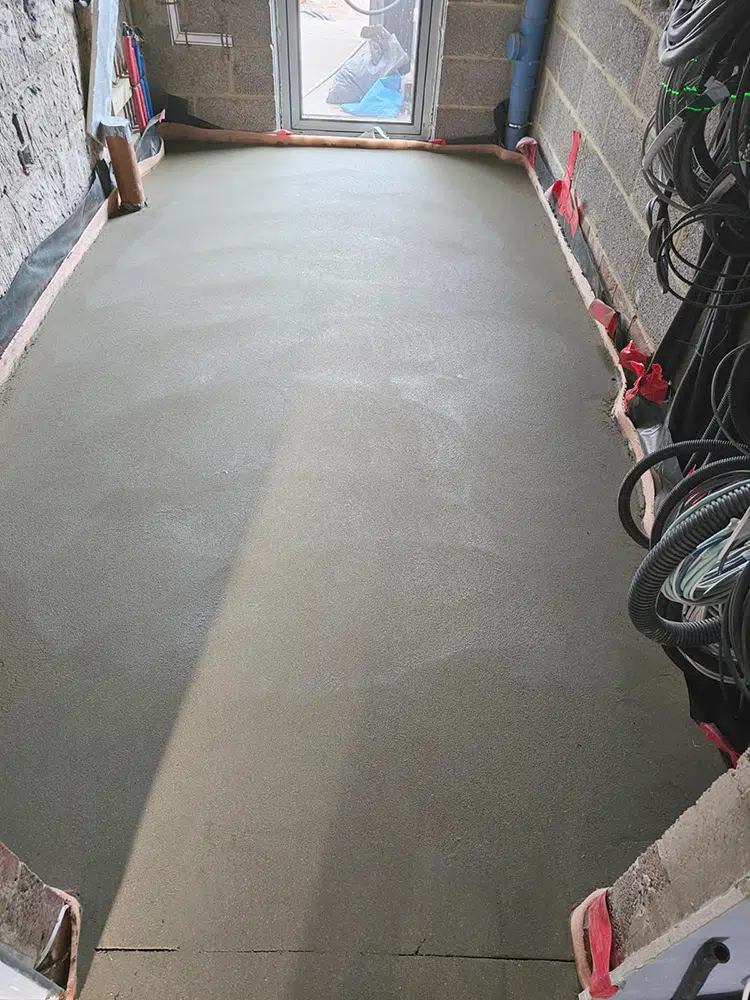
Latex screed gets its name from the liquid in the pack. A cement based powder is mixed with a latex emulsion instead of water, and the result is a compound that flows into a thin, smooth layer and grips well on surfaces that ordinary mixes find difficult. It is laid a few millimetres thick. Think of it as a smoothing coat for a floor that is already firm, not as a new floor.
That makes it useful in older houses, where a kitchen or bathroom refit can reveal a base patched again and again over the years. Terraced houses make up 13% of Caterham's homes, and in an older house the ground floor can hold a mix of materials from one room to the next. Firmly bonded quarry or ceramic tiles can stay in place and be covered. Sound old adhesive can sometimes be left too, once it is scraped back and the correct primer is applied. Uneven older concrete can be smoothed, provided it is dry and solid.
Timber is the exception. Where a room has a suspended timber floor, latex never goes straight onto the boards. They flex as people walk on them, and a thin layer would crack along every gap. The boards are screwed down and covered with flooring grade plywood first, and the latex goes onto the plywood.
Damp is the other check in this part of town. Houses of that age often have solid floors with no damp proof membrane underneath, and latex will not hold back moisture coming up from the ground. If a reading is high, the answer may be breaking out and relaying in sand and cement rather than latex.
When latex will not fix a Caterham floor
Homes built between 1919 and 1944 make up 23% of Caterham's housing, and the interwar houses that followed the Victorian and Edwardian ones often share the same weakness: a solid floor with no damp proof membrane. That matters, because a thin compound is no barrier. Damp rising through an old slab will lift a few millimetres of latex, and the vinyl or LVT on top with it. A moisture reading is taken before anything is mixed.
A few millimetres of compound also cannot rescue a room that is well off level. If a straightedge shows a room running out by more than latex can take, the sensible route is a new screed. Concrete that sounds hollow or has broken up needs a screed repair before that. Our floor levelling page for Caterham covers flatness classes and when ordinary compound will do.
Floorboards that bounce underfoot are the other trap. They need fixing down properly before any plywood or latex goes on, or the new layer will crack as the timber moves.
Once a floor passes those tests, primer is matched to the base. Concrete, old tiles and plywood each take their own, and on calcium sulphate the laitance must come off before the primer goes on. Where old paint or ridges in a slab would stop a primer from bonding, concrete floor grinding takes them off. Redhill is just under five miles away, and we lay latex screed in Redhill as well.
How we price latex screed in Caterham
A fixed written price within 24 hours, once we know the area and the base. See our floor screeding cost guide.
Who lays your latex screed in Caterham
K & B Screeding’s own team, led by director Donatas Bardisevicius. Founded 2019, company 12298780.
See what customers say in our Google reviews and on our testimonials page.
Latex Screed from Slough to Caterham
As the crow flies, our yard in Slough is about 30 miles from Caterham, which lies to the south-east. Postcodes here include CR3 and RH1, and Oxted (3.6 miles), Redhill (4.9 miles), Croydon (5.7 miles) and Reigate (6.3 miles) are close by.
More on latex screed, part of our screeding services.
