
Latex over ply and old tiles in Horley refits
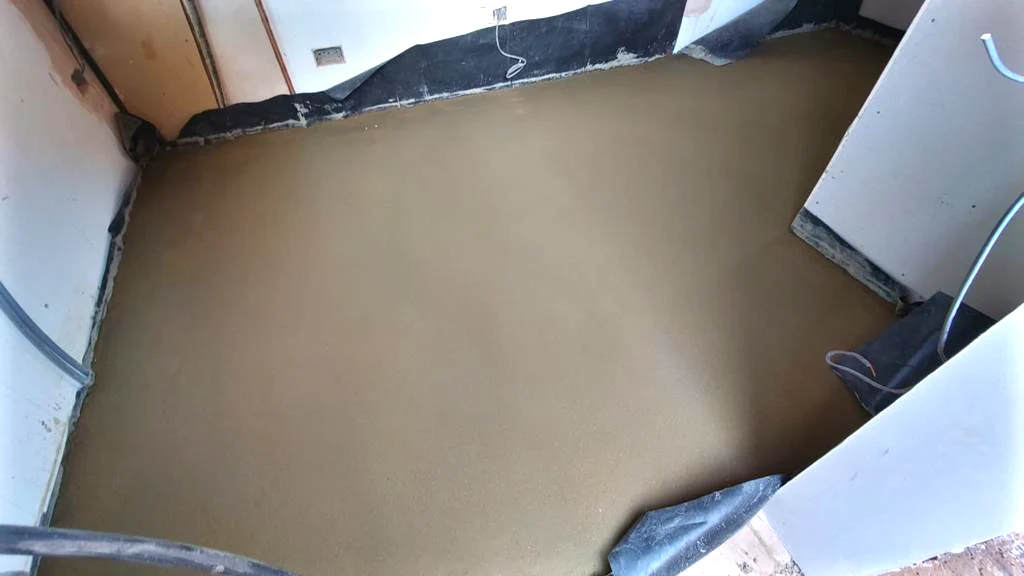
Pull up the lino in a Horley kitchen that was last refitted a couple of decades ago and the base underneath may be more than one material. There may be ceramic tiles by the sink, bare concrete where units once stood and a patch of filler near the back door. Sheet vinyl, lino or thin LVT laid straight over that mix would show every grout line within weeks.
A latex coat ties those surfaces together. Once glazed tiles and dense concrete have been cleaned and given the right primer, one thin pass covers both. Tiles have to be firmly bonded: tap each one, and any that sound hollow or rock are lifted and the gap filled first.
Upstairs, bathrooms in houses of every age sit on timber. Latex is never spread on bare floorboards, because boards shrink, swell and flex with the seasons and a thin coat cracks along every joint. The boards are screwed down, flooring grade plywood is fixed over them, and the latex goes onto the plywood.
Old adhesive needs a judgement. A thin, hard film that is firmly stuck can sometimes stay under a suitable primer. Anything soft, powdery or lifting has to come off, and grinding residue off a Horley floor is usually the cleanest way to do it.
The finishes that benefit are the thin, unforgiving ones: sheet vinyl, LVT, lino, rubber, safety flooring in a utility room and even carpet, where a smooth base stops ridges wearing through.
When a Horley floor needs more than latex
Latex smooths. It does not mend, and three faults have to be dealt with before it goes anywhere near a floor.
Damp is the first. A ground floor with moisture coming through will push the latex and the vinyl off together. We check the base before quoting a latex coat, and where the readings are high the answer is a membrane and a new floor, not a thicker skim.
Movement is the second. Plywood fixed over joists that bounce will flex the latex until it cracks. Loose boards are refixed and weak joists sorted by a carpenter first.
Level is the third. In Horley's post-war and later semis, a ground floor screed that has cracked or gone hollow is a known problem, and it shows once old flooring is lifted. Latex will not bridge that. Badly broken areas are cut out under screed repairs, and a room that falls well out of level from one wall to another belongs on our compound and flatness classes page.
Priming suits the base. Concrete, sand and cement, plywood and old tiles each take their own primer. A calcium sulphate screed, which a newer home may have, always has its laitance sanded off and is then primed before latex touches it. Crawley, about 4.1 miles away, is covered under latex smoothing for Crawley floors.
How we price latex screed in Horley
A fixed written price within 24 hours, once we know the area and the base. See our floor screeding cost guide.
Who lays your latex screed in Horley
K & B Screeding’s own team, led by director Donatas Bardisevicius. Founded 2019, company 12298780.
See what customers say in our Google reviews and on our testimonials page.
Latex Screed from Slough to Horley
As the crow flies, our yard in Slough is about 32.5 miles from Horley, which lies to the south-east. Postcodes here include RH6, and Crawley (4.1 miles), Redhill (4.8 miles), Reigate (4.9 miles) and East Grinstead (7.5 miles) are close by.
More on latex screed, part of our screeding services.