
Levelling for refits in Horley's business parks
When a unit in one of the business parks or the shopping centre changes tenant, the floor is usually the first thing to be stripped and the last thing to be finished. Old adhesive, patched screed and uneven joints between slabs all show through new carpet tiles or vinyl.
BS 8204 sets the yardstick, and the check is made with a 2m straightedge. Class SR1 permits 3mm under that straightedge, which is what many thin sheet floorings insist on. SR2 allows 5mm and suits most tiles and carpet tiles. SR3 allows 10mm and is acceptable only for less sensitive finishes. Knowing which class the flooring needs before starting avoids paying for more compound than the job requires.
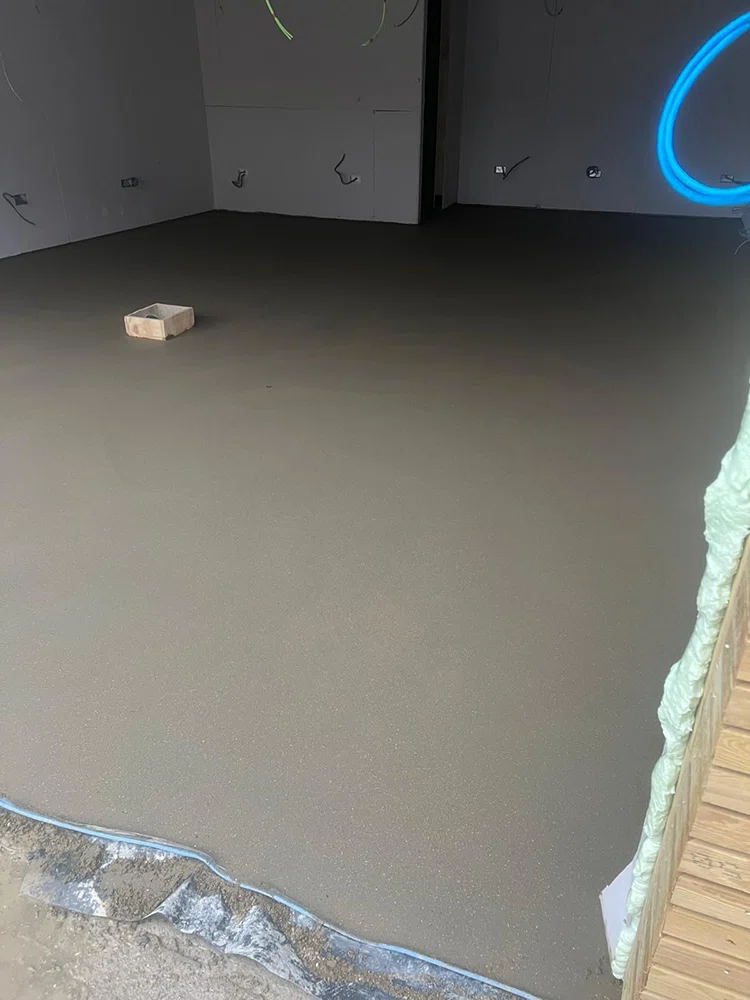
Typical compounds go down between roughly 2mm and 10mm, though certain products can be laid thicker. It is fast drying, which keeps a refit programme moving. In an office unit stripped back after the last tenant, the base is cleaned first and then primed to suit whatever it is, whether concrete, screed or an old floor, since compound laid on dust or leftover adhesive can lose its grip.
Where a refit uncovers a damaged slab or a screed that has broken up, levelling compound will not fix it. That calls for screed repairs first, or new screed. Larger units and warehouse floors are better handled through our commercial screeding service, and shop refits on tight timescales sometimes need a fast drying screed rather than a thin compound alone.
Smoothing Horley floors before LVT and tiles
Terraced houses are 16% of Horley's homes, with semis and detached houses making up much of the rest, and in all of them the same problem appears when new flooring is chosen. Rigid LVT, large porcelain tiles and engineered boards show every dip and ridge in the floor below.
Trouble usually shows first along the join between an extension and the original house, as on many Horley semis that have been built out at the back. The new floor may be a few millimetres higher or lower, or slightly out of plane. A compound feathered across the join can bring both sides into one flat surface. Floors that have had old tiles or vinyl lifted often need the same treatment, once loose material and adhesive have been taken off.
The limit is depth. Pouring compound much deeper than its product allows, to correct a floor that has sagged badly or failed, can crack and debond. If a straightedge shows more than about 10mm of variation, a new hand-laid sand and cement screed is often the honest answer. If the base is sound and only needs a thin skim, a latex smoothing screed can do the job. About 10.4 miles away, levelling floors in Horsham has a page of its own.
How we price floor levelling in Horley
A fixed written price within 24 hours, once we know the area and the base. See our floor screeding cost guide.
Who levels your floor in Horley
K & B Screeding’s own team, led by director Donatas Bardisevicius. Founded 2019, company 12298780.
See what customers say in our Google reviews and on our testimonials page.
Floor Levelling from Slough to Horley
As the crow flies, our yard in Slough is about 32.5 miles from Horley, which lies to the south-east. Postcodes here include RH6, and Crawley (4.1 miles), Redhill (4.8 miles), Reigate (4.9 miles) and East Grinstead (7.5 miles) are close by.
More on floor levelling, part of our screeding services. Not sure whether you need a thin compound or a full flowing screed? See self levelling screed explained.
