
Matching heated floors at Westvale Park and beyond
With 18% of Horley's homes built since 2015, a growing number of houses here already have screed laid over insulation and underfloor heating. When a garden room, conservatory or rear extension goes on, the sensible aim is a floor that warms up and behaves like the rest of the ground floor, rather than a cold step through the doorway.
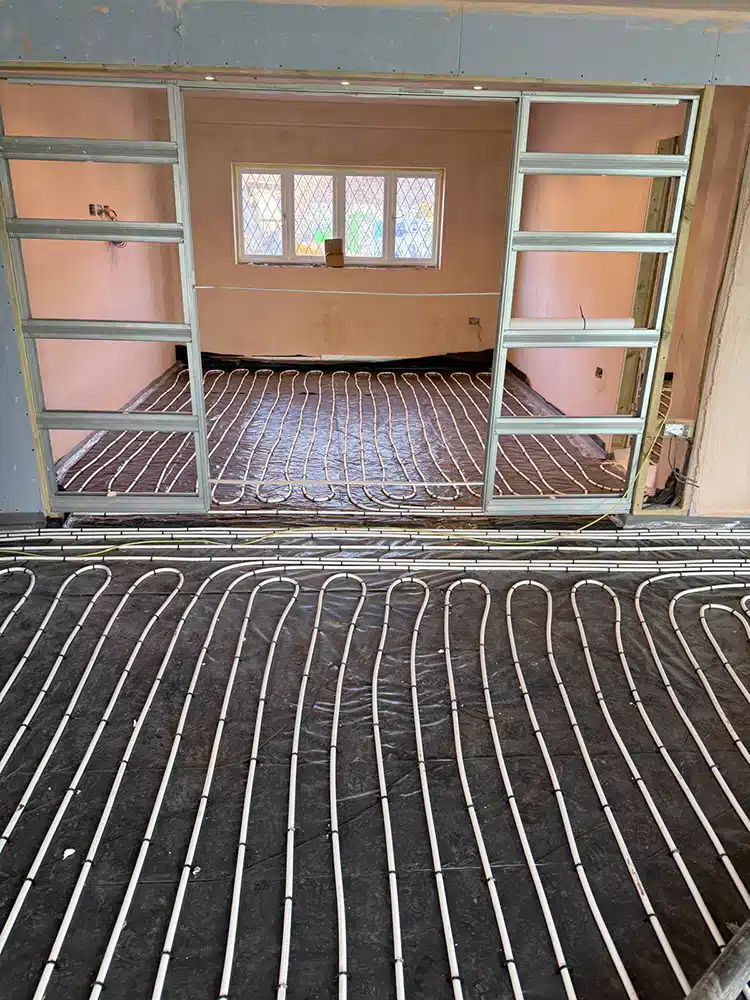
That means checking three things before the pour. First, the insulation and membrane under the new room, and the edge strip around its walls, which lets the screed expand as it heats. Our insulation and membranes service covers this if it is not already in place. Second, the finished level, which has to meet the existing floor at the threshold. Third, the screed type and the cover it needs over the pipes.
With liquid screed, allow 25mm or more above the pipes, which brings the whole layer to about 45 to 50mm. Hand-laid sand and cement wants around 45mm on top of them. Liquid flows fully around the pipes with no air pockets and usually responds faster, which is why pumped liquid screed in Horley is a common choice for heated rooms. Hand-laid still makes sense for a small room, or anywhere the floor could get wet.
In the 26% of Horley homes that are detached, a bigger ground floor often has one heating system running through several rooms. Mixing screed types under one system is possible, but each part then follows its own drying and heat-up timing.
Switching the heating on in a Horley home
The most common mistake with a new heated screed is turning the heating up to dry it out. On calcium sulphate, the heating can normally come on from around day 7; with sand and cement, hold off for 21 days at the very least. In both cases the heat goes on gradually, starting low and rising in small steps over several days, then coming back down before any moisture test.
Commissioning in this way protects the screed from cracking and the pipes from stress. Your heating engineer sets the flow temperatures; we hand over the screed type, depth and date of pour so the schedule fits, and we put the earliest safe date for heating in writing.
Retrofit is harder in older parts of a house, where floor height is tight. Removing an existing screed to make room for pipes is possible, but the new build-up has to fit under existing doors and thresholds. To see how pipes, insulation and screed stack up within the height you have, use our guide to screed depths. North of the town, see underfloor heating screed in Reigate.
Underfloor Heating Screed prices in Horley
Liquid screed over underfloor heating: £20 to £35 per m² supplied and laid (trade2base, June 2026), so £700 to £1,230 for 35 m². trade2base gives these figures excluding VAT. See our floor screeding cost guide or screed calculator.
Who lays your underfloor heating screed in Horley
K & B Screeding’s own team, led by director Donatas Bardisevicius. Founded 2019, company 12298780.
See what customers say in our Google reviews and on our testimonials page.
Underfloor Heating Screed from Slough to Horley
As the crow flies, our yard in Slough is about 32.5 miles from Horley, which lies to the south-east. Postcodes here include RH6, and Crawley (4.1 miles), Redhill (4.8 miles), Reigate (4.9 miles) and East Grinstead (7.5 miles) are close by.
More on underfloor heating screed, part of our screeding services.
