
Heated extensions on Oxted's post-war houses
The challenge with a heated extension on a house of this era is height. The existing floor sets the finished level, and everything in the new room, slab, insulation, pipes and screed, has to fit beneath it. If the slab is cast too high, there is a step at the doorway; too low, and the screed has to be made thicker than planned.
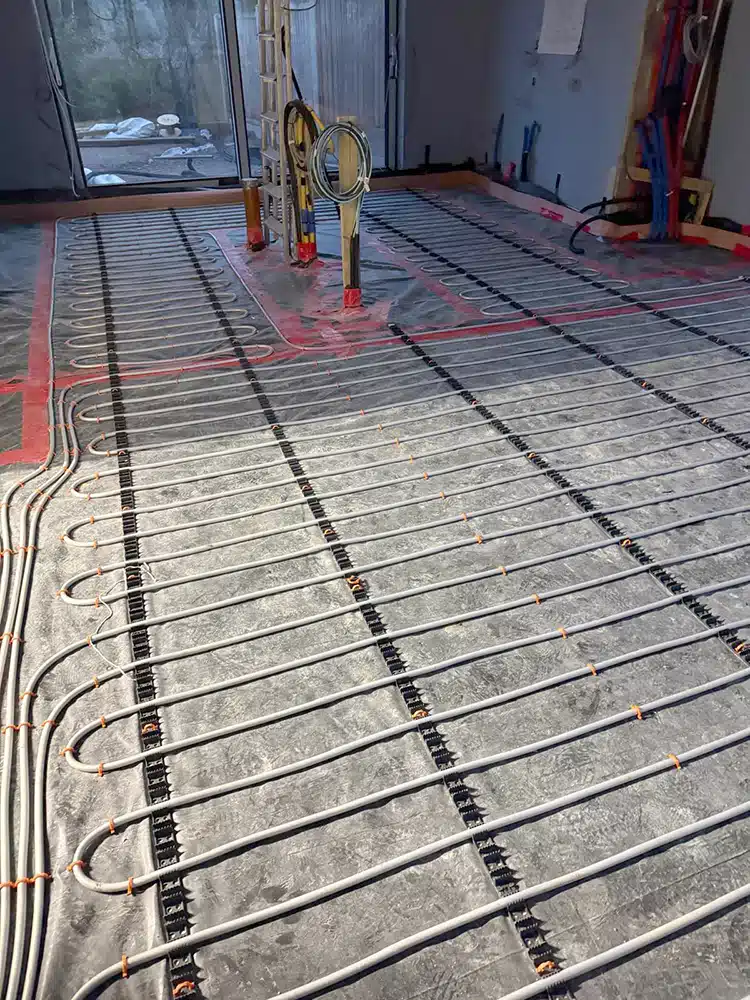
That is why we work out the depth of every layer before the slab is cast. For liquid, 25mm is the least cover over the pipes, which makes about 45 to 50mm overall. With sand and cement, plan on about 45mm of screed above the pipework. The arithmetic for slab, insulation, pipes and screed is set out in our screed depth guide.
The junction between old and new needs thought too. The heated screed expands and contracts as it warms and cools, while the older floor next to it does not. An edge strip or movement joint along the line stops cracks, and the flooring has to be laid to cope with it.
In a post-war extension, a flowing mix wraps itself round each pipe and leaves no voids, so heat reaches the surface evenly and the room responds fast; see pumping liquid screed into Oxted extensions for the pour itself. Sand and cement still suits small heated rooms such as bathrooms. We check the insulation and membrane below, or supply them through our insulation and membrane work.
Retrofit heating in older Oxted homes
Adding underfloor heating to an existing older ground floor, rather than an extension, is harder. Floor height is usually tight, and doors, skirting and stairs fix where the finished floor can sit.
In older Oxted homes where the solid floor has no damp proof membrane, or a timber floor is failing, the floor is often coming out anyway. That creates the chance to dig down and insulate, have your heating engineer lay the pipes, and screed over them, all within the existing height. Where the floor is staying, a thinner build-up may be the only route, and that limits the system choice.
Whichever way the floor is built, the heating comes on gradually. Give calcium sulphate about 7 days before any heat goes in, and sand and cement no fewer than 21. Start low, raise the temperature slowly over several days, then bring it back down before testing for moisture. Your heating engineer sets the flow temperatures from the details we hand over.
For the same service close by, see underfloor heating screed in Redhill.
Underfloor Heating Screed prices in Oxted
Liquid screed over underfloor heating: £20 to £35 per m² supplied and laid (trade2base, June 2026), so £700 to £1,230 for 35 m². trade2base gives these figures excluding VAT. See our floor screeding cost guide or screed calculator.
Who lays your underfloor heating screed in Oxted
K & B Screeding’s own team, led by director Donatas Bardisevicius. Founded 2019, company 12298780.
See what customers say in our Google reviews and on our testimonials page.
Underfloor Heating Screed from Slough to Oxted
Oxted is about 33.6 miles east-south-east of our Slough base as the crow flies, with postcodes including RH8 and CR3. The nearest towns to it are Caterham (3.6 miles), Redhill (7.4 miles), Croydon (8.2 miles) and Sevenoaks (8.5 miles).
More on underfloor heating screed, part of our screeding services.
