
Heated floors in larger Sevenoaks homes
Many Sevenoaks houses are large and valuable: 42% of homes sit in council tax bands F to H. Projects on houses of that scale often include underfloor heating across a whole open-plan kitchen, dining and family space, or through a new basement. Across a floor that large, the screed does two jobs. It spreads heat evenly from the pipes, and it carries a finish that may be stone or engineered timber costing far more than the screed itself. Get either job wrong and the fault shows up as cold patches, cracks or a finish that lifts.
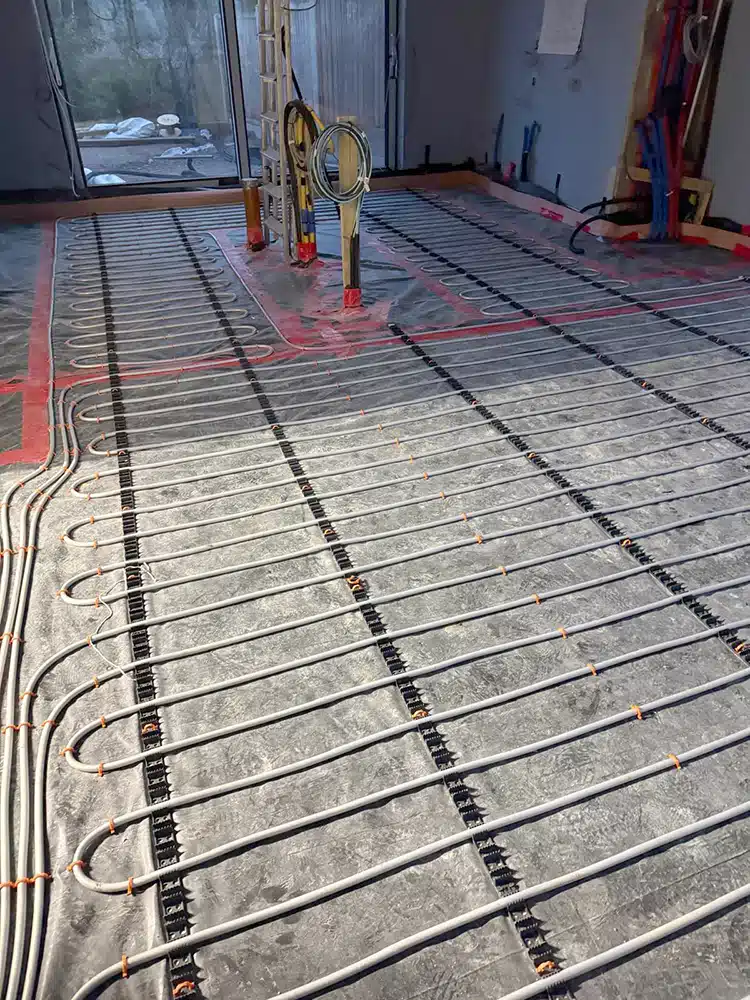
Pipe cover is the first decision. A pumped liquid screed gets at least 25mm over the pipe tops, so the layer finishes at roughly 45 to 50mm, while a hand-laid sand and cement floor carries about 45mm over those same pipes. Liquid screed is the usual pick for a heated floor this size, because it closes round every pipe with no air gaps and its thinner layer warms up sooner. Our liquid screed service in Sevenoaks explains how it is pumped in.
Where the specification calls for a particular calcium sulphate grade, that detail belongs on the anhydrite screed specification page.
Laying the pipes falls to your heating engineer rather than K & B: they fix them over the insulation with the edge strip in place and pressure test them, then our team checks that build-up before pouring.
Retrofitting heating under older Sevenoaks floors
Retrofitting heating in an existing Sevenoaks house is harder than in an extension, because doors, stairs and the floors of adjoining rooms set the finished height. Of Sevenoaks homes, 26% date from 1945 to 1972. In houses of that period, and in older ones, the existing floor usually has to come out before insulation, pipes and screed will fit.
If height is short, liquid screed keeps the layer over the pipes thinner. If there is room, and especially if the floor includes a wet area, a traditional sand and cement screed is laid with about 45mm over the pipes.
Bring the heating up slowly the first time, and not too soon: calcium sulphate can usually be warmed from around day 7, whereas sand and cement should be left a minimum of three weeks, 21 days, before anyone turns the heating on. After that, raise the temperature a little at a time as the heating engineer's commissioning schedule sets out, hold it, and bring it down the same way. Switching straight to full output can crack the screed and spoil a stone floor.
Our screed drying guide covers what happens to the moisture during this stage.
Underfloor Heating Screed prices in Sevenoaks
Liquid screed over underfloor heating: £20 to £35 per m² supplied and laid (trade2base, June 2026), so £700 to £1,230 for 35 m². trade2base gives these figures excluding VAT. See our floor screeding cost guide or screed calculator.
Who lays your underfloor heating screed in Sevenoaks
K & B Screeding’s own team, led by director Donatas Bardisevicius. Founded 2019, company 12298780.
See what customers say in our Google reviews and on our testimonials page.
Underfloor Heating Screed from Slough to Sevenoaks
Sevenoaks is about 40.4 miles east-south-east of our Slough base as the crow flies, with postcodes including TN13 and TN15. The nearest towns to it are Tonbridge (6.4 miles), Oxted (8.5 miles), Swanley (8.8 miles) and Bromley (9.6 miles).
More on underfloor heating screed, part of our screeding services.
