
Heating period floors in Royal Tunbridge Wells
Retrofitting underfloor heating into an older house is mostly a question of millimetres, and of measuring them before anything is ordered. Original doors, skirtings, stair nosings and joinery set the finished floor level, and everything must fit beneath it: insulation, membrane, pipes and the screed that covers them.
Over the pipes, the screed is doing two things at once. It must encapsulate the pipes fully, with no air pockets, and it must be deep enough above them to spread heat and carry load. A liquid mix must bury the pipes under at least 25mm, for an overall depth near 45 to 50mm. A sand and cement floor needs around 45mm above them and ends up deeper. In a tight period house, that difference often decides the choice.
Where the old ground floor has no membrane, as pre-1919 floors may not, it usually has to come out anyway, which frees up height for insulation and a heated screed. Our guide to how thick each layer should be totals up the build.
A new extension or garden room is far less fiddly. The floor can be designed around the heating, and a pumped liquid screed over the pipes gives a thin, fast-responding floor.
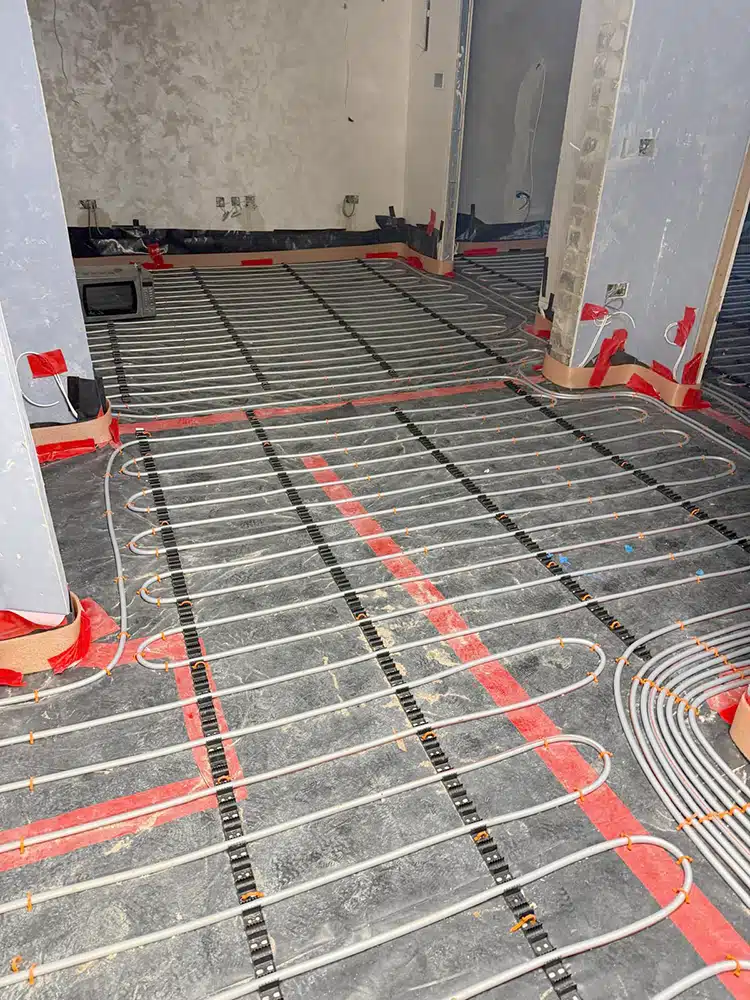
On the day, we expect the pipes clipped down, tested and still holding pressure, sitting on insulation and a membrane, with an edge strip round the walls. If the base still needs those layers, our insulation and membranes service can prepare it.
Commissioning new heated floors around High Brooms and Hawkenbury
Whether the heated floor is in High Brooms, Hawkenbury or elsewhere in town, what happens after the pour matters as much as the pour itself.
Heat can generally go into calcium sulphate after about 7 days. Sand and cement must sit cold for 21 days or more first. Start low and increase the water temperature gradually over several days, following the heating engineer's commissioning plan and the screed manufacturer's schedule. Turning the system straight up to full output is a common cause of cracking, and of edges curling away from the walls. Keep a note of the dates and temperatures used, because the flooring fitter and the heating engineer may both ask for it later.
Once commissioned, the heating is the quickest way to dry the floor. Even so, the screed needs a moisture test before tiles, LVT or engineered wood are laid, and calcium sulphate floors need their laitance sanded off first.
For a liquid floor over heating, published 2026 UK figures sit at £20 to £35 per m². The final price depends on depth, area and access. We also screed heated floors in Sevenoaks, about ten miles away.
Underfloor Heating Screed prices in Royal Tunbridge Wells
Liquid screed over underfloor heating: £20 to £35 per m² supplied and laid (trade2base, June 2026), so £700 to £1,230 for 35 m². trade2base gives these figures excluding VAT. See our floor screeding cost guide or screed calculator.
Who lays your underfloor heating screed in Royal Tunbridge Wells
K & B Screeding’s own team, led by director Donatas Bardisevicius. Founded 2019, company 12298780.
See what customers say in our Google reviews and on our testimonials page.
Underfloor Heating Screed from Slough to Royal Tunbridge Wells
As the crow flies, our yard in Slough is about 48 miles from Royal Tunbridge Wells, which lies to the east-south-east. Postcodes here include TN1, TN2 and TN4, and Tonbridge (4.1 miles), Crowborough (6.7 miles), Sevenoaks (10 miles) and East Grinstead (11.8 miles) are close by.
More on underfloor heating screed, part of our screeding services.
