
Period floors around Mount Ephraim, Mount Sion and Calverley Park
The historic heart of the town, taking in Calverley Park, Calverley Crescent, Mount Ephraim, Mount Pleasant and Mount Sion, is where period buildings are concentrated. In a pre-1919 house, the ground floor may have been laid straight onto the earth, with no membrane to stop moisture rising. When modern flooring goes over that, damp and failed adhesive tend to follow.
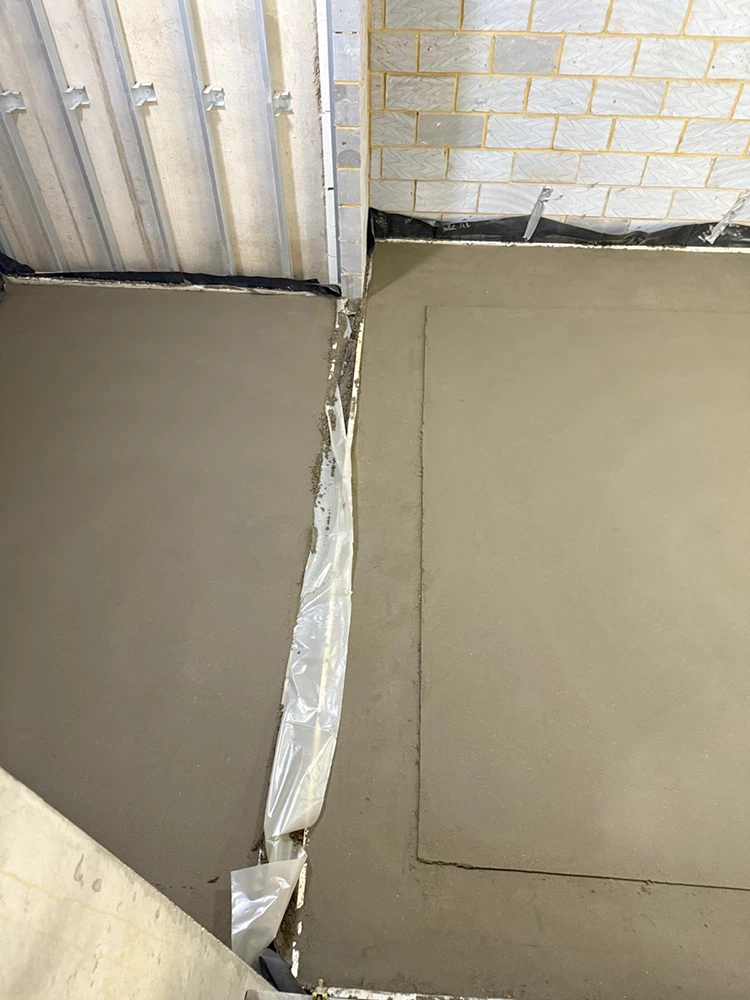
Rebuilding is what lasts. Out comes the old floor, and whatever lies under it is made good. A damp proof membrane goes down and is turned up at the walls, then rigid insulation, then a floating sand and cement screed. Houses get 65mm of it, and commercial premises 75mm.
We mix the screed on site to the right consistency, lay it in bays, compact it by hand and finish it level. A hand-laid screed is well suited to old buildings: rooms are irregular, doorways are fixed, and there may be no room for a pump truck in the street.
Sometimes the height simply is not there for insulation. If the concrete already there is sound, we prepare it and bond 25 to 40mm of screed directly on, a method set out under bonded screeding.
You pay for all this in waiting. Over its first 40mm, expect roughly as many days as millimetres, which is slower than a pumped floor. Where that is a problem, our quick drying screed service uses rapid drying additives.
Wet rooms, garages and conversions in Royal Tunbridge Wells
Some floors call for cement screed however old the building is. Wet rooms need their floors to tip towards the waste, and that tilt is something we can form accurately with a trowel. Calcium sulphate screed should be kept out of any area that may stay wet.
Conversions are a large part of the housing here: 13% of homes are converted flats or flats in shared houses and other converted buildings. Splitting a house into flats often means new bathrooms, new kitchens and floors rebuilt to carry them, and sand and cement suits those smaller, awkward rooms.
Garage conversions are another case. Turning one into a room means raising a cold, low slab with insulation, a membrane and a screed to meet the house floor. Our guide to screed for garage conversions walks through it.
Where heavy use comes early, a workshop being the obvious example, cement is the practical base, and mixing in fibres adds £1 to £3 per m². Nearby, we lay sand and cement screed in Crowborough as well.
Sand and Cement Screed prices in Royal Tunbridge Wells
Sand and cement screed: £18 to £25 per m² supplied and laid (MyJobQuote, August 2026), so £450 to £630 for 25 m². MyJobQuote does not say whether these figures include VAT. See our floor screeding cost guide or screed calculator.
Who lays your sand and cement screed in Royal Tunbridge Wells
K & B Screeding’s own team, led by director Donatas Bardisevicius. Founded 2019, company 12298780.
See what customers say in our Google reviews and on our testimonials page.
Sand and Cement Screed from Slough to Royal Tunbridge Wells
As the crow flies, our yard in Slough is about 48 miles from Royal Tunbridge Wells, which lies to the east-south-east. Postcodes here include TN1, TN2 and TN4, and Tonbridge (4.1 miles), Crowborough (6.7 miles), Sevenoaks (10 miles) and East Grinstead (11.8 miles) are close by.
More on sand & cement screed, part of our screeding services.
