
Rebuilding older solid floors in Snodland houses
Snodland's older fabric goes back a long way. The Wealden hall house at Mulberry Cottages on the High Street dates from around 1450, and the town grew through the lime works and paper mills long before the late 20th century housing arrived. Houses from before 1919, plus a further 3% built between the wars, are where failed solid floors turn up.
The usual sign is a floor that has dropped along one wall, sounds hollow or shows damp at the skirting. Putting it right means breaking the old slab out, putting down insulation plus a damp proof membrane as the new base, then screeding over the top. In small rooms, narrow hallways and around old thresholds, a sand and cement screed is easier to manage than a pumped one. It can be laid a room at a time and stopped at a door without fuss.
There are two main ways to lay it. Bonded to sound concrete, the screed can be kept to between 25 and 40mm. Floating, it rests on insulation boards and needs a minimum of 65mm in a home, or 75mm for commercial use. Most rebuilt floors over new insulation are floating.
Unlike calcium sulphate, it copes with water, which makes it the obvious base when a Snodland bathroom becomes a wet room with the floor sloping to a drain. Mixing fibres in gives a fibre reinforced screed that resists cracking better.
Snodland garages, wet rooms and slower drying
Garage conversions suit it as well. Garage slabs tend to sit below the level of the house, and the insulation plus screed lift the new room until it meets the hall floor. Our guide to screeding a garage floor for conversion explains the build-up and the depths involved.
Wet rooms are another. A self-levelling screed always settles flat, whereas one laid by hand can be shaped to slope gently down to the shower drain. The screed also gives a cement substrate, which many tile and waterproofing systems prefer.
The catch is the wait. Sand and cement needs about 40 days to dry its first 40mm and slows after that, so at 65mm you are several weeks from laying a finish that dislikes moisture. A quick drying mix can shorten that, and the choice is worth making early if the kitchen fitter is already booked.
If you are weighing the two main options for a larger floor, read liquid screed against sand and cement. For a wide, open extension with underfloor heating, the Snodland liquid screed page may be the better starting point. Rochester, about 4.9 miles away, has its own hand-laid screed page.
Sand and Cement Screed prices in Snodland
Sand and cement screed: £18 to £25 per m² supplied and laid (MyJobQuote, August 2026), so £450 to £630 for 25 m². MyJobQuote does not say whether these figures include VAT. See our floor screeding cost guide or screed calculator.
Who lays your sand and cement screed in Snodland
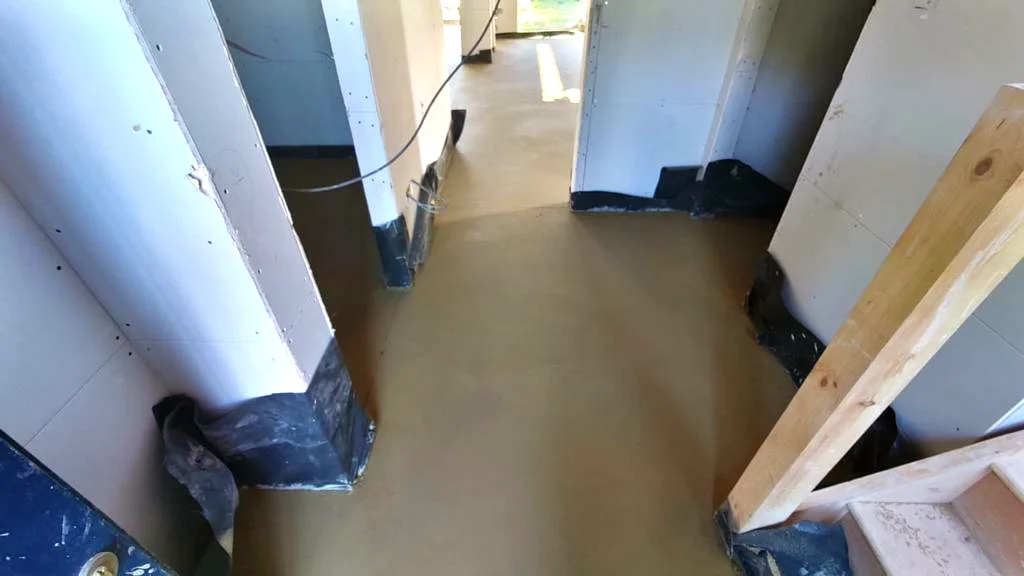
K & B Screeding’s own team, led by director Donatas Bardisevicius. Founded 2019, company 12298780.
See what customers say in our Google reviews and on our testimonials page.
Sand and Cement Screed from Slough to Snodland
As the crow flies, our yard in Slough is about 49 miles from Snodland, which lies to the east-south-east. Postcodes here include ME6, ME19 and ME20, and Rochester (4.9 miles), Maidstone (5.2 miles), Chatham (5.2 miles) and Gillingham (6.5 miles) are close by.
More on sand & cement screed, part of our screeding services.
