
Rebuilding New Brompton ground floors with a membrane
When a kitchen or extension goes into an older New Brompton terrace, the ground floor is often the first problem. Without a damp proof membrane, moisture rises through the old slab into the new finish, and the only lasting fix is to take the floor out and build it again.
There is a fixed sequence to it. First the old slab is broken up and carried out; then the ground is excavated to suit the new layers, with a compacted sub-base and slab put in if needed. A membrane comes next, then insulation, then the screed. Breaking out and clearing the old floor fall under our floor preparation work.
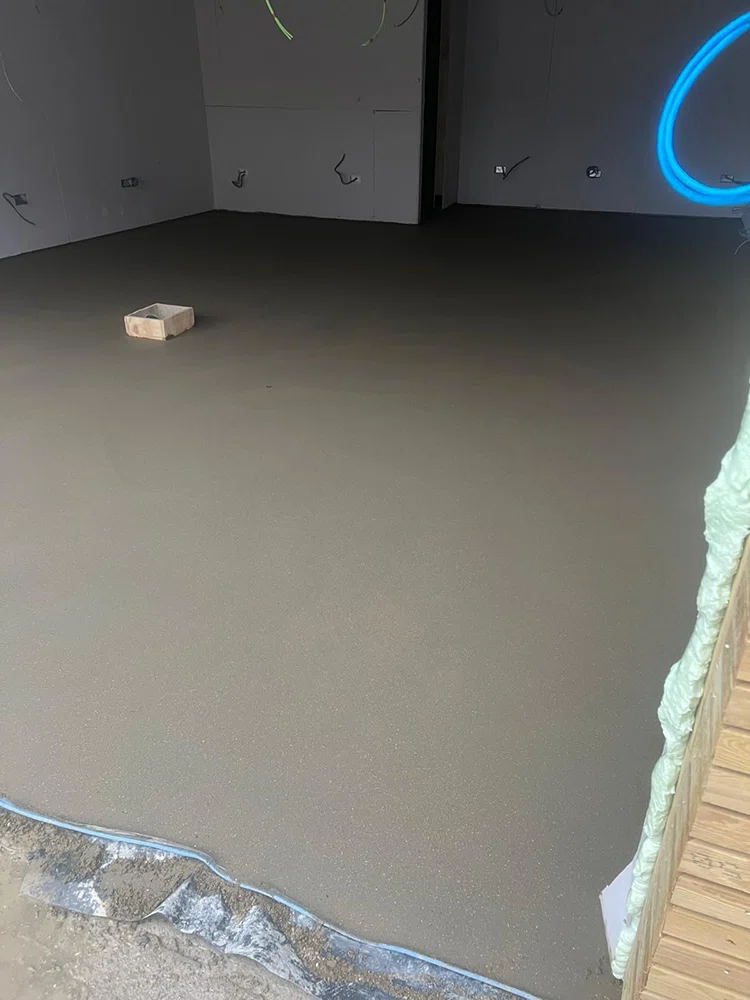
Sand and cement suits this job because it can be laid to whatever depth each room needs. A floating screed over insulation in a house is about 65mm, and a terrace often has a hall, a back room and a kitchen at slightly different levels. The screed is mixed on site, spread and compacted by hand, then finished flat, room by room.
Not every older floor has to come out. Homes built between 1919 and 1944 make up 14% of Gillingham's stock, and where a slab of any age is sound but its surface is breaking up, a thinner bonded screed of 25 to 40mm, bonded to the concrete below, can sometimes be enough and saves digging out the whole floor.
Crumbling screeds, garages and wet rooms in Gillingham
Older sand and cement screeds do not last forever. Where one has crumbled, there are two usual fixes. A small area can be cut back to sound material and patched through our screed repairs service. Where the damage is widespread, a full relay is sounder, and a fibre reinforced mix adds resistance to cracking for about £1 to £3 per m² more.
Showers and wet rooms take a cement screed, since calcium sulphate does not tolerate floors that may get wet. We lay the screed to a fall towards the drain, so water runs away rather than sitting in corners.
Converting a garage is another job for a hand-laid floor. Garage floors usually sit below the house, so insulation, membrane and screed are stacked up until the new room meets the hall at one height. Our garage conversion floors guide compares the build-up options.
Expect a slower drying time than with liquid screed. At 65mm, sand and cement takes weeks to dry out, heating must stay off for a minimum of 21 days, and no flooring goes down until a moisture test is passed.
Sand and Cement Screed prices in Gillingham
Sand and cement screed: £18 to £25 per m² supplied and laid (MyJobQuote, August 2026), so £450 to £630 for 25 m². MyJobQuote does not say whether these figures include VAT. See our floor screeding cost guide or screed calculator.
Who lays your sand and cement screed in Gillingham
K & B Screeding’s own team, led by director Donatas Bardisevicius. Founded 2019, company 12298780.
See what customers say in our Google reviews and on our testimonials page.
Sand and Cement Screed from Slough to Gillingham
As the crow flies, our yard in Slough is about 54 miles from Gillingham, which lies to the east. Postcodes here include ME8 and ME7, and Chatham (2.5 miles), Rochester (3.5 miles), Snodland (6.5 miles) and Sittingbourne (7.1 miles) are close by.
More on sand & cement screed, part of our screeding services.