
Rebuilding pre-1919 solid floors in Southend-on-Sea
Pre-1919 houses may have solid floors with no damp proof membrane, laid long before modern standards. Over time they can turn damp, crumble or dip, and a new covering on top only hides the problem. Some of the city goes back a long way: Cliff Town was built between 1859 and 1861 behind the clifftop and is now the Clifftown Conservation Area.
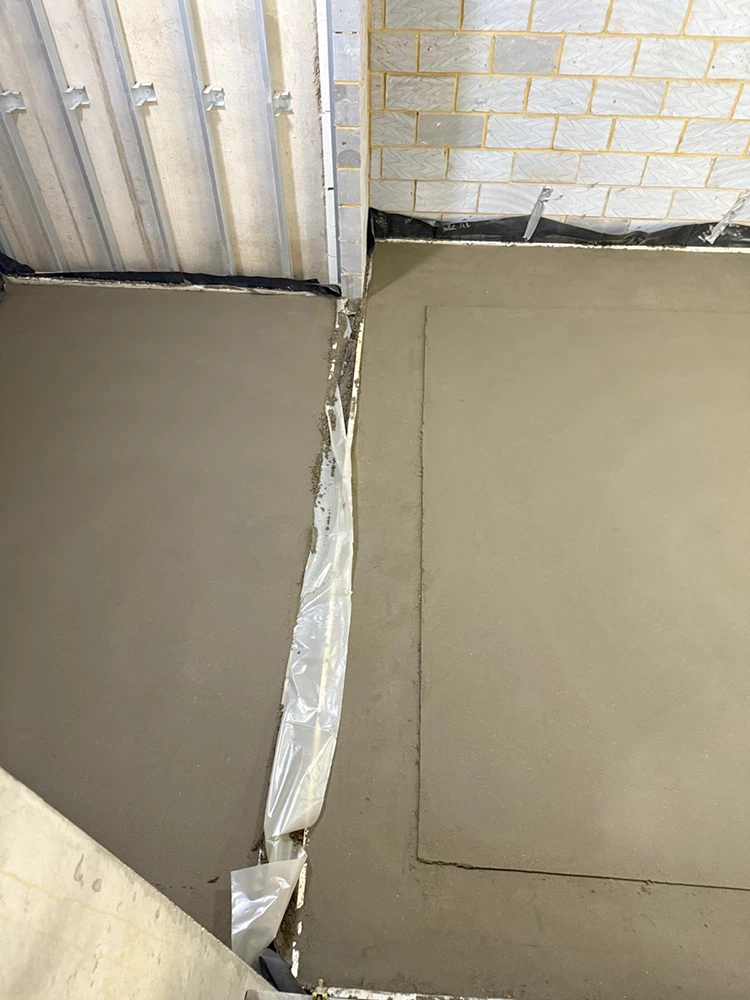
The fix is a rebuild from the ground. We break out and cart away the old floor, prepare the base, lay a membrane with insulation over it, and finish with a fresh sand and cement screed. Hand laying suits rooms like these, where walls may be out of square and the new floor must meet thresholds and neighbouring rooms at their existing heights.
Terraced houses make up 17% of Southend-on-Sea's homes, and on a narrow terrace a traditional screed avoids setting up a pump for a small back room. It is also the natural choice where the rebuilt floor includes a bathroom, because sand and cement tolerates wet areas that calcium sulphate cannot.
Not every old floor needs to come out completely. Where only part has failed, screed repairs may be enough, and a sound slab can sometimes take a thinner bonded screed. For the full sequence of membrane and insulation under a new floor, see insulation and membranes.
Wet rooms, garages and bonded screeds in Southend-on-Sea
Wet rooms and walk-in showers need a screed laid to falls, sloping from the walls to the drain, and it must tolerate moisture over the long term. Sand and cement does both. The fall is formed by hand, then compacted and finished to take tanking and tiles.
Garages are another job for a traditional mix. Turning a garage into a room means lifting its floor, which is normally lower than the house, with insulation, a membrane and a screed until it reaches the new level. Our guide to garage floor screeding takes you through each layer.
Where a slab is sound and flat enough, a bonded screed at 25 to 40mm, fixed directly to the prepared concrete, saves height; published prices for bonded work are £12 to £18 per m² (trade2base, June 2026). Float it on insulation instead and you need about 65mm in a home, or 75mm in commercial space.
The main downside is drying time. At about a day per millimetre for the first 40mm and slower beyond, a thick traditional floor takes weeks longer than a thin liquid one, so the programme should allow for it. Rapid drying additives and fibres can help. If the old floor is sound but uneven, levelling compound in Southend-on-Sea may do instead.
Sand and Cement Screed prices in Southend-on-Sea
Sand and cement screed: £18 to £25 per m² supplied and laid (MyJobQuote, August 2026), so £450 to £630 for 25 m². MyJobQuote does not say whether these figures include VAT. See our floor screeding cost guide or screed calculator.
Who lays your sand and cement screed in Southend-on-Sea
K & B Screeding’s own team, led by director Donatas Bardisevicius. Founded 2019, company 12298780.
See what customers say in our Google reviews and on our testimonials page.
Sand and Cement Screed from Slough to Southend-on-Sea
Southend-on-Sea is about 58.5 miles east of our Slough base as the crow flies, with postcodes including SS1, SS3, SS0 and SS9. The nearest towns to it are Rochford (2.9 miles), Rayleigh (5.6 miles), South Woodham Ferrers (8.2 miles) and Wickford (9.6 miles).
More on sand & cement screed, part of our screeding services.
