
Better Queensway and heated floors in Southend-on-Sea
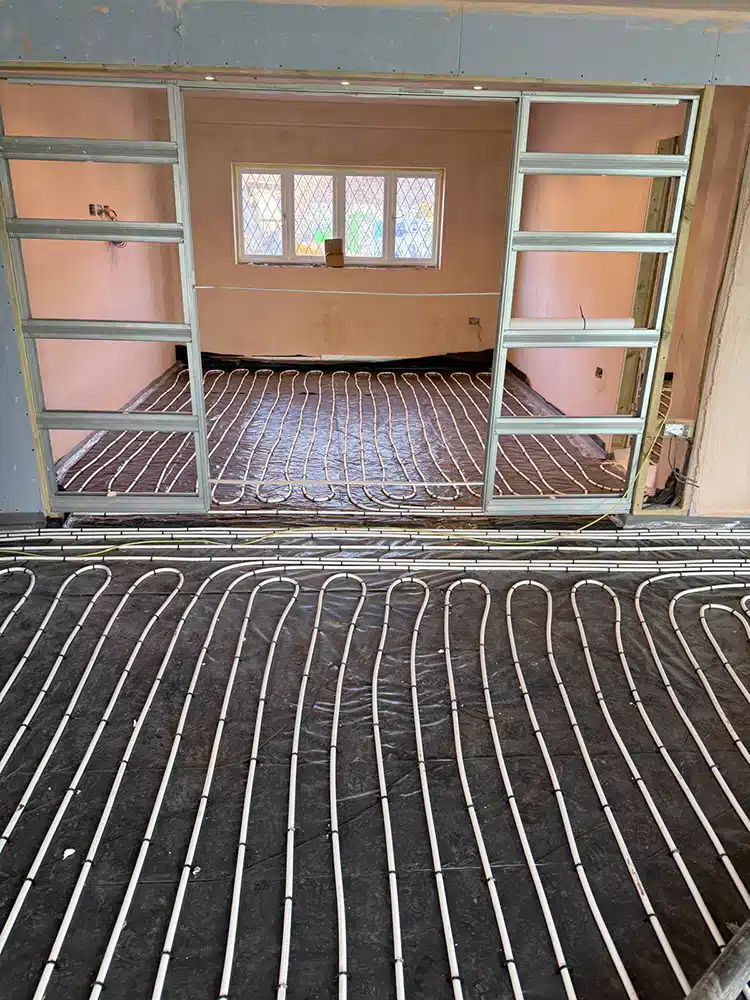
New apartment blocks are built around their heating. On each floor the insulation and membrane go down, the heating contractor fixes and pressure tests the pipes, and the screed follows. With 9% of homes in the city built since 2000, a scheme on the scale of Better Queensway is a notable addition, and its floors will be poured storey by storey as each phase rises.
Over pipes, the screed has one job above all: surround every pipe completely. Air gaps under a pipe become cold spots and weak points. Flowing screed fills beneath and between the pipework with no voids. Over the top it wants 25mm as a minimum, which usually makes the whole layer about 45 to 50mm. A sand and cement screed can also be used, with about 45mm of cover and a thicker overall section that warms more slowly.
The screed also carries the finish. Heated floors often receive tiles, LVT or engineered wood, all of which need a flat, dry base, and the screed layer is where that flatness is set.
The pipes themselves are laid by your heating contractor, not by us. We check that the insulation, membrane and edge strip are correct, pour over the tested system and hand over heat-up guidance. For supply of the layers underneath, see insulation and membranes for heated floors, and for depths in detail, the screed thickness guide.
Retrofitting heating in older Southend-on-Sea houses
Southend-on-Sea's housing leans old. Homes built between 1945 and 1972 account for 24% of the stock, and a larger share is older still, so adding underfloor heating usually means working within an existing floor height. The finished floor must line up with doors, stairs and the rooms next to it, and there is only so much depth for insulation, pipes and screed.
In a pre-1919 house with a solid floor and no membrane, the floor often has to come out anyway, which creates room for a proper heated build-up. In an inter-war or 1950s semi getting a kitchen extension, the heated floor is designed with the extension and set to meet the old kitchen. The thinner cover needed by a liquid screed can make the difference where height is tight.
Timing after the pour is fixed by the material. A calcium sulphate floor can generally have its heating run after a week or so, but sand and cement needs three full weeks first. The first warm-up then begins cool and creeps up over several days. Our drying guide explains why rushing it causes cracks. For extensions, see liquid screed for Southend-on-Sea extensions, or underfloor heating screed in Rayleigh.
Underfloor Heating Screed prices in Southend-on-Sea
Liquid screed over underfloor heating: £20 to £35 per m² supplied and laid (trade2base, June 2026), so £700 to £1,230 for 35 m². trade2base gives these figures excluding VAT. See our floor screeding cost guide or screed calculator.
Who lays your underfloor heating screed in Southend-on-Sea
K & B Screeding’s own team, led by director Donatas Bardisevicius. Founded 2019, company 12298780.
See what customers say in our Google reviews and on our testimonials page.
Underfloor Heating Screed from Slough to Southend-on-Sea
Southend-on-Sea is about 58.5 miles east of our Slough base as the crow flies, with postcodes including SS1, SS3, SS0 and SS9. The nearest towns to it are Rochford (2.9 miles), Rayleigh (5.6 miles), South Woodham Ferrers (8.2 miles) and Wickford (9.6 miles).
More on underfloor heating screed, part of our screeding services.
