
Heated rear extensions on Sittingbourne semis
Homes built between 1945 and 1972 make up 30% of Sittingbourne's housing, and the post-war semi with a rear extension is a typical project here. When the extension is heated, the floor is designed from the slab up: insulation, pipes clipped to it, an edge strip round the walls and then the screed, finished at the same height as the old house.
Pipe cover sets the depth. Poured as liquid, the screed surrounds every pipe with no air gaps and must cover them by at least 25mm, giving a floor of about 45 to 50mm on the semi's extension. Laid in sand and cement, it needs about 45mm over the pipes and so ends up deeper. Heated extensions usually take a liquid screed over the heating because it is thinner, warms faster and spreads heat evenly.
The old house often has no underfloor heating, so the new floor has to meet an existing concrete or timber floor at the join. Planning the heights before the slab is poured avoids a step, and any small difference can be taken out with levelling compound at the join before the finish goes down.
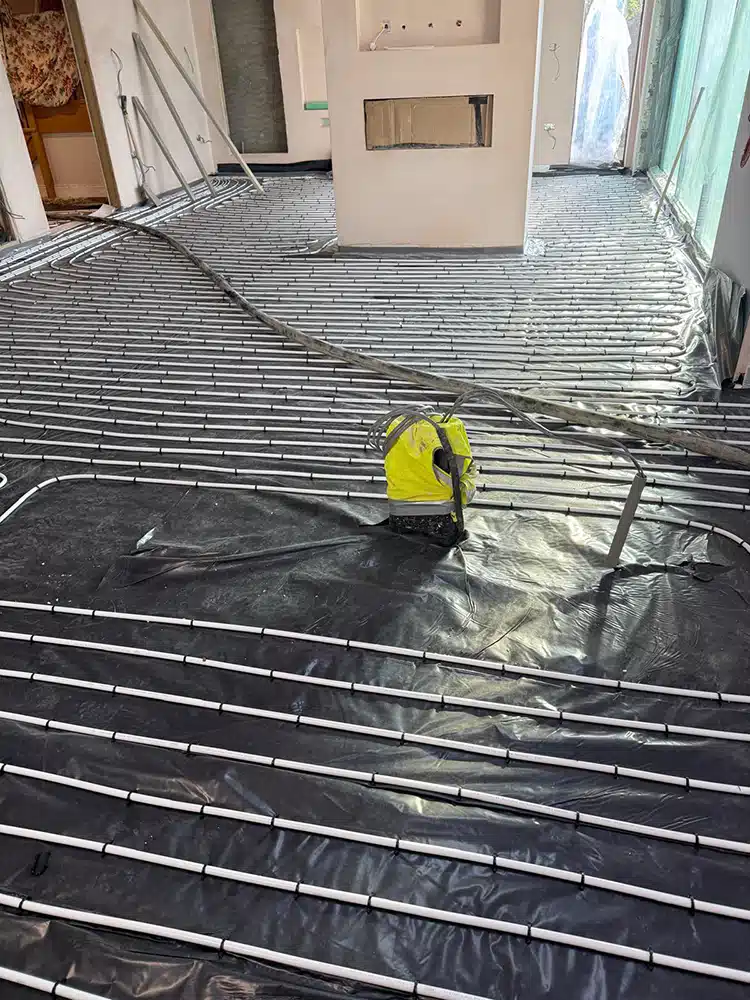
K & B leaves the pipework to the heating trade. Your heating engineer lays and pressure tests them before we arrive, and we check the build-up before pouring: insulation laid tight, membrane taped, edge strip fixed and the pipes held down firmly so they cannot float up as the screed flows around them.
New build heating and first heat-up in Sittingbourne
Newer homes are often heated from the floor from the start. 10% of Sittingbourne's homes were built since 2015, and on plots like these the heating, insulation and screed are planned together, often with a flowing screed; our anhydrite specification page covers the grades developers name.
Whatever the screed, the first heat-up must be slow. Calcium sulphate can normally have the heating run from about day 7 after the pour, and sand and cement after no less than 21 days. After that, the commissioning schedule from the heating engineer raises the temperature in small steps over several days, holds it there, then brings it back down. Turn the thermostat straight up to full and the new extension floor may crack.
Bathrooms and wet areas with underfloor heating need a cement based screed, such as a sand and cement screed in wet rooms, because calcium sulphate is not suited to floors that may get wet.
The floor finish sets the final test. Tiles, LVT and engineered wood over heating all need the screed dry to the flooring maker's limit, checked with a hygrometer, and our guide to screed drying explains why.
Underfloor Heating Screed prices in Sittingbourne
Liquid screed over underfloor heating: £20 to £35 per m² supplied and laid (trade2base, June 2026), so £700 to £1,230 for 35 m². trade2base gives these figures excluding VAT. See our floor screeding cost guide or screed calculator.
Who lays your underfloor heating screed in Sittingbourne
K & B Screeding’s own team, led by director Donatas Bardisevicius. Founded 2019, company 12298780.
See what customers say in our Google reviews and on our testimonials page.
Underfloor Heating Screed from Slough to Sittingbourne
Sittingbourne is about 61.1 miles east of our Slough base as the crow flies, with postcodes including ME10 and ME9. The nearest towns to it are Faversham (7 miles), Gillingham (7.1 miles), Chatham (9.6 miles) and Maidstone (10.4 miles).
More on underfloor heating screed, part of our screeding services.