
Newer estates and extensions across Sittingbourne
Liquid screed earns its place on floors that are wide, open and prepared for it, and Sittingbourne has two common sources of those. Newer houses tend to come with insulated ground floors meant for a flowing screed, sometimes with heating pipes already clipped down, so a pump can lay a whole ground floor in one visit. Older semis, extended at the back, create large kitchen and family rooms where hand laying would take much longer.
Flatness is the main benefit. Pumped, it gets to SR1 or SR2 without much effort, and because it barely shrinks, a Sittingbourne kitchen extension needs far fewer joints than it would in sand and cement. That matters for large format tiles and long runs of LVT, where a joint or a ridge will show.
Flats, 13% of Sittingbourne homes, are another good fit. The hose runs from the pump up the stairwell, and no one has to carry heavy mixed screed up to the flat.
Depth is also lower. Floating in a house it starts at about 35mm, where sand and cement needs about 65mm, and that saving lets a new extension floor run into the original house with no step at the doorway.
Two kinds are on offer, calcium sulphate based and cement based, and the room decides between them. If a grade has been specified, see the calcium sulphate screed page. Our screed cost guide explains what changes the total on a pumped floor.
Pump access on Sittingbourne streets and drives
Every liquid pour starts outside. Our mixer and pump have to stand within hose reach of your door, which the drive of a Sittingbourne semi usually allows. On a terraced street, or a new estate where roads are tight and parking is allocated, the kit may have to stand on the road for a few hours. Mention parking restrictions, estate management rules and any shared access when you send the details.
From there the hose is laid through the house to wherever the pour is. On a new plot the route is usually open; in an occupied house it goes through a hall with floors protected. A long run or an upper floor is not a problem, as long as we know about it in advance.
Preparation decides the result. The insulation has to be laid tight, a membrane taped at every joint, an edge strip fixed around the walls and each doorway dammed. All of that is inspected before pumping starts, and if it is missing, the build-up can come from our insulation and membrane fitters.
Afterwards, allow for drying. You can cross it in a day or two, yet most coverings must wait until the moisture is below the flooring maker's limit, and the first 40mm alone takes about a day per millimetre to get there. The screed drying times guide has the detail.
Liquid Screed prices in Sittingbourne
Liquid screed: £24 to £31 per m² supplied and laid (MyJobQuote, August 2026), so £960 to £1,240 for 40 m². MyJobQuote does not say whether these figures include VAT. See our floor screeding cost guide or screed calculator.
Who lays your liquid screed in Sittingbourne
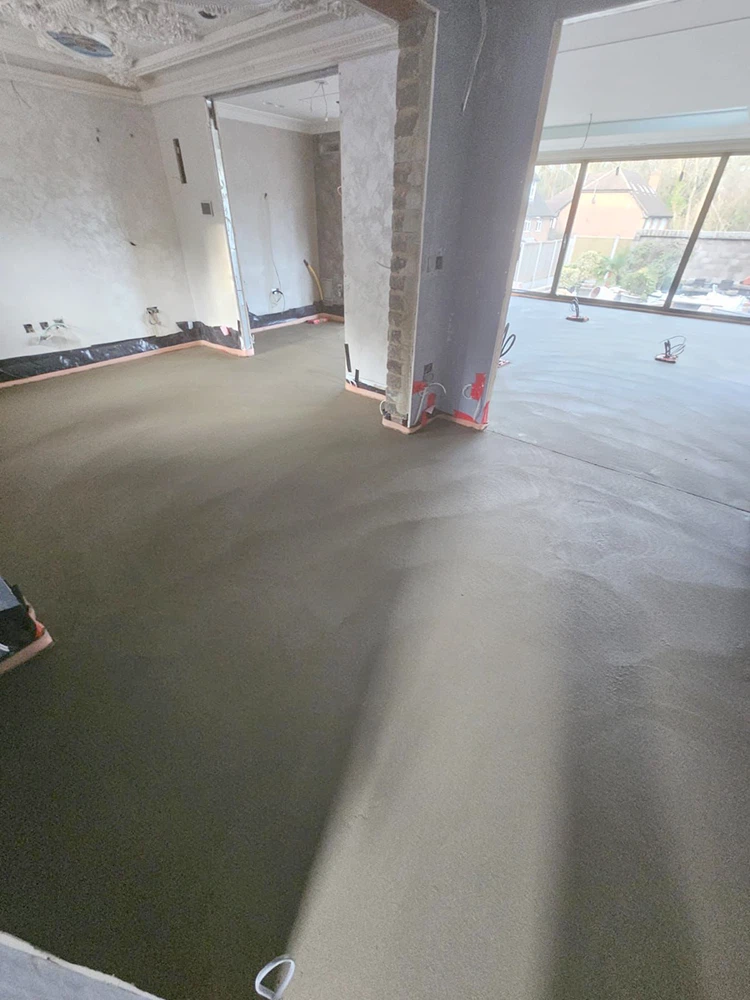
K & B Screeding’s own team, led by director Donatas Bardisevicius. Founded 2019, company 12298780.
See what customers say in our Google reviews and on our testimonials page.
Liquid Screed from Slough to Sittingbourne
Sittingbourne is about 61.1 miles east of our Slough base as the crow flies, with postcodes including ME10 and ME9. The nearest towns to it are Faversham (7 miles), Gillingham (7.1 miles), Chatham (9.6 miles) and Maidstone (10.4 miles).
More on liquid screed, part of our screeding services.
