
Pouring extensions on Southend-on-Sea's inter-war semis
Homes built between 1919 and 1944 account for 25% of the city's housing, and the city also has a large stock of 1950s semis. These houses suit kitchen extensions, often a single-storey addition opened into the existing kitchen. That gives a floor that is broad, open and joined to an older room, the conditions where a pumped screed makes sense.
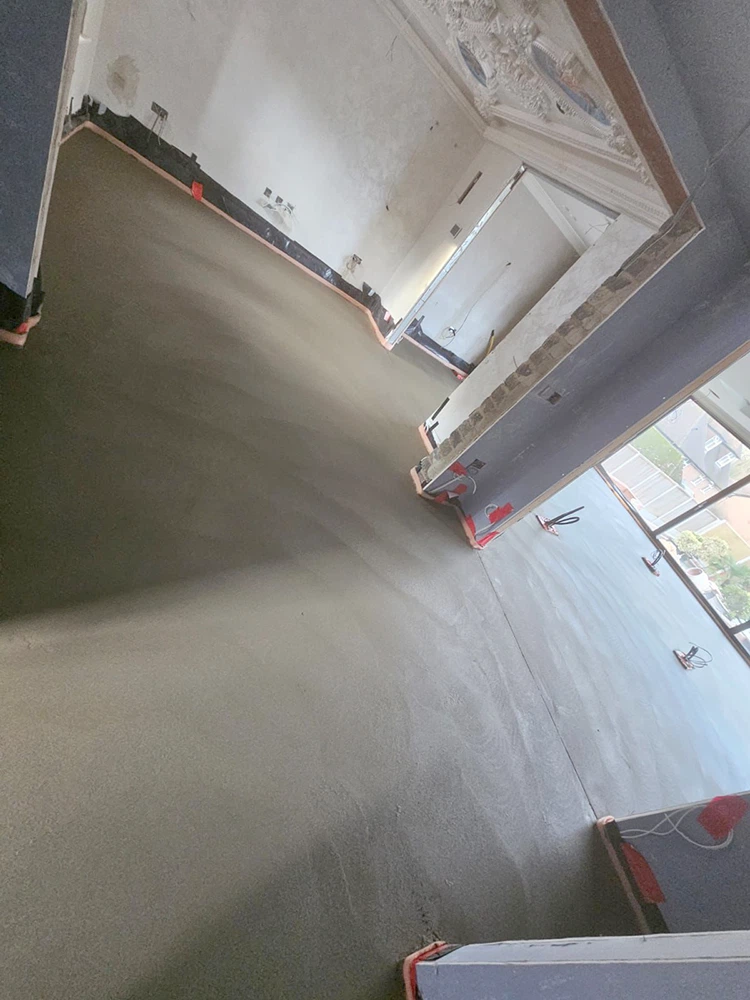
A liquid screed arrives as a fluid from the mixer and is pumped by hose into the room, where it flows out and levels itself. A big floor is done in a day with far fewer joints than hand laying would leave, and it readily reaches SR1 or SR2 for surface regularity, which is good news if large tiles or LVT are planned. Floating over insulation, a domestic liquid screed starts at about 35mm, so the insulation depth is chosen to bring the finished floor level with the old kitchen.
Flats are the other fit. Purpose-built flats make up 20% of homes in Southend-on-Sea, and in a block the hose carries screed up to the floor being worked on without barrows in stairwells.
Liquid screeds are made with calcium sulphate or cement binders, and the choice follows the room: cement based where it may get wet, calcium sulphate for many dry, heated floors. Grades and testing for the calcium sulphate kind are on our Southend-on-Sea anhydrite screed page, and if you are still choosing between pumped and hand-laid, pumped or hand-laid screed compared sets out the differences.
Pump access and drying times across Southend-on-Sea
First, where does the pump go? Normally the mixer and pump sit on the street or your drive, and the hose goes through the house or along a side passage. Terraced streets, parking restrictions and flats above shops all need planning, so tell us the distance from the kerb to the room, any steps or stairs, and the parking rules when you ask for a price. Whether the job is in Eastwood, Southchurch or Westcliff-on-Sea, the questions are the same.
A floor you can walk on can still be wet underneath. Footfall is fine once a day or two has passed. Anything that dislikes damp, though, stays off until the screed has dried out, and drying runs near a day a millimetre through the first 40mm, slower deeper down. If calcium sulphate goes over heating, the system can speed the drying from about 7 days. Screed drying times, stage by stage has the detail.
We pump our own screeds and do not hire out pumps or machines; screed pumping explains how a pour day runs. Rochford, about 3 miles away, has its own Rochford liquid screed page.
Liquid Screed prices in Southend-on-Sea
Liquid screed: £24 to £31 per m² supplied and laid (MyJobQuote, August 2026), so £960 to £1,240 for 40 m². MyJobQuote does not say whether these figures include VAT. See our floor screeding cost guide or screed calculator.
Who lays your liquid screed in Southend-on-Sea
K & B Screeding’s own team, led by director Donatas Bardisevicius. Founded 2019, company 12298780.
See what customers say in our Google reviews and on our testimonials page.
Liquid Screed from Slough to Southend-on-Sea
Southend-on-Sea is about 58.5 miles east of our Slough base as the crow flies, with postcodes including SS1, SS3, SS0 and SS9. The nearest towns to it are Rochford (2.9 miles), Rayleigh (5.6 miles), South Woodham Ferrers (8.2 miles) and Wickford (9.6 miles).
More on liquid screed, part of our screeding services.