
CA grades on Southend-on-Sea apartment floors
Specifiers write calcium sulphate screed as a code, using the system in the European screed standard. The C part tells you how well it resists crushing and the F part how well it resists bending, each in N/mm2. A bedroom with light wear can be CA-C20-F4, a typical flat, home or office floor is CA-C25-F5, and somewhere that takes a pounding gets CA-C30-F6. In a block like those planned at Better Queensway, the engineer picks the grade and that is the grade we pour.
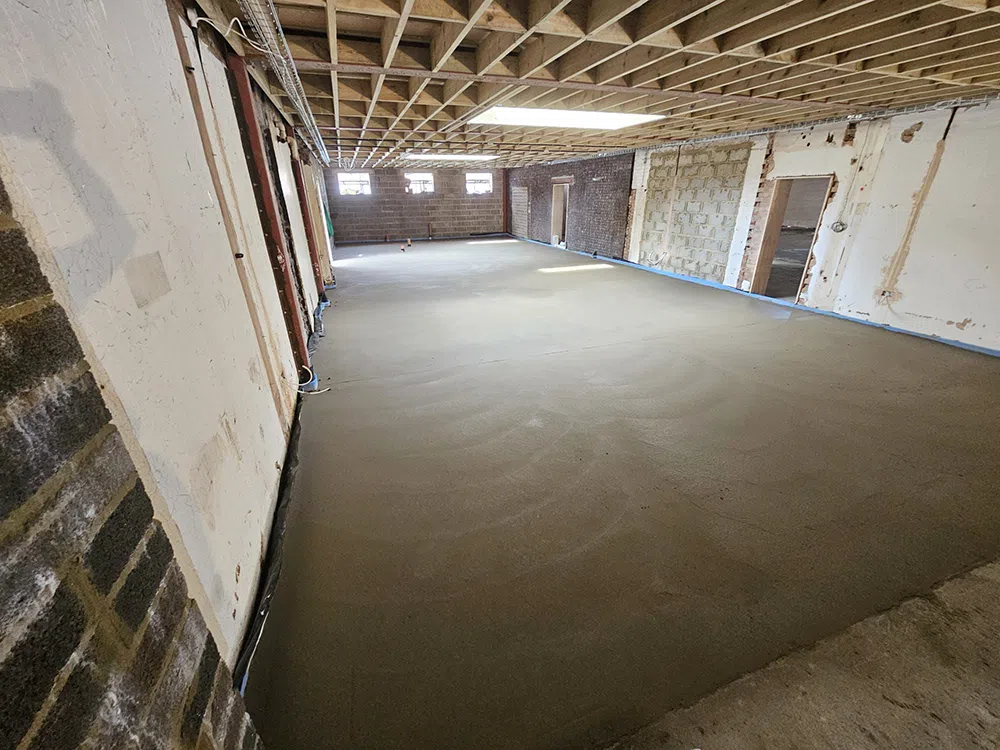
Low shrinkage is why this material suits blocks of flats. Wide bays with few joints are possible, which means a whole apartment floor, insulation and heating pipes included, can be poured in a single visit. Doorways and the borders between heating zones are where joints still go, and the bay layout is agreed before the pump starts. Our own team prepares the edge strip, membrane and perimeter.
When a refurbishment has little floor height to spare, or the floor has to dry sooner, an alpha hemihydrate product may be used instead. Each such product carries its maker's own depth and drying figures, and we work to those figures rather than general anhydrite advice.
Only 4% of Southend-on-Sea's homes date from 2015 or later, so outside new schemes the material is more likely to be specified for an extension or a flat refurbishment than a whole building. For the background on how it behaves, see anhydrite screed explained.
Laitance and moisture checks before Southend-on-Sea flooring
Calcium sulphate forms a surface layer of laitance as it dries, a weak skin that adhesives cannot hold on to. Once the screed has dried sufficiently we sand that skin off, then prime with a product made to work on calcium sulphate, and only after that does levelling compound or adhesive go on.
Testing comes before the flooring. Flooring manufacturers often allow calcium sulphate less moisture than a cement screed, which means a floor can look ready and still be too wet. We use a hygrometer and record the reading, so the flooring contractor has evidence the base is ready. Where an apartment has underfloor heating, turning it on gently in stages from about 7 days can usually speed the drying.
Keep calcium sulphate out of anything that may get wet. For a flat, that rules out the shower room or wet room, where a flowing cement screed goes in, or a hand-laid sand and cement floor shaped to fall to the drain. Where a finished anhydrite floor needs a smoother surface for thin vinyl, floor levelling in Southend-on-Sea follows the priming stage.
Anhydrite & Flow Screed prices in Southend-on-Sea
Liquid flowing screed (which includes anhydrite): £24 to £31 per m² supplied and laid (MyJobQuote, August 2026), so £960 to £1,240 for 40 m². MyJobQuote does not say whether these figures include VAT. See our floor screeding cost guide or screed calculator.
Who lays your anhydrite and flow screed in Southend-on-Sea
K & B Screeding’s own team, led by director Donatas Bardisevicius. Founded 2019, company 12298780.
See what customers say in our Google reviews and on our testimonials page.
Anhydrite & Flow Screed from Slough to Southend-on-Sea
Southend-on-Sea is about 58.5 miles east of our Slough base as the crow flies, with postcodes including SS1, SS3, SS0 and SS9. The nearest towns to it are Rochford (2.9 miles), Rayleigh (5.6 miles), South Woodham Ferrers (8.2 miles) and Wickford (9.6 miles).
More on anhydrite screed, part of our screeding services.
