
Reading a calcium sulphate specification for Basildon flats
A specification for flow screed normally names a grade, such as CA-C25-F5. CA tells you the binder is calcium sulphate. The figures after C and F give its strength in N/mm2, compressive then flexural, as set by the European screed standard. For a lightly used domestic floor, CA-C20-F4 is enough. Most houses, flats and offices get CA-C25-F5, and heavier use steps up to CA-C30-F6.
Alpha hemihydrate screeds sit in their own group. Specifiers pick them when the floor must dry quicker or be thinner, and each one follows its maker's product sheet, not the general guidance.
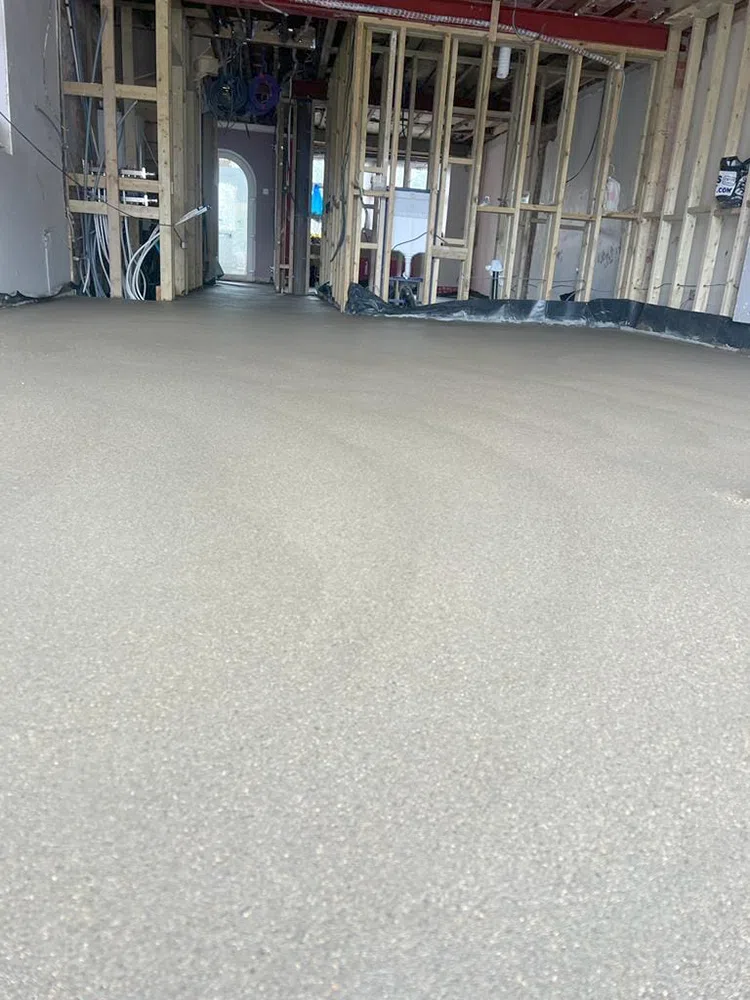
In a Basildon block being refurbished, the screed may float on an acoustic layer to cut sound passing between flats. Calcium sulphate has practical advantages here. Low shrinkage lets us pour big bays with few joints, and the material settles flat and dense over the resilient layer with no compacting. Bays and joints for the block are worked out in advance, and the build-up underneath is laid by our own team.
New build plots are the other setting where a calcium sulphate grade is often specified, with many homes poured to the same drawing. Basildon has seen rebuilding as well as refurbishment: Craylands has been rebuilt as Beechwood Village. Either way, the product on the delivery ticket should match the grade on the drawing, and we check that it does.
For pumping and access, the liquid screed page for Basildon covers that side. There is more on the material itself in our guide to anhydrite screed.
Laitance, moisture and wet areas in Basildon
Calcium sulphate screed needs more care after the pour than a cement screed. Drying leaves a thin, weak skin on top, known as laitance. Unless that skin is sanded away after drying, adhesive and compound will not grip properly. Priming follows, using a primer designed for calcium sulphate rather than one meant for cement.
Moisture is the next step. Flooring makers often allow less moisture in calcium sulphate than in cement, so a figure that clears tiles on cement may not clear them on anhydrite. A hygrometer test is the usual check, and the covering's own data sheet has the final say. In a flat with heating pipes in the floor, the system can normally be run from about day 7 to force dry it.
The material also has a limit. Keep it out of rooms that may see water on the floor, like a shower area or wet room in a Basildon flat. Those spaces need a flowing screed with a cement binder instead, or, for a small area laid to falls, hand-laid sand and cement. If a finished anhydrite floor is uneven after sanding, floor levelling in Basildon covers the compound and primer that go on top.
Anhydrite & Flow Screed prices in Basildon
Liquid flowing screed (which includes anhydrite): £24 to £31 per m² supplied and laid (MyJobQuote, August 2026), so £960 to £1,240 for 40 m². MyJobQuote does not say whether these figures include VAT. See our floor screeding cost guide or screed calculator.
Who lays your anhydrite and flow screed in Basildon
K & B Screeding’s own team, led by director Donatas Bardisevicius. Founded 2019, company 12298780.
See what customers say in our Google reviews and on our testimonials page.
Anhydrite & Flow Screed from Slough to Basildon
On the map, Basildon sits east of Slough, about 47.4 miles from our base in a straight line (postcodes including SS14, SS13, SS16 and SS15), next to Stanford-le-Hope (3.1 miles), Billericay (4 miles), Wickford (4.2 miles) and Rayleigh (6.7 miles).
More on anhydrite screed, part of our screeding services.
