
Anhydrite specifications for Rayleigh new builds and flats
Anhydrite, the usual trade name for calcium sulphate screed, is bought by grade. The code on a Land North of London Road drawing gives two strengths in N/mm2: C for compressive and F for flexural.
Most buildings use one of three. CA-C20-F4 is for domestic floors with light use. CA-C25-F5 is the everyday choice for most homes, flats and offices. Floors with harder wear are specified as CA-C30-F6. The developer's engineer picks the grade for each plot, and we pour exactly that, with no swaps.
A Land North of London Road drawing could instead call up an alpha hemihydrate screed where the designer wants quicker drying or a thinner pour. That product's data sheet then governs how deep it goes and how long it takes to dry.
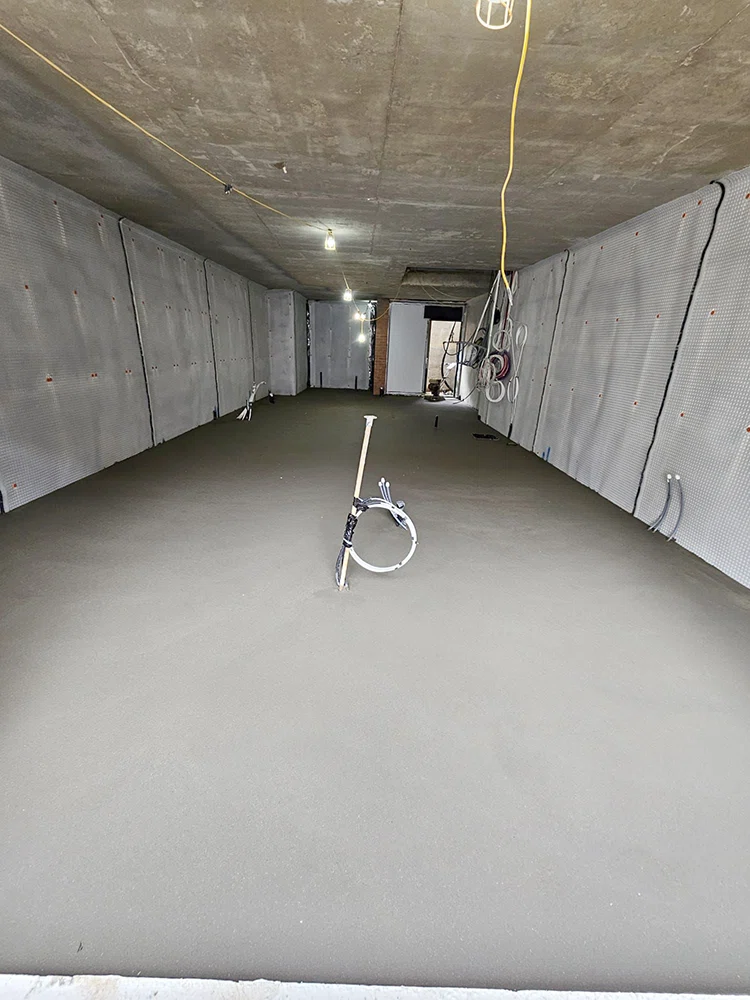
Why specify it at all? It barely shrinks as it sets, which lets a Rayleigh flat or new house floor go down in wide bays with only a handful of joints. That suits apartment floors, where a whole level can go down in one visit over acoustic or thermal insulation, and open-plan ground floors in new houses. If a threshold or a change of heating zone calls for a joint, the layout is drawn up ahead of the pour, and the layers beneath are laid by our own team.
Bathrooms with walk-in showers and other rooms that may get wet should not have calcium sulphate at all. Those rooms take a cement flowing screed instead, or a hand-packed cement floor if the room is small. Our anhydrite screed guide has more on how it behaves.
Preparing Rayleigh anhydrite floors for flooring
On a Rayleigh new build, getting the screed in is just the start. While an anhydrite floor dries, a soft, weak film called laitance rises to its surface. Lay adhesive or compound straight onto that film and the finish grips the film rather than the floor, so it has to go first. When the screed is dry enough, the film is sanded off and the floor sealed with a calcium sulphate primer. Ordinary primers for cement are not always suitable.
Moisture is where anhydrite catches people out. A cement screed and an anhydrite one can give the same reading, yet only the cement floor may be ready for timber or LVT, because suppliers usually set a lower moisture limit for calcium sulphate. We measure it with a hygrometer and leave written notes on drying and laitance for the Rayleigh plot.
Where the floor is heated, drying can be speeded up. Once about 7 days have passed, the heating can usually help dry the floor, turned up a little at a time. On a Rayleigh new build with a fixed handover date, that is often what makes the programme work. Nearby, the same specification rules apply to anhydrite screed in Basildon.
Anhydrite & Flow Screed prices in Rayleigh
Liquid flowing screed (which includes anhydrite): £24 to £31 per m² supplied and laid (MyJobQuote, August 2026), so £960 to £1,240 for 40 m². MyJobQuote does not say whether these figures include VAT. See our floor screeding cost guide or screed calculator.
Who lays your anhydrite and flow screed in Rayleigh
K & B Screeding’s own team, led by director Donatas Bardisevicius. Founded 2019, company 12298780.
See what customers say in our Google reviews and on our testimonials page.
Anhydrite & Flow Screed from Slough to Rayleigh
As the crow flies, our yard in Slough is about 54 miles from Rayleigh, which lies to the east. Postcodes here include SS6, and South Woodham Ferrers (4.1 miles), Wickford (4.1 miles), Rochford (4.4 miles) and Southend-on-Sea (5.6 miles) are close by.
More on anhydrite screed, part of our screeding services.
