
Grades and products for Stanford-le-Hope specifications
Specifications for calcium sulphate screed use a code from the European standard covering screed materials. C stands for how much load it takes in compression and F for its strength in bending, with both numbers in N/mm2. For a house floor that sees light use, CA-C20-F4 does the job. In an ordinary house, flat or office, the grade poured is CA-C25-F5. Floors taking more punishment get CA-C30-F6. When an architect or engineer has written a grade on the drawings, that is what gets poured, and we do not swap it for something else.
There are also alpha hemihydrate products. Specifiers pick them when a quicker dry or a thinner layer is needed, as in a flat refurbishment with no spare height. Their depth limits and drying times are set by the manufacturer's own sheet, and we stick to whatever it says.
Specifiers like the material for its low shrinkage. There is very little movement while it cures, which lets big areas go down with hardly any joints, a good match for open-plan flats and broad ground floors in new homes. Doorways and the boundaries between heating zones on separate controls still need joints, and we mark those out ahead of pouring.
Only 3% of homes in the town date from 2000 to 2014, so in Stanford-le-Hope the material is as likely to go into a single new-build plot or a flat refurbishment as into a large scheme. There is more about the material's behaviour in what anhydrite screed is and does.
Laitance, primers and moisture in Stanford-le-Hope flats
While it dries, this screed grows a fragile surface film known as laitance. Adhesive laid over it grips the skin rather than the screed, and the floor finish can lift months later. Once drying has gone far enough, we sand the film off and seal the floor with a calcium sulphate primer. A primer meant only for cement is the wrong choice.
Moisture is the second trap. Flooring manufacturers are often stricter about moisture on anhydrite than on cement screed, and a figure good enough for tiling on cement may fail here. A hygrometer test settles it. If the floor has heating pipes in it, running the heating can normally start drying it from about day 7, which brings the date forward.
Water is the one thing the material does not tolerate. So where the plan includes a wet room, a utility room prone to leaks or a walk-in shower, the floor there should be a flowing screed made with cement or a hand-trowelled sand and cement floor. In a flat, that often means two materials on one floor, divided at the bathroom door. For the wider choice of pumped screeds and how the pump reaches the room, see liquid screed in Stanford-le-Hope.
Anhydrite & Flow Screed prices in Stanford-le-Hope
Liquid flowing screed (which includes anhydrite): £24 to £31 per m² supplied and laid (MyJobQuote, August 2026), so £960 to £1,240 for 40 m². MyJobQuote does not say whether these figures include VAT. See our floor screeding cost guide or screed calculator.
Who lays your anhydrite and flow screed in Stanford-le-Hope
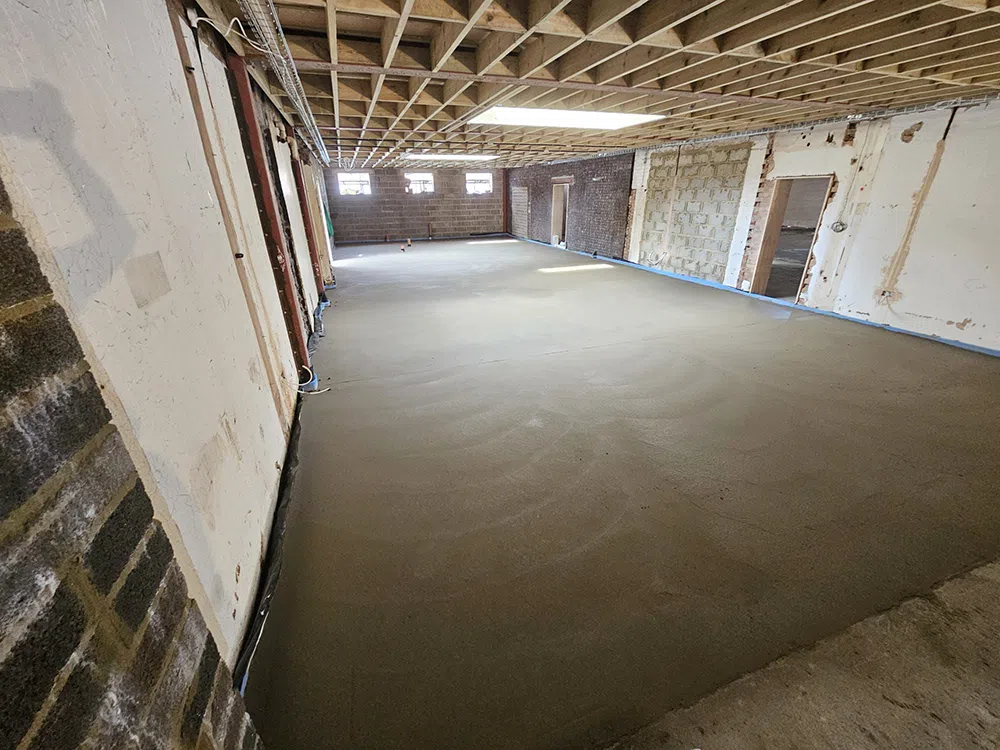
K & B Screeding’s own team, led by director Donatas Bardisevicius. Founded 2019, company 12298780.
See what customers say in our Google reviews and on our testimonials page.
Anhydrite & Flow Screed from Slough to Stanford-le-Hope
Stanford-le-Hope is about 47.2 miles east of our Slough base as the crow flies, with postcodes including SS17. The nearest towns to it are Basildon (3.1 miles), Tilbury (5.7 miles), Grays (6.2 miles) and Gravesend (6.7 miles).
More on anhydrite screed, part of our screeding services.
