
What latex screed does on Stanford-le-Hope refits
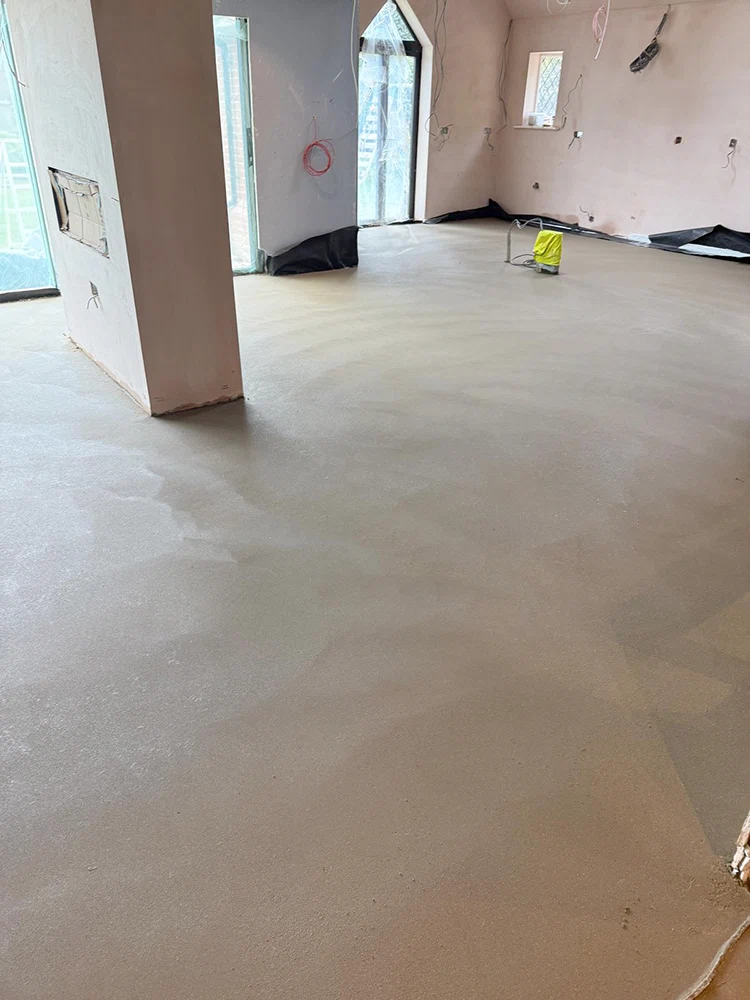
Latex screed is the flooring trade's name for a compound supplied in two parts. One is a cement based powder; the other is a latex liquid, which goes into the bucket in place of water. It is spread thin, normally a few millimetres, and its job is to make a sound base smooth rather than to build a new one.
That fits the refits now under way in Stanford-le-Hope's older housing. The homes that went up between Corringham Road and Billet Lane from the late 1920s are close to a century old, and stripping out a kitchen or bathroom in a house of that age may not uncover a clean slab. There can be quarry tiles, an earlier ceramic floor or concrete patched by several owners. If those old tiles are still firmly bonded, latex can go over them once they are degreased and primed, which spares the mess of chiselling them up.
Timber floors take an extra step. Latex never goes straight onto bare floorboards, because boards move and leave gaps. They are screwed down and overboarded with flooring grade plywood first, and the latex then hides the sheet joints and screw heads so none of them shows through a thin finish.
Semi-detached houses make up 47% of homes in the town, so a typical latex job here is a single kitchen, utility or cloakroom in a semi rather than a whole floor of a block.
When latex is wrong for a Stanford-le-Hope floor
Latex smooths. It does not repair, dry out or stiffen anything, so the base gets checked before any is mixed.
Damp comes first. An older solid floor with no reliable membrane can push moisture up into a new finish, and a skin of latex will not stop it. We test suspect floors, and where damp is coming through, the floor needs proper treatment or a rebuild with a new sand and cement floor laid over a membrane.
Next comes movement. Boards that bounce underfoot will crack a thin layer, whatever plywood is put on top. Loose boards are fixed and the joists checked before overboarding goes ahead.
Then level. An old floor that has sunk at one side or dips across the middle is a different problem from a rough surface. A few millimetres of latex cannot correct a fall across a room. Where the problem is wider than a skim can deal with, the answer is a deeper self levelling compound or new screed, with latex only where the base is otherwise sound.
Priming is the last check. Every base gets the primer that suits it, and a calcium sulphate screed always has its laitance removed and is primed before latex touches it. Old adhesive can stay only if it is thin, hard and well stuck; soft or flaky residue is ground off, which is covered on our concrete floor grinding page for Stanford-le-Hope.
How we price latex screed in Stanford-le-Hope
A fixed written price within 24 hours, once we know the area and the base. See our floor screeding cost guide.
Who lays your latex screed in Stanford-le-Hope
K & B Screeding’s own team, led by director Donatas Bardisevicius. Founded 2019, company 12298780.
See what customers say in our Google reviews and on our testimonials page.
Latex Screed from Slough to Stanford-le-Hope
Stanford-le-Hope is about 47.2 miles east of our Slough base as the crow flies, with postcodes including SS17. The nearest towns to it are Basildon (3.1 miles), Tilbury (5.7 miles), Grays (6.2 miles) and Gravesend (6.7 miles).
More on latex screed, part of our screeding services.
