
Latex over mixed bases in Rochester refits
Stir a cement based smoothing powder into water and you get an ordinary levelling compound. Stir the same kind of powder into the latex liquid packed with it and you get what the trade calls latex screed. That liquid makes the set layer slightly flexible and improves its grip on dense or smooth surfaces, which is why it is chosen for difficult bases rather than clean new screed.
Refits are where it earns its keep. Lift the old flooring in a Rochester kitchen and you may find quarry tiles in one corner, a concrete patch where a wall came out, and a skin of old adhesive elsewhere. Lift a bathroom floor upstairs and you will usually find timber. Each of those can take latex, provided it is firm and properly prepared.
Timber always needs a step in between. Floorboards are not a base for latex, because they move and their joints open. They are fixed down and overboarded with flooring grade plywood, and the latex is spread over the plywood.
The layer stays thin, typically a few millimetres. That is enough to lose grout lines, board joints and small hollows, and to stop them printing through a thin finish. Sheet vinyl, LVT, safety flooring, lino and rubber benefit most, because they hide nothing. If the whole floor is out of level rather than just rough, that is a different job, described on the Rochester floor levelling page.
Checking the base first, from Borstal to Wainscott
Whether the room is in Borstal, Troy Town, Frindsbury, Wainscott or The Delce, the base is tested before any latex is mixed. Three things rule it out until they are dealt with.
A floor that flexes is the first. Springy boards crack a thin layer at every joint, so loose boards and weak joists are fixed and the floor overboarded first.
Rising moisture is the second. In a pre-1919 Rochester house the ground floor may have been laid with no damp proof membrane at all, and latex does nothing to hold back water rising through it. Vinyl or LVT laid on top will lift. A floor in that state is rebuilt with a membrane, as covered under replacing an old floor in sand and cement.
A badly uneven floor is the third. Latex smooths, it does not rebuild height, so a deep dip needs filling or a new screed before the latex finish.
Once the base passes, primer comes next, and it has to match the surface. Plywood, glazed tile, concrete and old adhesive each need their own, and a calcium sulphate screed must be sanded free of laitance and primed with a compatible product. Where stubborn glue or paint has to come off first, our Rochester concrete grinding service clears it. A mile away, we lay latex screed in Chatham too.
How we price latex screed in Rochester
A fixed written price within 24 hours, once we know the area and the base. See our floor screeding cost guide.
Who lays your latex screed in Rochester
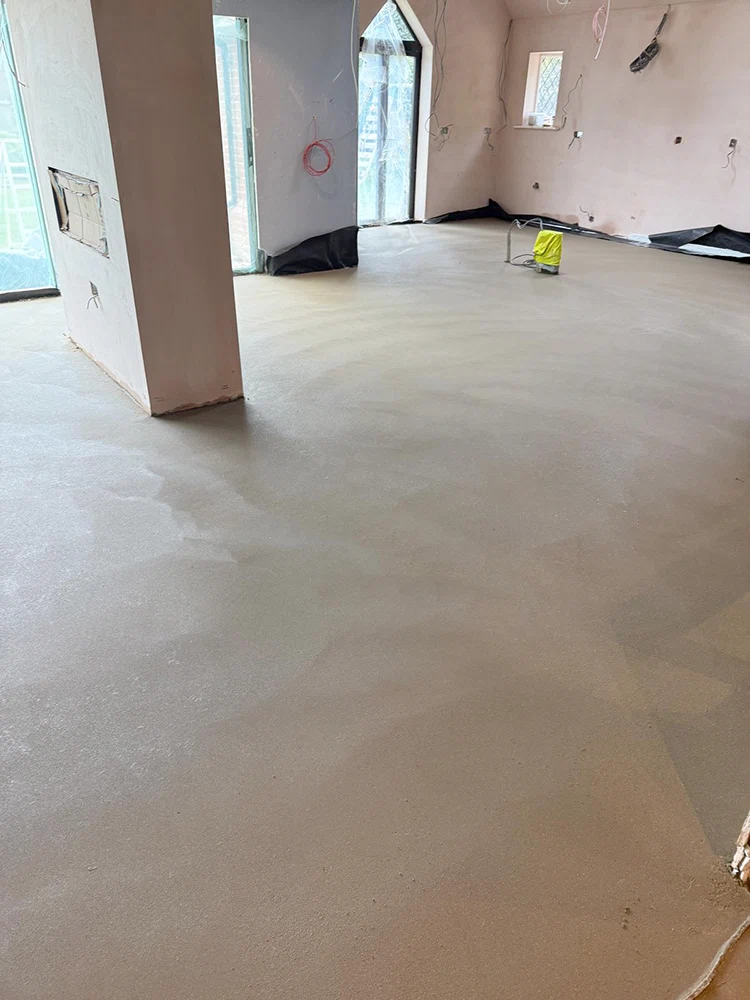
K & B Screeding’s own team, led by director Donatas Bardisevicius. Founded 2019, company 12298780.
See what customers say in our Google reviews and on our testimonials page.
Latex Screed from Slough to Rochester
As the crow flies, our yard in Slough is about 50.6 miles from Rochester, which lies to the east. Postcodes here include ME1, ME2 and ME3, and Chatham (1 miles), Gillingham (3.5 miles), Snodland (4.9 miles) and Gravesend (6.9 miles) are close by.
More on latex screed, part of our screeding services.
