
Rebuilding floors without a membrane in older Rochester houses
Damp, lifting tiles and a musty smell under a floor covering are the usual signs that an old solid floor has no membrane. Sealing the surface rarely fixes that, because moisture keeps rising from below. What lasts is taking the old floor out completely and building a new one from the base upwards.
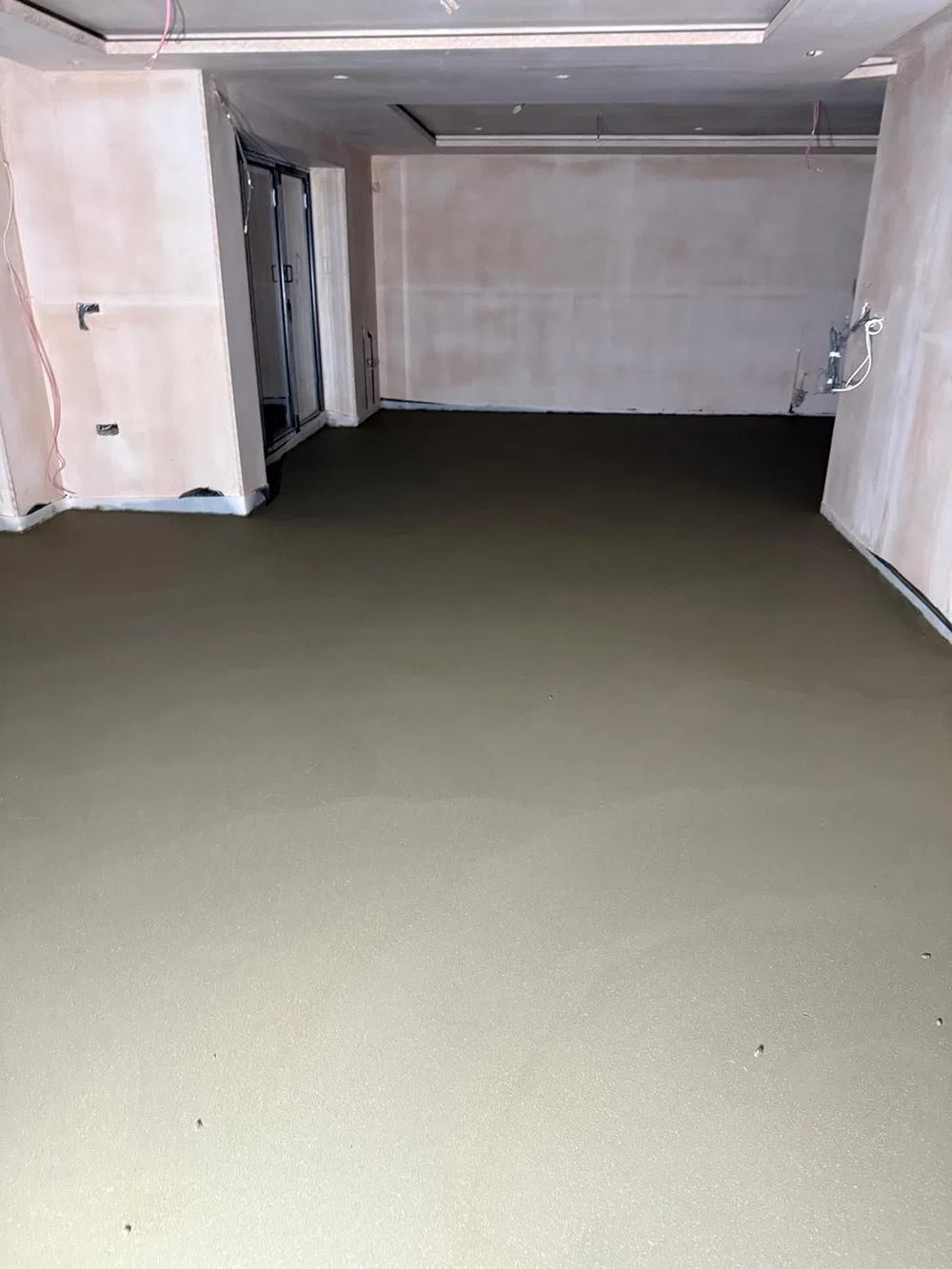
That rebuild follows a set order. First we dig out the old floor and make good whatever lies beneath. Next comes the damp proof membrane, overlapped at the joins and taken up the face of each wall. Insulation follows, then a floating sand and cement screed at 65mm, which is the domestic depth. In commercial space the figure is 75mm.
Each batch is mixed on site for that room's size and depth. It is laid in bays, compacted by hand and finished level, ready for tiles, wood or sheet flooring. Because nothing is pumped, it suits small rooms, narrow halls and houses where the street leaves no room for a truck.
If the slab below is still sound but there is little height to spare, we bond a thinner 25 to 40mm layer straight to the prepared concrete. Our bonded screed service covers that method, which published 2026 figures price at £12 to £18 per m² (trade2base, June 2026).
Homes built between the wars make up 18% of the stock, and their floors can need the same assessment. Its drying clock runs slower than a pumped floor's, at around one millimetre a day through the first 40mm.
Wet rooms, garages and early loads in Strood and Borstal
Whether a house is old or new, certain rooms belong on cement. A wet room needs falls running to its gully, and trowelling the screed by hand gets those falls accurate. Calcium sulphate is not for floors that may stay wet, which leaves sand and cement as the sound choice.
Garage conversions are another use, wherever a house in Strood, Borstal or elsewhere has an integral or attached garage. Garage slabs are generally set a step down from the house floor. Building up insulation, a membrane and screed on top lifts it to match and keeps the new room warm. Every layer of that build is set out in screeding a garage for conversion.
Where a floor has to take weight early, such as a workshop or a kitchen with heavy stone worktops going in, cement screed gives a solid base. Adding fibres costs £1 to £3 per m² and helps stop cracks, and a stronger sand and cement mix can go in where the floor will work harder.
In a hurry? An additive that speeds drying brings the flooring date forward. Nearby, we lay sand and cement screed in Gillingham on the same basis.
Sand and Cement Screed prices in Rochester
Sand and cement screed: £18 to £25 per m² supplied and laid (MyJobQuote, August 2026), so £450 to £630 for 25 m². MyJobQuote does not say whether these figures include VAT. See our floor screeding cost guide or screed calculator.
Who lays your sand and cement screed in Rochester
K & B Screeding’s own team, led by director Donatas Bardisevicius. Founded 2019, company 12298780.
See what customers say in our Google reviews and on our testimonials page.
Sand and Cement Screed from Slough to Rochester
As the crow flies, our yard in Slough is about 50.6 miles from Rochester, which lies to the east. Postcodes here include ME1, ME2 and ME3, and Chatham (1 miles), Gillingham (3.5 miles), Snodland (4.9 miles) and Gravesend (6.9 miles) are close by.
More on sand & cement screed, part of our screeding services.