
Breaking out old solid floors in Gravesend terraces
A renovation in an older Gravesend terrace usually starts below the floor. With no membrane, ground moisture comes up through the old slab into anything laid over it, so the floor has to come out and be rebuilt to last. That first stage is handled by our preparation and break-out service.
The order of work is much the same in every house. Up comes the old floor, then the ground is excavated to the depth required. A sub-base and slab go in if needed, then a membrane, then insulation, then the screed. Floating over insulation, a sand and cement layer is about 65mm thick in houses and about 75mm on commercial floors. The total has to fit under existing thresholds, so we work the numbers out before the digging starts.
Hand-laid screed copes well with what old houses present. Rooms are rarely square, walls lean, and a hall, front room and kitchen may each sit at a slightly different level. Because the mix is made on site in batches, each room can be laid to its own height, compacted by hand and finished flat.
Inter-war homes make up 18% of Gravesend's stock. On the 1920s streets of King's Farm, a kitchen or garden room extension needs its new screed to meet the existing slab at exactly the right height. Sand and cement can be built up and finished by hand to that line, room by room.
Wet rooms, garages and bonded screeds in Gravesend
Water rules out calcium sulphate, so any floor that may get wet needs a cement base. Wet rooms, walk-in showers and utility rooms with a floor drain are laid in sand and cement, with the falls formed by hand towards the outlet so water drains away from the walls.
Garages are a regular conversion. Because the garage slab is normally a step down from the house, it gets insulation, a membrane and screed on top until the converted room runs flush into the hall. Read our garage floor screed article for the full build-up.
Not every floor needs a full rebuild. If the concrete below is sound, a 25 to 40mm bonded screed can be fixed straight onto it once prepared. Published 2026 figures for bonded screed run from £12 to £18 per m² (trade2base, June 2026).
Heavier or busier floors can take a stronger mix. A small workshop or a trade counter needs a surface that stands up to knocks and early loading, and a higher strength screed is designed for that.
The price of all this versatility is time. A 65mm floor laid by hand dries a good deal slower than liquid, and it cannot be heated until 21 days have passed at the earliest.
Sand and Cement Screed prices in Gravesend
Sand and cement screed: £18 to £25 per m² supplied and laid (MyJobQuote, August 2026), so £450 to £630 for 25 m². MyJobQuote does not say whether these figures include VAT. See our floor screeding cost guide or screed calculator.
Who lays your sand and cement screed in Gravesend
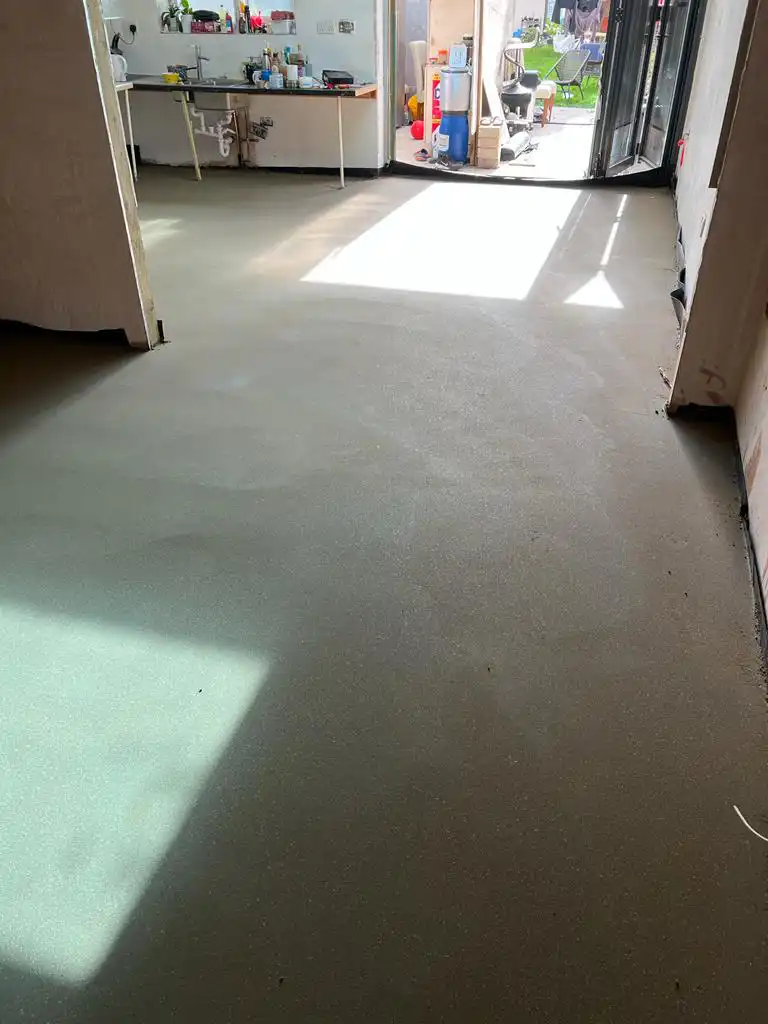
K & B Screeding’s own team, led by director Donatas Bardisevicius. Founded 2019, company 12298780.
See what customers say in our Google reviews and on our testimonials page.
Sand and Cement Screed from Slough to Gravesend
Gravesend is about 44.2 miles east of our Slough base as the crow flies, with postcodes including DA11 and DA12. The nearest towns to it are Northfleet (1 miles), Tilbury (1.3 miles), Grays (3.2 miles) and Swanscombe (3.7 miles).
More on sand & cement screed, part of our screeding services.
