
Relaying worn floors in Tilbury's inter-war and ex-council homes
Some 28% of Tilbury's homes were built between 1919 and 1944, and only 2% before that; the town itself was only created in the late nineteenth century. Where a house of that age has a solid ground floor, it usually has little insulation, and its damp protection may have failed. A kitchen floor in a house of that age has often been patched several times.
When the floor comes up, the choice is between levelling what is there and rebuilding it. If the slab is cracked through, loose or damp, rebuilding is the only lasting option: break it out, lay hardcore and insulation with a membrane, then screed. Sand and cement is the usual screed here for practical reasons. It is mixed on site, so no pump needs to park outside. It can take a different depth in each room. And it can be laid by hand in narrow kitchens and awkward back rooms.
Floated on insulation, the layer is roughly 65mm in a house, going up to 75mm for commercial use. Bond it to solid concrete and 25 to 40mm will do, useful when a Tilbury kitchen floor has to come up level with the hall next to it. Where the base needs cleaning or grinding before a bonded screed, floor preparation comes first. Fibres can be added to resist cracking, as set out under fibre reinforced screed.
Bathrooms, garages and drying in Tilbury houses
Bathrooms and showers are where this material earns its keep. In a wet room the floor slopes to the outlet, and the screeder forms that slope with the trowel as the mix is laid. It also stands up to water better than calcium sulphate, so it is the base to use under a tanked, tiled shower floor.
Garages are another fit. Garage bases normally sit below the level of the house, so converting one means building up insulation and screed until the new room meets the hall floor. The garage conversion screed guide sets out that build-up, including where a membrane goes.
Patience is the cost. A 65mm hand-laid floor dries far more slowly than a thin pumped screed, as the first answer below sets out. If the kitchen fitter is booked soon, an additive that speeds drying can claw back time. On 2026 published rates that costs between £20 and £28 per m², compared with between £18 and £25 for an ordinary mix.
The upside of a hand-laid screed on a small Tilbury job is simplicity: materials arrive by van, the mix is made on site, and the floor is laid, compacted and finished in one visit.
Sand and Cement Screed prices in Tilbury
Sand and cement screed: £18 to £25 per m² supplied and laid (MyJobQuote, August 2026), so £450 to £630 for 25 m². MyJobQuote does not say whether these figures include VAT. See our floor screeding cost guide or screed calculator.
Who lays your sand and cement screed in Tilbury
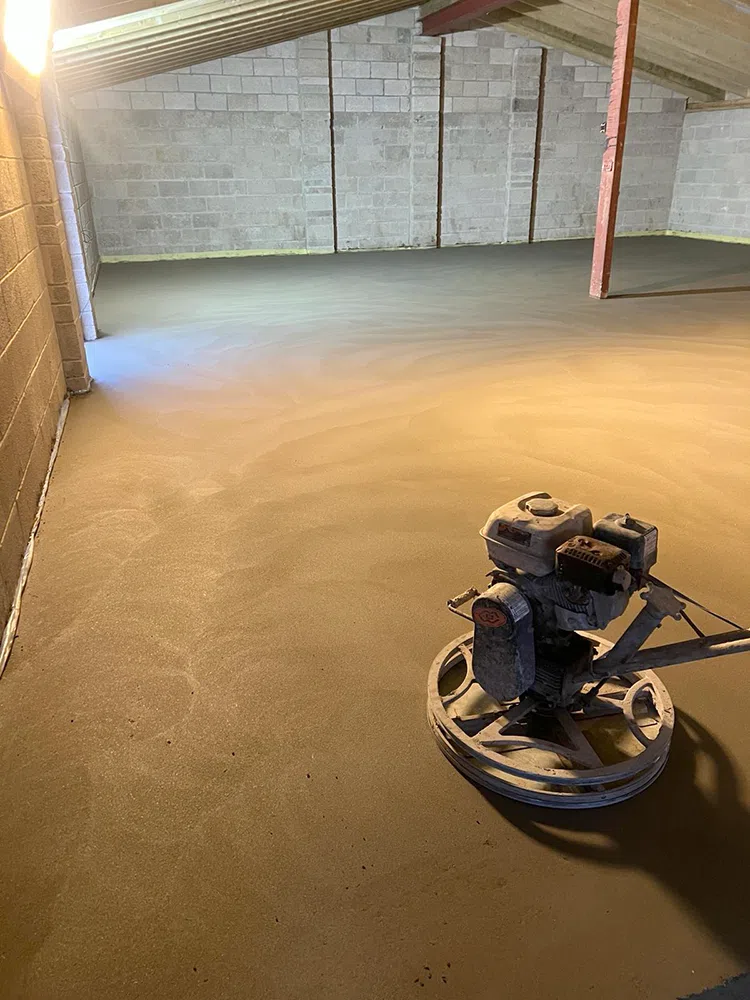
K & B Screeding’s own team, led by director Donatas Bardisevicius. Founded 2019, company 12298780.
See what customers say in our Google reviews and on our testimonials page.
Sand and Cement Screed from Slough to Tilbury
Tilbury is about 43.8 miles east of our Slough base as the crow flies, with postcodes including RM18. The nearest towns to it are Gravesend (1.3 miles), Northfleet (1.7 miles), Grays (2 miles) and Swanscombe (3.5 miles).
More on sand & cement screed, part of our screeding services.
