
Rebuilding cold ground floors in Basildon's post war houses
The first new town house in Basildon was finished in 1951, and building carried on through the following decades. Floors from those years were usually laid as plain concrete with little thought for insulation. Now they feel cold underfoot, and some have cracked or settled. To sort it for good, the old floor comes out and a new one is built up in its place.
That means excavating to the right depth, laying a damp proof membrane and rigid insulation, and finishing with a new screed. Over insulation in a home, a floating hand-laid layer normally needs 65mm at least, and the excavation must be deep enough for that on top of the boards. Our team can supply and lay the membrane and boards as well as the screed, which keeps the whole build-up with one contractor.
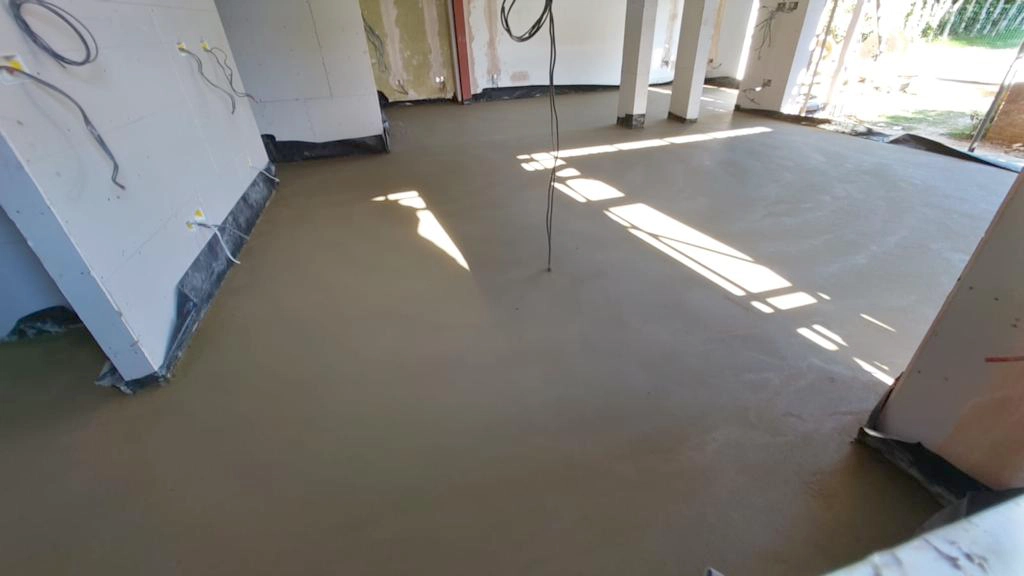
Hand-laying earns its keep on these floors. A ground floor split into a hallway, a cloakroom and a kitchen may need a slightly different level in each. Mixing on site means each area can be laid to its own depth, and a hand-laid screed is easy to form up to a threshold or a step. It is also cement based, so it is the right choice for a bathroom, a utility room or anywhere a floor may get wet.
If only part of the floor has failed, a local screed repair may be enough. Putting heating pipes into the rebuilt floor? See screeding over heating pipes in Basildon for cover depths and the first warm-up.
Wet rooms, garages and falls in Basildon homes
A few rooms call for a cement screed in any Basildon house, old or newer. Take a wet room or a level-access shower: the floor must slope to the drain, and hand-laid sand and cement can be formed to that slope, then tiled when dry. Calcium sulphate screeds are not suitable where water will sit on the floor, so this is where hand-laid screed earns its place.
Garages are another. When a garage becomes a bedroom or office, its floor normally has to come up to the level of the house, with insulation and a membrane under the new screed. The depths for that are set out in our guide to screeding a garage floor.
Bonded or floating is the other decision. A bonded screed of 25 to 40mm is fixed to a sound concrete base and suits a utility floor that only needs building up. A floating screed at 65mm sits on insulation and suits a rebuilt living room. For a larger area, mixing in fibres helps resist cracking and adds £1 to £3 per m²; see fibre reinforced screed.
The trade-off is drying. Hand-laid screed dries slower than a pumped one. Count on about a day for each millimetre up to 40mm, which leaves a 65mm floor weeks away from most coverings. Whether the house is in Pitsea, Fryerns or Great Berry, book the flooring fitter around that drying time, not before it.
Sand and Cement Screed prices in Basildon
Sand and cement screed: £18 to £25 per m² supplied and laid (MyJobQuote, August 2026), so £450 to £630 for 25 m². MyJobQuote does not say whether these figures include VAT. See our floor screeding cost guide or screed calculator.
Who lays your sand and cement screed in Basildon
K & B Screeding’s own team, led by director Donatas Bardisevicius. Founded 2019, company 12298780.
See what customers say in our Google reviews and on our testimonials page.
Sand and Cement Screed from Slough to Basildon
On the map, Basildon sits east of Slough, about 47.4 miles from our base in a straight line (postcodes including SS14, SS13, SS16 and SS15), next to Stanford-le-Hope (3.1 miles), Billericay (4 miles), Wickford (4.2 miles) and Rayleigh (6.7 miles).
More on sand & cement screed, part of our screeding services.
