
Raising garage floors in Wickford conversions
Garage conversions are one of the main uses for sand and cement in Wickford. An attached garage on a family house usually has a bare concrete floor that sits a step below the hallway, with no insulation and often a slope towards the door. Turning it into a bedroom, office or playroom means building that floor up to meet the house.
The build-up follows a set order. First comes a damp-proof membrane over the old concrete. Rigid insulation sits on that, a separating sheet covers the boards, and the floating screed is laid last. For a house that screed is about 65mm thick. Going thinner over insulation risks cracking, so if the height is tight the insulation is usually adjusted, not the screed. Our garage floor screed guide takes you through the stages.
Sand and cement is well suited to this because it is mixed in small batches and laid to exact levels, and the room is often too small and awkward to justify a pump. It also gives a cement base that can take an early load once cured.
Housing age plays a part too. 37% of Wickford's homes were built between 1945 and 1972, and ground floors from that period usually predate modern insulation standards. When one of those floors is being opened up for a new kitchen or a conversion, it is worth checking what is underneath first. How deep each kind of floor needs to be is covered in our guide to screed depths.
Wet rooms and bonded screeds in Wickford homes
Water is the other reason Wickford bathrooms end up with sand and cement. Being cement based, it puts up with wet conditions that would damage a calcium sulphate screed. So when a walk-in shower or full wet room goes into one of the town's post-war houses, we shape the slope to the drain into the screed, giving your tiler an accurate fall to work to.
Not every floor needs a full floating screed. If the old slab is solid and only needs lifting a little, we prepare it, apply a bonding agent and lay a thin bonded layer, 25 to 40mm deep, straight on top. Published 2026 prices for bonded work run from £12 to £18 per m² (trade2base, June 2026).
Terraced houses, 16% of Wickford's homes, tend to have smaller ground floor rooms where a hand-laid screed is often the practical choice. A garage or utility floor that will see hard wear can have fibres mixed in to help resist cracking, adding £1 to £3 per m². Our page on fibre reinforced screed explains when that extra is worth paying for.
The downside for a Wickford homeowner is the wait. At 65mm deep, this floor takes much longer to dry than a thin pumped one, so leave room in your plans before the carpet or tiles go down.
Sand and Cement Screed prices in Wickford
Sand and cement screed: £18 to £25 per m² supplied and laid (MyJobQuote, August 2026), so £450 to £630 for 25 m². MyJobQuote does not say whether these figures include VAT. See our floor screeding cost guide or screed calculator.
Who lays your sand and cement screed in Wickford
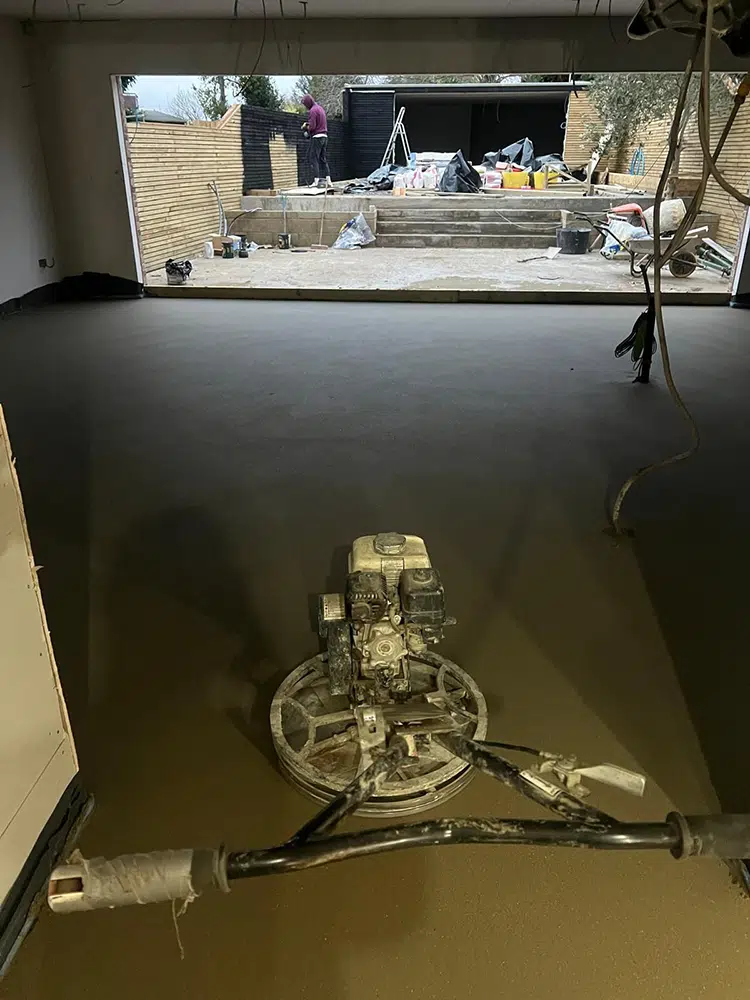
K & B Screeding’s own team, led by director Donatas Bardisevicius. Founded 2019, company 12298780.
See what customers say in our Google reviews and on our testimonials page.
Sand and Cement Screed from Slough to Wickford
As the crow flies, our yard in Slough is about 50.5 miles from Wickford, which lies to the east. Postcodes here include SS12 and SS11, and Rayleigh (4.1 miles), Basildon (4.2 miles), Billericay (4.5 miles) and South Woodham Ferrers (4.9 miles) are close by.
More on sand & cement screed, part of our screeding services.