
Relaying solid floors in Moulsham's older terraces
In Chelmsford, 22% of homes are terraced and 6% were built before 1919. Many of the oldest sit in Moulsham, close to the centre. When one of those houses is renovated, the ground floor is often the part that needs the most work.
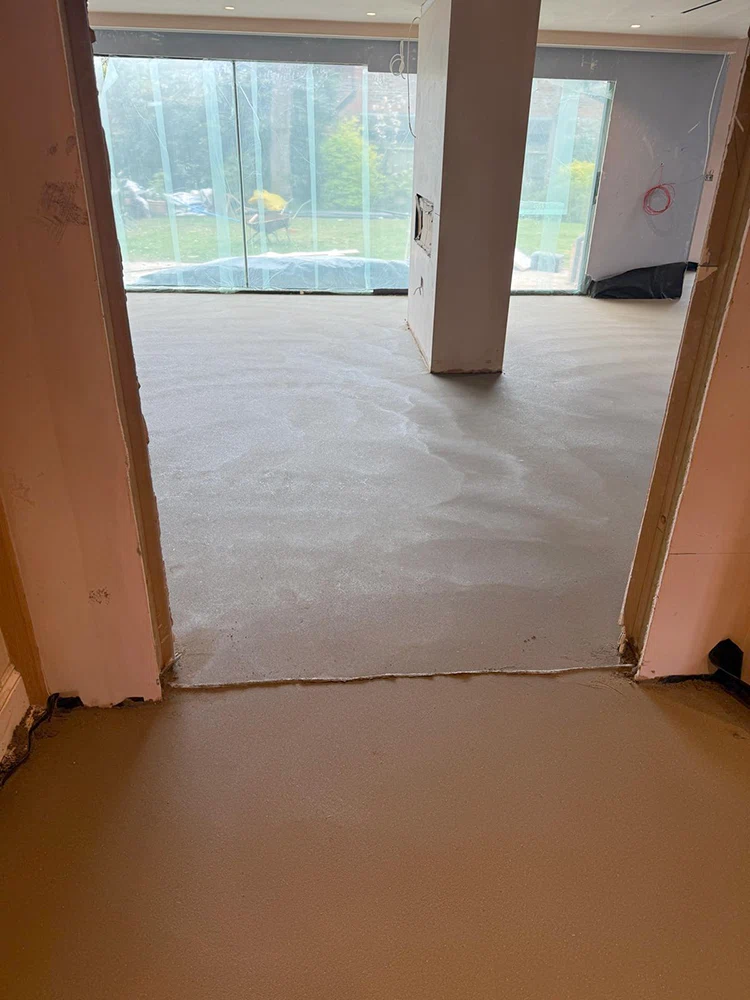
Without a membrane, a solid floor simply wicks ground moisture upwards. Finishes lift, timber rots and the room never feels dry. The fix is to break the old floor out, compact and level the ground, and lay a damp proof membrane with lapped joints turned up the walls. Next comes insulation, then 65mm of floating sand and cement, compacted by hand over the top.
There are plain, practical reasons this material fits a Moulsham renovation. Rooms in houses of this age tend to be smaller and divided, access for a pump may be poor, and work often goes room by room while the house is occupied. It also gives a cement surface that many tile adhesives and finishes need, and it can take early load once cured. Mixing in fibres adds crack resistance and, on published figures, £1 to £3 a square metre.
Depth is sometimes the limiting factor, especially where a floor must line up with original thresholds. How each layer's depth gets decided is explained in our guide to screed depths. Where the old base is being kept and needs cleaning or shot blasting first, see our floor preparation service.
Wet rooms, garages and bonded screeds in Chelmsford
Turn a bathroom into a wet room and the floor must tilt gently towards the drain, a slope we shape by hand. Cement is the binder for that job, since calcium sulphate cannot go anywhere water may sit.
Converting a garage is the next classic case. Its slab usually sits lower than the house and has nothing to keep the cold out, so we lift it with a membrane, insulation and new screed until it lines up. Every layer is listed in our garage conversion screed guide.
If the concrete below is solid and only its surface is worn, bonding 25 to 40mm of screed straight to it keeps the floor shallow. Commercial floors laid floating need 75mm.
The main drawback is time. The usual rule of thumb is one drying day for each millimetre up to 40mm, then slower beyond that, so a 65mm floor is a matter of weeks rather than days. Want it sooner? A fast drying version costs £20 to £28 for each square metre on published 2026 figures, and shortens the wait. The ordinary mix comes in at £18 to £25. For nearby work, see sand and cement screed in Witham.
Sand and Cement Screed prices in Chelmsford
Sand and cement screed: £18 to £25 per m² supplied and laid (MyJobQuote, August 2026), so £450 to £630 for 25 m². MyJobQuote does not say whether these figures include VAT. See our floor screeding cost guide or screed calculator.
Who lays your sand and cement screed in Chelmsford
K & B Screeding’s own team, led by director Donatas Bardisevicius. Founded 2019, company 12298780.
See what customers say in our Google reviews and on our testimonials page.
Sand and Cement Screed from Slough to Chelmsford
Chelmsford is about 50.2 miles east-north-east of our Slough base as the crow flies, with postcodes including CM1, CM3 and CM2. The nearest towns to it are Billericay (8.2 miles), Witham (8.4 miles), Wickford (8.8 miles) and Maldon (8.8 miles).
More on sand & cement screed, part of our screeding services.