
Rebuilding floors near the Market Place and The Causeway
The old streets of Great Dunmow have a long history. The town gained a market charter in 1227, the Old Town Hall dates from 1578, and The Clock House stands on The Causeway. The houses in this part of town often have solid ground floors with no damp proof membrane, which shows up as damp, cold rooms and failing floor finishes.
Putting it right usually means taking the old floor out, laying membrane and insulation, and screeding over them. Sand and cement is laid as a floating screed at least 65mm deep in a house, which gives it the strength to span the insulation. Where a sound concrete base can be kept, a bonded screed of 25 to 40mm is laid straight onto it, saving height at old doorways.
Hand-laid screed has advantages in older rooms. It is mixed to suit each area, so a floor that falls towards the back or meets a step can be handled as it goes down. It can be compacted and floated to a dense, level finish around hearths, alcoves and uneven walls, and it takes early foot traffic and loads well.
The mix can be adapted. Rapid drying additives shorten the wait where flooring must follow soon, and our quick drying screed page explains the trade-offs. The fast drying version costs a little more, with published 2026 figures of £20 to £28 per m².
If the finished floor needs to be flatter than a hand finish allows, a thin coat of compound is added; see levelling a new screed.
Wet rooms, garages and workshops in Great Dunmow
Cement based screed is the base for any floor that may get wet, because calcium sulphate cannot be used there. A Great Dunmow wet room or walk-in shower therefore usually gets a hand-laid sand and cement floor, with the slope to the drain shaped as it is laid.
Garage conversions raise a similar question of levels: a garage slab is often lower than the house and sloped to the door. The new floor has to bring it up to the hall level, sometimes over new insulation. Our garage conversion floor guide shows each layer in order.
For the open span workshops at Station Road Industrial Estate, a commercial floating screed is laid at least 75mm deep, and fibres can be added for crack resistance.
Expect a slower dry than with a pumped floor: one day per millimetre for 40mm, and beyond that it takes longer again. If there is underfloor heating, sand and cement keeps it switched off for 21 days or more. Depths for each kind of job are listed in our screed thickness guide.
In return, a sand and cement floor can be walked on and loaded early, and it is the cost effective option on a single small room.
Sand and Cement Screed prices in Great Dunmow
Sand and cement screed: £18 to £25 per m² supplied and laid (MyJobQuote, August 2026), so £450 to £630 for 25 m². MyJobQuote does not say whether these figures include VAT. See our floor screeding cost guide or screed calculator.
Who lays your sand and cement screed in Great Dunmow
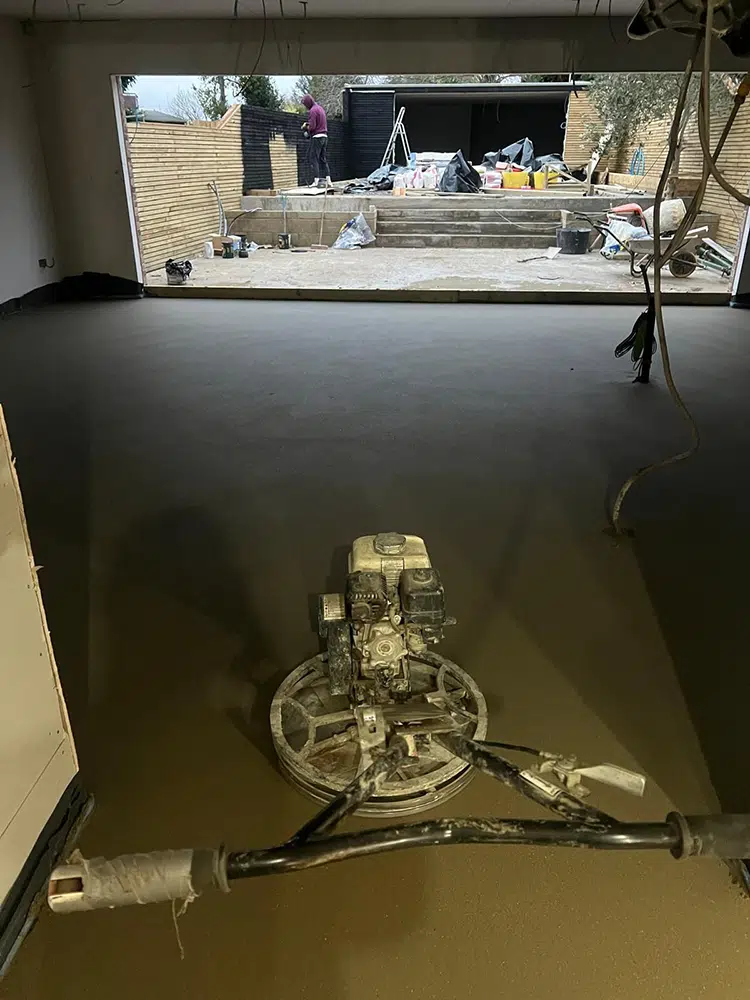
K & B Screeding’s own team, led by director Donatas Bardisevicius. Founded 2019, company 12298780.
See what customers say in our Google reviews and on our testimonials page.
Sand and Cement Screed from Slough to Great Dunmow
On the map, Great Dunmow sits east-north-east of Slough, about 49.3 miles from our base in a straight line (postcodes including CM6), next to Braintree (8.1 miles), Bishop's Stortford (8.7 miles), Sawbridgeworth (10 miles) and Chelmsford (10.4 miles).
More on sand & cement screed, part of our screeding services.
