
Rebuilding tired floors in older Haverhill homes
Few Haverhill homes are truly old. Only 9% were built before 1919, and the older town survives around Market Hill and the High Street. But plenty of later floors are now worn out, having settled, cracked or been patched over the years.
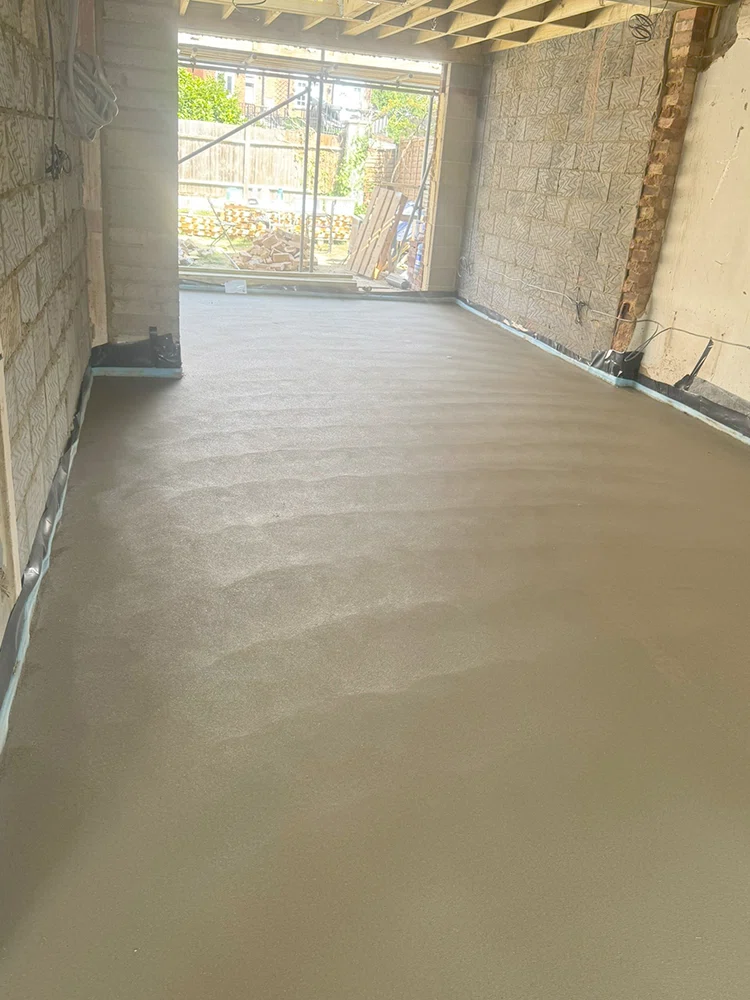
When a patched floor is dug out, it can be rebuilt properly. The order is usually: break out and remove the old floor, compact the base, lay a damp proof membrane lapped up the walls, fit insulation, add a separating layer, and then lay a floating sand and cement screed. In a home that screed is at least 65mm deep. The mix is prepared on site to the right consistency, spread, compacted by hand and finished with a trowel to a dense, level surface.
Hand-laid screed suits these jobs because they are usually small, broken into several rooms and full of awkward thresholds, and because a pump brings little advantage for a hallway and a front room. You also end up with a cement substrate, which certain adhesives and finishes insist on.
The finished height is the main constraint. Doors, skirting and the step to the front door were set to the old floor. If there is not enough depth for insulation plus 65mm of floating screed, a bonded screed onto sound concrete at 25 to 40mm may be the alternative, or a thinner liquid screed option over insulation.
Around Market Hill, where the town hall is Grade II listed, check listed building rules before lifting any original floor.
Haverhill wet rooms, utility rooms and garages
Some rooms need cement screed regardless of the house. Where a shower is open to the room, or the whole room is a wet room, the floor has to slope towards the drain, and shaping those falls by hand in sand and cement is the straightforward way to do it. Calcium sulphate screed is not suitable where floors may get wet, so utility rooms, shower rooms and similar spaces normally get a cement screed too.
Garages and workshops need strength. A floor carrying a car, a workbench or heavy storage can be laid at 75mm, with fibres added at about £1 to £3 per m² to reduce cracking, or a fibre reinforced mix specified from the outset. If a garage is being converted into a room, our garage floor screed guide covers raising the floor to the house level.
What you pay for that versatility is a longer wait. Up to 40mm deep, reckon on about one drying day per millimetre, and slower beyond that, so a 65mm utility or garage floor takes weeks to dry rather than days. Additives that speed drying can help where time is short.
Sand and Cement Screed prices in Haverhill
Sand and cement screed: £18 to £25 per m² supplied and laid (MyJobQuote, August 2026), so £450 to £630 for 25 m². MyJobQuote does not say whether these figures include VAT. See our floor screeding cost guide or screed calculator.
Who lays your sand and cement screed in Haverhill
K & B Screeding’s own team, led by director Donatas Bardisevicius. Founded 2019, company 12298780.
See what customers say in our Google reviews and on our testimonials page.
Sand and Cement Screed from Slough to Haverhill
On the map, Haverhill sits north-east of Slough, about 60 miles from our base in a straight line (postcodes including CB9), next to Saffron Walden (9.3 miles), Newmarket (11.2 miles), Halstead (12.7 miles) and Sudbury (12.9 miles).
More on sand & cement screed, part of our screeding services.