
Relaying old floors inside the Bury St Edmunds medieval grid
Of the homes in Bury St Edmunds, 13% were built before 1919. Older houses within the grid of streets laid out around 1080 often have no damp proof membrane under the ground floor. When such a floor cracks, sweats or lifts its covering, patching the surface rarely lasts, because the damp and the weak base are still underneath. Lifting the floor out is what lasts.
A typical relay runs in this order. The sequence: lift and skip the old floor, compact what lies beneath, then lay a membrane dressed up the face of each wall. Insulation follows, then a separating layer, and finally a floating sand and cement screed at a minimum of 65mm in a home. The mix is made on site and compacted by hand, which suits small rooms, thick uneven walls and awkward thresholds far better than a pumped product.
The finished level matters in an old house. Doors, hearths and steps were set to the original floor, so the new build-up has to fit the height available. Where it cannot, a thinner insulation board or a bonded screed of 25 to 40mm straight onto a sound slab may be the answer. The bonded screed page sets out the conditions it needs.
In a listed building, check with the council's conservation officer before any floor is removed.
Wet rooms and garages across Bury St Edmunds
Age of house aside, certain rooms can only take a cement screed. Showers, wet rooms and utility rooms may get water on the floor, and calcium sulphate screed is not suitable there. Sand and cement also lets us form falls to a drain by hand, so water runs away from the door rather than across the room.
Garages and workshops are another common use. A floor that will carry a car or heavy storage can be laid at 75mm, and fibres or a higher strength mix for heavy loads can be added where the use calls for it. Fibres in the mix add roughly £1 to £3 to each m².
The trade-off is time. Pumped screed dries quicker. On a cement floor the first 40mm takes about a day per millimetre and deeper layers longer, so a 65mm garage or shower floor needs weeks before it is worth testing for moisture. If the builder cannot spare those weeks, a rapid drying cement mix cuts them down. For a job about 13 miles west, read the hand-laid screed page for Newmarket.
Sand and Cement Screed prices in Bury St Edmunds
Sand and cement screed: £18 to £25 per m² supplied and laid (MyJobQuote, August 2026), so £450 to £630 for 25 m². MyJobQuote does not say whether these figures include VAT. See our floor screeding cost guide or screed calculator.
Who lays your sand and cement screed in Bury St Edmunds
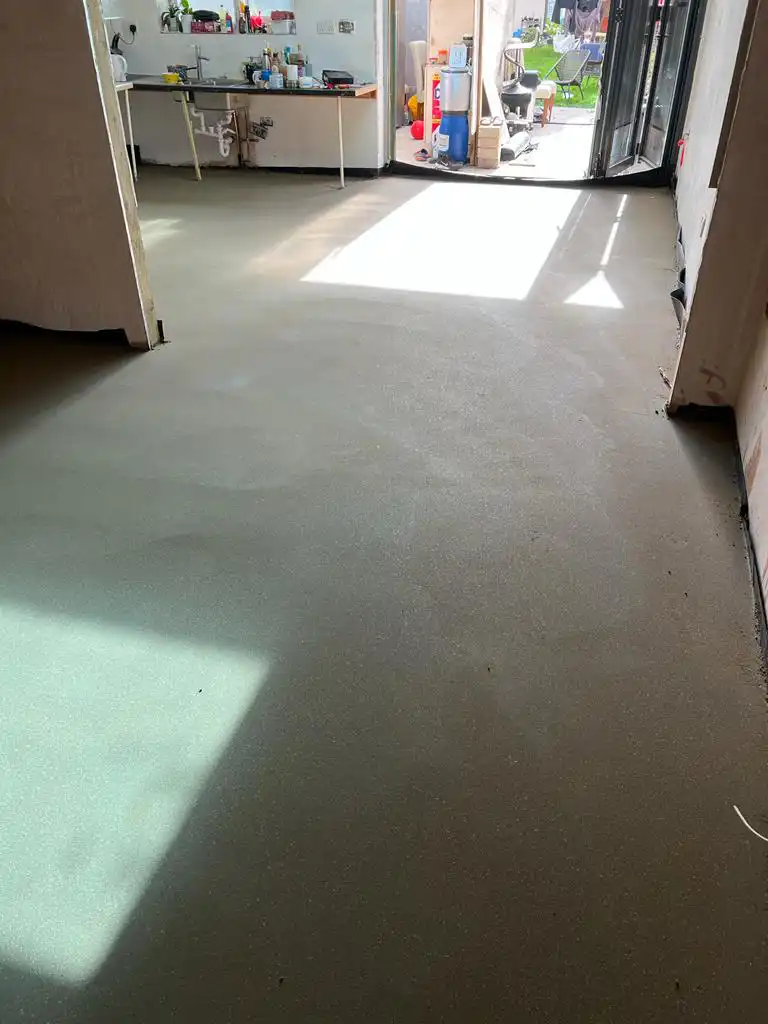
K & B Screeding’s own team, led by director Donatas Bardisevicius. Founded 2019, company 12298780.
See what customers say in our Google reviews and on our testimonials page.
Sand and Cement Screed from Slough to Bury St Edmunds
On the map, Bury St Edmunds sits north-east of Slough, about 76.3 miles from our base in a straight line (postcodes including IP33), next to Newmarket (13.1 miles), Sudbury (14.3 miles), Haverhill (16.3 miles) and Soham (17 miles).
More on sand & cement screed, part of our screeding services.
