
Heated extensions on Moreton Hall and older semis
Homes built between 1945 and 1972 account for 28% of the Bury St Edmunds stock, and those from 1973 to 1999 for a further 30%. Post-war and late 20th century semis and terraces, including homes on the Moreton Hall estate, are common candidates for rear extensions. A new rear extension is the easiest place to put in underfloor heating, because the whole floor build-up can be designed around it from the start.
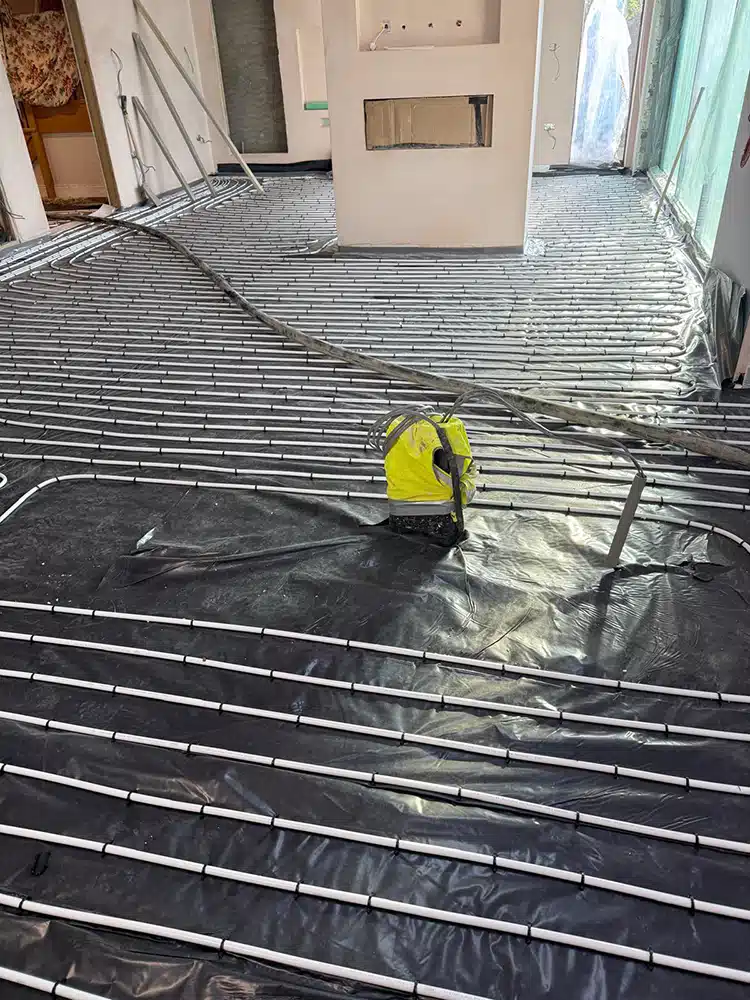
The build-up is insulation, then a membrane or pipe fixing layer, the pipes themselves, an edge strip round the walls and the screed on top. Our side covers the edge strip, membrane and insulation: we inspect what is there or bring our own. Laying pipes is not a K & B job, so your heating engineer installs them and proves them under pressure before the pour.
On a heated floor, everything hangs on how much screed sits over the pipes. A liquid screed that flows around pipes needs at least 25mm above them, around 45 to 50mm in total. Sand and cement tamped by hand wants about 45mm over them instead, and the floor grows thicker to match. Liquid screed also surrounds the pipes completely, with no voids, and that tends to warm the room faster.
Matching the new heated floor to the house floor is often the tricky part. Plan the insulation thickness around the existing finished floor height before the foundations are dug.
Switching on the heating in a Bury St Edmunds floor
A new heated screed must be commissioned slowly. Turning the heating up to full on a fresh floor can crack it or debond the finish laid on top later.
Timing depends on the screed. Calcium sulphate is normally ready for warmth from about day 7. Sand and cement must stand for 21 days at minimum. From then on, start low, raise the temperature in steps across several days, hold it, then ease it back. The heating engineer's commissioning schedule sets the exact steps, and we hand over written guidance so the whole team works to it.
Retrofits in older rooms are harder. If there is little height to spare over an existing slab, the options narrow to low profile systems and a thin liquid screed, or digging the old floor out and rebuilding it. The sand and cement relay option is covered on its own page, including the membrane and insulation that go beneath it. For a heated floor that is sound but uneven before new tiles, see floor preparation.
Underfloor Heating Screed prices in Bury St Edmunds
Liquid screed over underfloor heating: £20 to £35 per m² supplied and laid (trade2base, June 2026), so £700 to £1,230 for 35 m². trade2base gives these figures excluding VAT. See our floor screeding cost guide or screed calculator.
Who lays your underfloor heating screed in Bury St Edmunds
K & B Screeding’s own team, led by director Donatas Bardisevicius. Founded 2019, company 12298780.
See what customers say in our Google reviews and on our testimonials page.
Underfloor Heating Screed from Slough to Bury St Edmunds
On the map, Bury St Edmunds sits north-east of Slough, about 76.3 miles from our base in a straight line (postcodes including IP33), next to Newmarket (13.1 miles), Sudbury (14.3 miles), Haverhill (16.3 miles) and Soham (17 miles).
More on underfloor heating screed, part of our screeding services.
