
Screeding heated extensions on 1970s to 1990s Newmarket houses
Newmarket's biggest age band is 1973 to 1999, which accounts for 32% of its homes. When one of these houses gains a rear extension, underfloor heating is often designed in from the start, because the whole floor build-up is new.
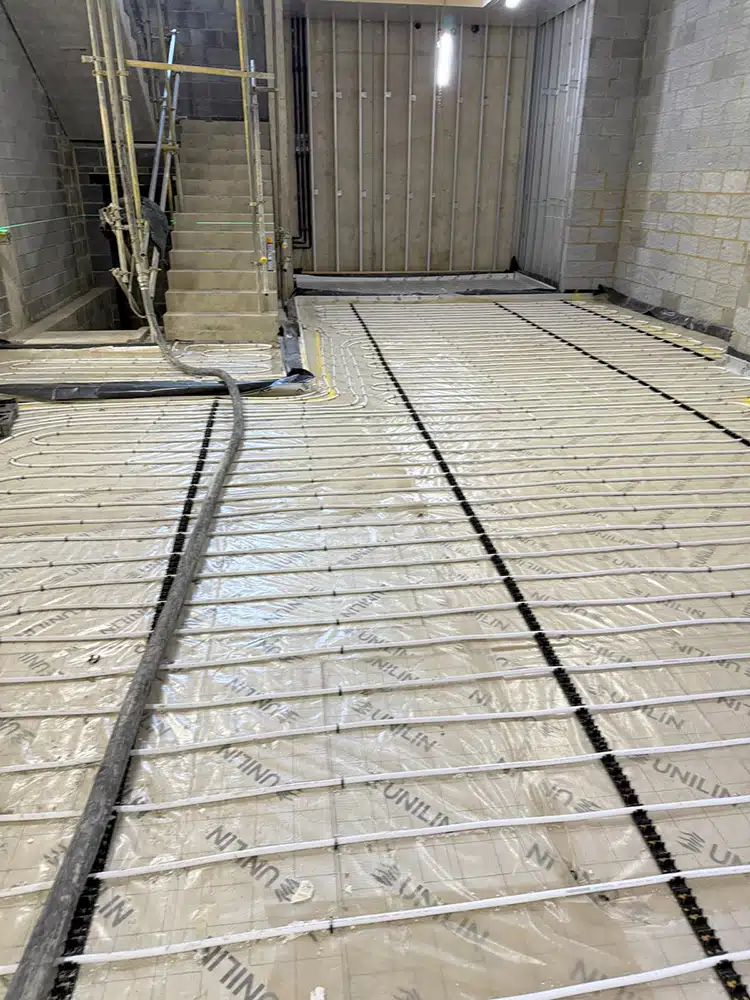
That build-up runs: slab, insulation, a membrane or pipe fixing layer, the heating pipes, an edge strip round the perimeter and then screed. We look over the insulation board, the membrane and the strip round the walls, or bring them ourselves. Pipework is outside our trade. A heating engineer lays and pressure tests them, and the system stays full of water while we pour.
Pipe cover is the critical dimension. A pumped floor needs a minimum 25mm above the pipes, so 45 to 50mm or thereabouts overall, while hand-laid sand and cement takes about 45mm over them and ends up thicker. Because the extension usually has to meet the existing kitchen floor, that difference in depth often decides which screed to use.
Pumped screed also surrounds every pipe completely, so no air is trapped. That gives faster warm-up and better heating efficiency, and it is one reason the pumped liquid option suits heated floors. Once dried, both are flat enough to take tiles, LVT or engineered boards.
Garden rooms follow the same rules, with the added question of how far the pump hose must run to reach them.
Retrofitting heating into older Newmarket terraces
Older terraces are harder. Their floors are often suspended timber or early concrete with no damp proof membrane, and there is little height to spare. Laying pipes over such a floor would lose heat into the ground and leave damp untreated. The sound route is usually to dig the floor out, add insulation and a membrane, lay the pipes and screed at the original level. The rebuilding side of that is covered on our Newmarket sand and cement screed page.
Whichever screed is chosen, the heating must be commissioned slowly. Calcium sulphate normally tolerates gentle warmth after about 7 days; for sand and cement the wait is 21 days or more. The first firing should use cool water, nudged warmer in small steps over several days, held, then brought back down. We hand over written guidance, and the heating engineer's schedule sets the detail.
Running the heating speeds drying too, yet a moisture test is still needed. For drying times before floor finishes on a heated screed, see our guide on screed drying times.
Underfloor Heating Screed prices in Newmarket
Liquid screed over underfloor heating: £20 to £35 per m² supplied and laid (trade2base, June 2026), so £700 to £1,230 for 35 m². trade2base gives these figures excluding VAT. See our floor screeding cost guide or screed calculator.
Who lays your underfloor heating screed in Newmarket
K & B Screeding’s own team, led by director Donatas Bardisevicius. Founded 2019, company 12298780.
See what customers say in our Google reviews and on our testimonials page.
Underfloor Heating Screed from Slough to Newmarket
Newmarket is about 66.6 miles north-east of our Slough base as the crow flies, with postcodes including CB8. The nearest towns to it are Soham (6.7 miles), Haverhill (11.2 miles), Ely (12.4 miles) and Cambridge (12.4 miles).
More on underfloor heating screed, part of our screeding services.
